
Pulp Fiction, 1938 · page 70 of 100
Air Stories — page 70: what you’re looking at
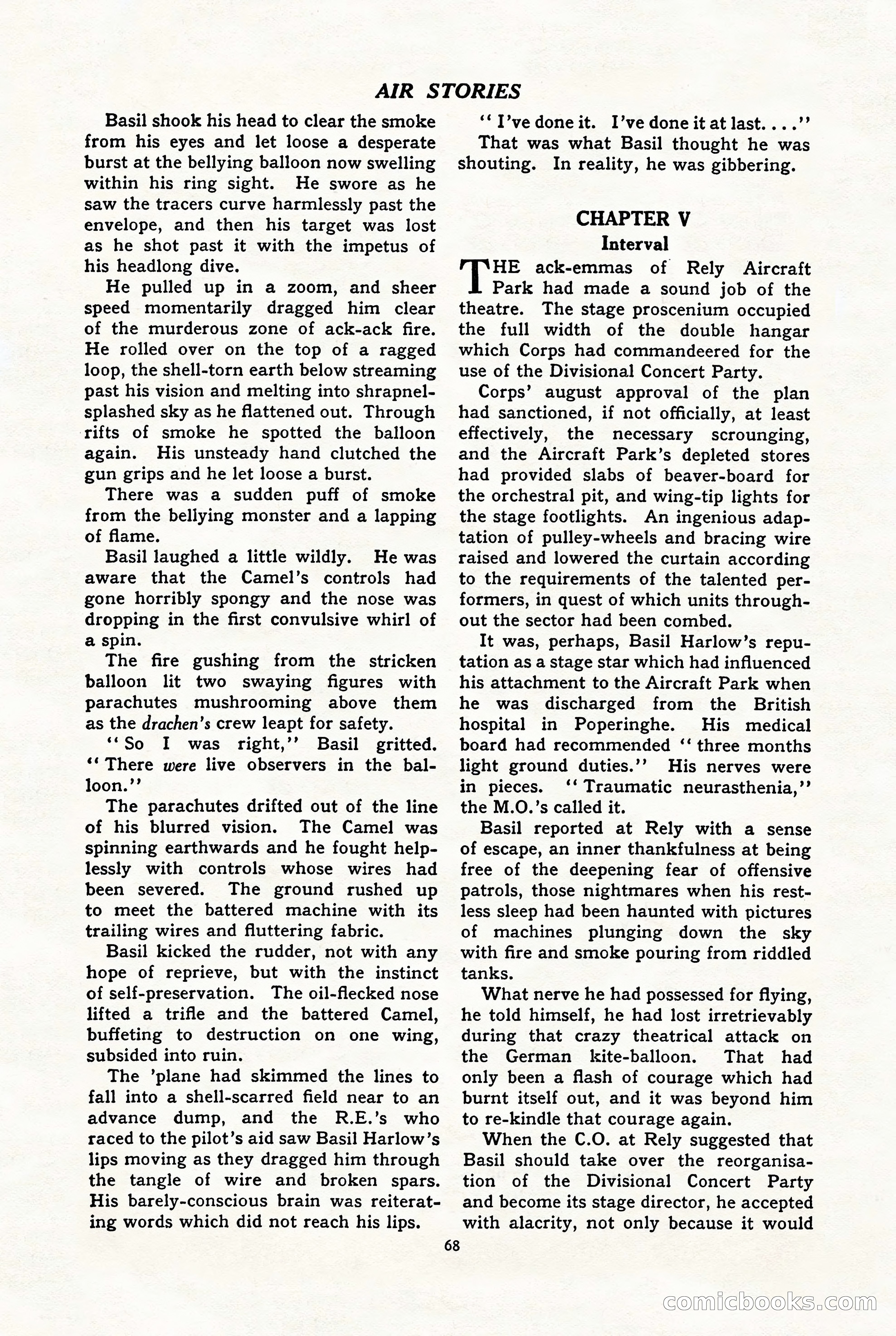
A restored page from Pulp Fiction, 1938. Page through the whole issue in the reader above.
📄 Transcribed text from this page (OCR, searchable)
Machine-transcribed from the original scan — historical spelling and the odd misread are preserved.
AIR STORIES Basil shook his head to clear the smoke from his eyes and let loose a desperate burst at the bellying balloon now swelling within his ring sight. He swore as he saw the tracers curve harmlessly past the envelope, and then his target was lost as he shot past it with the impetus of his headlong dive. He pulled up in a zoom, and sheer speed momentarily dragged him clear of the murderous zone of ack-ack fire. He rolled over on the top of a ragged loop, the shell-torn earth below streaming past his vision and melting into shrapnel- splashed sky as he flattened out. Through rifts of smoke he spotted the balloon again. His unsteady hand clutched the gun grips and he let loose a burst. There was a sudden puff of smoke from the bellying monster and a lapping of flame. Basil laughed a little wildly. He was aware that the Camel’s controls had gone horribly spongy and the nose was dropping in the first convulsive whirl of a spin. The fire gushing from the stricken balloon lit two swaying figures with parachutes mushrooming above them as the drachen’s crew leapt for safety. ‘So I was right,’’ Basil gritted. ‘* There were live observers in the bal- loon.’’ The parachutes drifted out of the line of his blurred vision. The Camel was spinning earthwards and he fought help- lessly with controls whose wires had been severed. The ground rushed up to meet the battered machine with its trailing wires and fluttering fabric. Basil kicked the rudder, not with any hope of reprieve, but with the instinct of self-preservation. The oil-flecked nose lifted a trifle and the battered Camel, buffeting to destruction on one wing, subsided into ruin. The ’plane had skimmed the lines to fall into a shell-scarred field near to an advance dump, and the R.E.’s who raced to the pilot’s aid saw Basil Harlow’s lips moving as they dragged him through the tangle of wire and broken spars. His barely-conscious brain was reiterat- ing words which did not reach his lips. 68 ‘‘T’ve done it. I’ve done it at last....’’ That was what Basil thought he was shouting. In reality, he was gibbering. CHAPTER V Interval HE ack-emmas of Rely Aircraft Park had made a sound job of the theatre. The stage proscenium occupied the full width of the double hangar which Corps had commandeered for the use of the Divisional Concert Party. Corps’ august approval of the plan had sanctioned, if not officially, at least effectively, the mecessary scrounging, and the Aircraft Park’s depleted stores had provided slabs of beaver-board for the orchestral pit, and wing-tip lights for the stage footlights. An ingenious adap- tation of pulley-wheels and bracing wire raised and lowered the curtain according to the requirements of the talented per- formers, in quest of which units through- out the sector had been combed. It was, perhaps, Basil Harlow’s repu- tation as a stage star which had influenced his attachment to the Aircraft Park when he was discharged from the British hospital in Poperinghe. His medical board had recommended ‘‘ three months light ground duties.’’ His nerves were in pieces. ‘‘ Traumatic neurasthenia,’’ the M.O.’s called it. Basil reported at Rely with a sense of escape, an inner thankfulness at being free of the deepening fear of offensive patrols, those nightmares when his rest- less sleep had been haunted with pictures of machines plunging down the sky with fire and smoke pouring from riddled tanks. What nerve he had possessed for flying, he told himself, he had lost irretrievably during that crazy theatrical attack on the German kite-balloon. That had only been a flash of courage which had burnt itself out, and it was beyond him to re-kindle that courage again. When the C.O. at Rely suggested that Basil should take over the reorganisa- tion of the Divisional Concert Party and become its stage director, he accepted with alacrity, not only because it would Co VOO