
Pulp Fiction, 1938 · page 69 of 100
Air Stories — page 69: what you’re looking at
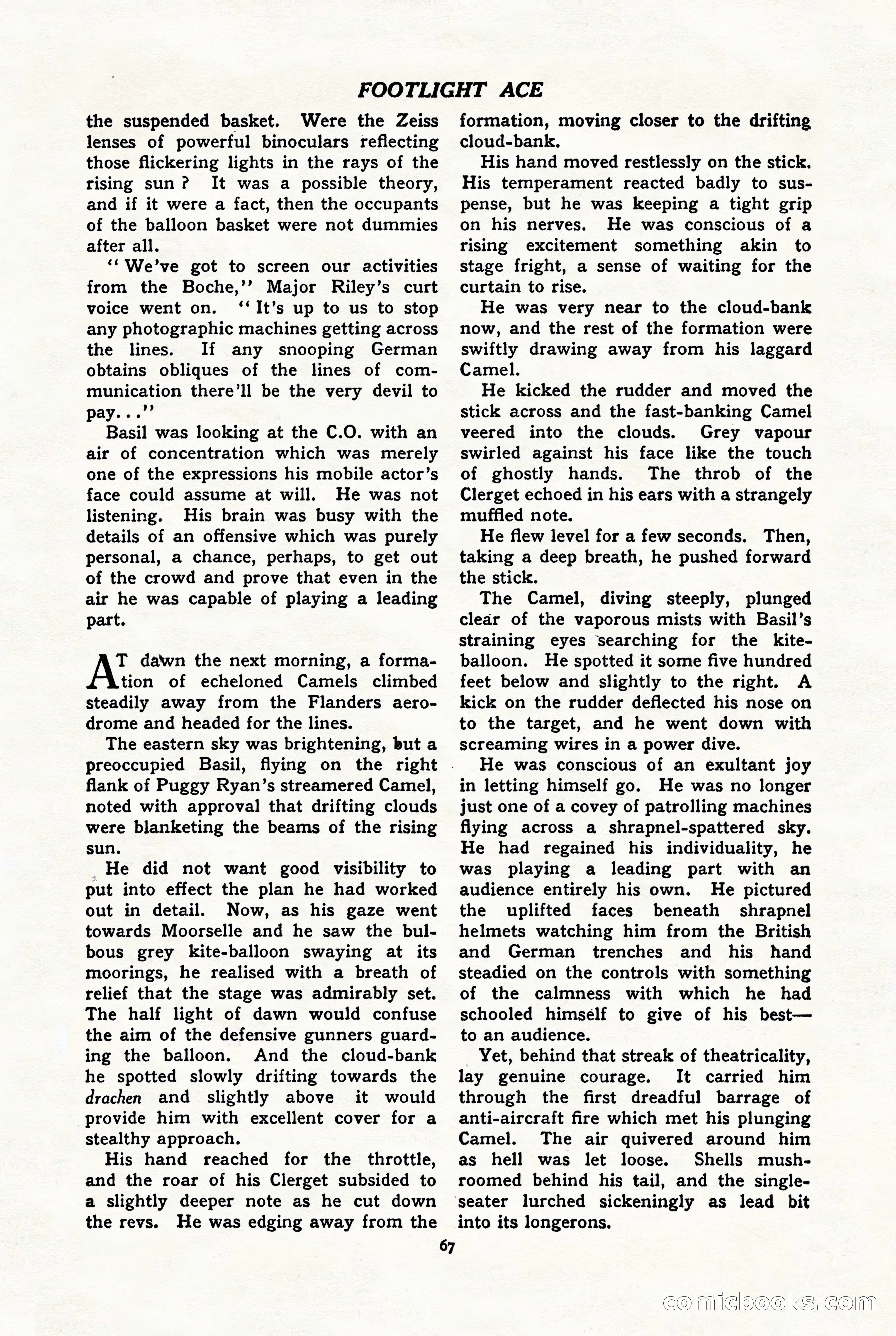
A restored page from Pulp Fiction, 1938. Page through the whole issue in the reader above.
📄 Transcribed text from this page (OCR, searchable)
Machine-transcribed from the original scan — historical spelling and the odd misread are preserved.
FOOTLIGHT ACE the suspended basket. Were the Zeiss lenses of powerful binoculars reflecting those flickering lights in the rays of the rising sun? It was a possible theory, and if it were a fact, then the occupants of the balloon basket were not dummies after all. ‘We've got to screen our activities from the Boche,’’ Major Riley’s curt voice went on. ‘‘ It’s up to us to stop any photographic machines getting across the lines. If any snooping German obtains obliques of the lines of com- munication there’ll be the very devil to pay...’’ Basil was looking at the C.O. with an air of concentration which was merely one of the expressions his mobile actor’s face could assume at will. He was not listening. His brain was busy with the details of an offensive which was purely personal, a chance, perhaps, to get out of the crowd and prove that even in the air he was capable of playing a leading part. T dawn the next morning, a forma- tion of echeloned Camels climbed steadily away from the Flanders aero- drome and headed for the lines. The eastern sky was brightening, but a preoccupied Basil, flying on the right . flank of Puggy Ryan’s streamered Camel, noted with approval that drifting clouds were blanketing the beams of the rising sun. He did not want good visibility to put into effect the plan he had worked out in detail. Now, as his gaze went towards Moorselle and he saw the bul- bous grey kite-balloon swaying at its moorings, he realised with a breath of relief that the stage was admirably set. The half light of dawn would confuse the aim of the defensive gunners guard- ing the balloon. And the cloud-bank he spotted slowly drifting towards the drachen and slightly above it would provide him with excellent cover for a stealthy approach. His hand reached for the throttle, and the roar of his Clerget subsided to a slightly deeper note as he cut down the revs. He was edging away from the formation, moving closer to the drifting cloud-bank. His hand moved restlessly on the stick. His temperament reacted badly to sus- pense, but he was keeping a tight grip on his nerves. He was conscious of a rising excitement something akin to stage fright, a sense of waiting for the curtain to rise. He was very near to the cloud-bank now, and the rest of the formation were swiftly drawing away from his laggard Camel. He kicked the rudder and moved the stick across and the fast-banking Camel veered into the clouds. Grey vapour swirled against his face like the touch of ghostly hands. The throb of the Clerget echoed in his ears with a strangely muffled note. He flew level for a few seconds. Then, taking a deep breath, he pushed forward the stick. The Camel, diving steeply, plunged clear of the vaporous mists with Basil’s straining eyes searching for the kite- balloon. He spotted it some five hundred feet below and slightly to the right. A kick on the rudder deflected his nose on to the target, and he went down with screaming wires in a power dive. He was conscious of an exultant joy in letting himself go. He was no longer just one of a covey of patrolling machines flying across a shrapnel-spattered sky. He had regained his individuality, he was playing a leading part with an audience entirely his own. He pictured the uplifted faces beneath shrapnel helmets watching him from the British and German trenches and his hand steadied on the controls with something of the calmness with which he had schooled himself to give of his best— to an audience. Yet, behind that streak of theatricality, lay genuine courage. It carried him through the first dreadful barrage of anti-aircraft fire which met his plunging Camel. The air quivered around him as hell was let loose. Shells mush- roomed behind his tail, and the single- ‘seater lurched sickeningly as lead bit 67 into its longerons. CO LOO