
Pulp Fiction, 1938 · page 61 of 100
Air Stories — page 61: what you’re looking at
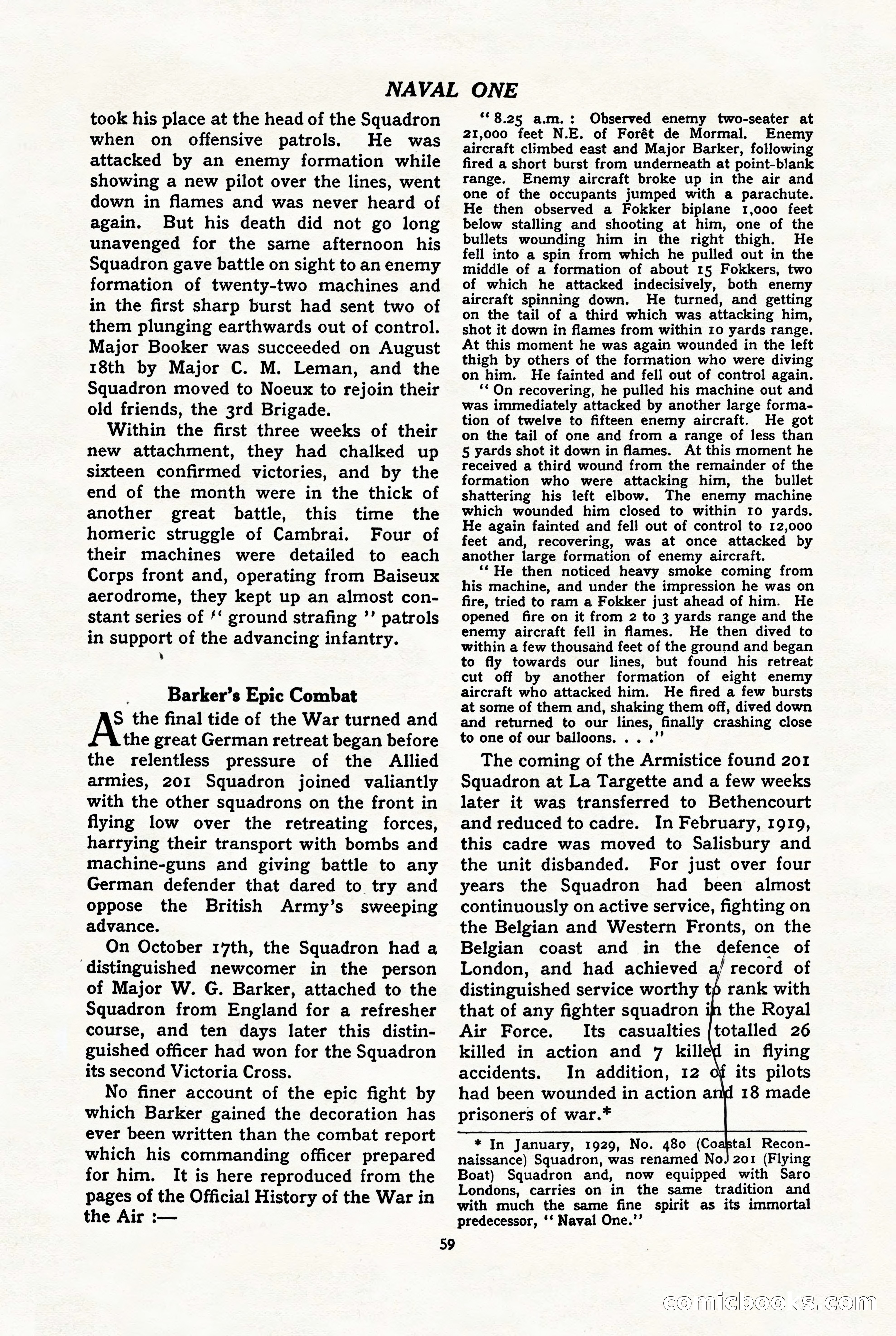
A restored page from Pulp Fiction, 1938. Page through the whole issue in the reader above.
📄 Transcribed text from this page (OCR, searchable)
Machine-transcribed from the original scan — historical spelling and the odd misread are preserved.
NAVAL ONE took his place at the head of the Squadron when on offensive patrols. He was attacked by an enemy formation while showing a new pilot over the lines, went down in flames and was never heard of again. But his death did not go long unavenged for the same afternoon his Squadron gave battle on sight to an enemy formation of twenty-two machines and in the first sharp burst had sent two of them plunging earthwards out of control. Major Booker was succeeded on August 18th by Major C. M. Leman, and the Squadron moved to Noeux to rejoin their old friends, the 3rd Brigade. Within the first three weeks of their new attachment, they had chalked up sixteen confirmed victories, and by the end of the month were in the thick of another great battle, this time the homeric struggle of Cambrai. Four of their machines were detailed to each Corps front and, operating from Baiseux aerodrome, they kept up an almost con- stant series of ‘‘ ground strafing ’’ patrols in support of the advancing infantry. ‘ Barker’s Epic Combat S the final tide of the War turned and the great German retreat began before the relentless pressure of the Allied armies, 201 Squadron joined valiantly with the other squadrons on the front in flying low over the retreating forces, harrying their transport with bombs and machine-guns and giving battle to any German defender that dared to try and oppose the British Army’s sweeping advance. On October 17th, the Squadron had a distinguished newcomer in the person of Major W. G. Barker, attached to the Squadron from England for a refresher course, and ten days later this distin- guished officer had won for the Squadron its second Victoria Cross. No finer account of the epic fight by which Barker gained the decoration has ever been written than the combat report which his commanding officer prepared for him. It is here reproduced from the pages of the Official History of the War in the Air :— 59 **8.25 a.m.: Observed enemy two-seater at 21,000 feet N.E. of Forét de Mormal. Enemy aircraft climbed east and Major Barker, following fired a short burst from underneath at point-blank range. Enemy aircraft broke up in the air and one of the occupants jumped with a parachute. He then observed a Fokker biplane 1,000 feet below stalling and shooting at him, one of the bullets wounding him in the right thigh. He fell into a spin from which he pulled out in the middle of a formation of about 15 Fokkers, two of which he attacked indecisively, both enemy aircraft spinning down. He turned, and getting on the tail of a third which was attacking him, shot it down in flames from within Io yards range. At this moment he was again wounded in the left thigh by others of the formation who were diving on him. He fainted and fell out of control again. ‘* On recovering, he pulled his machine out and was immediately attacked by another large forma- tion of twelve to fifteen enemy aircraft. He got on the tail of one and from a range of less than 5 yards shot it down in flames. At this moment he received a third wound from the remainder of the formation who were attacking him, the bullet shattering his left elbow. The enemy machine which wounded him closed to within 10 yards. He again fainted and fell out of control to 12,000 feet and, recovering, was at once attacked by another large formation of enemy aircraft. ‘‘ He then noticed heavy smoke coming from his machine, and under the impression he was on fire, tried to ram a Fokker just ahead of him. He opened fire on it from 2 to 3 yards range and the enemy aircraft fell in flames. He then dived to within a few thousand feet of the ground and began to fly towards our lines, but found his retreat cut off by another formation of eight enemy aircraft who attacked him. He fired a few bursts at some of them and, shaking them off, dived down and returned to our lines, finally crashing close to one of our balloons. .. .’’ The coming of the Armistice found 201 Squadron at La Targette and a few weeks later it was transferred to Bethencourt and reduced to cadre. In February, 1919, this cadre was moved to Salisbury and the unit disbanded. For just over four years the Squadron had been almost continuously on active service, fighting on the Belgian and Western Fronts, on the Belgian coast and in the defence of London, and had achieved a/ record of distinguished service worthy tp rank with that of any fighter squadron in the Royal Air Force. Its casualties {totalled 26 killed in action and 7 killed in flying accidents. In addition, 12 its pilots had been wounded in action and 18 made prisoners of war.* * In January, 1929, No. 480 (Coagbtal Recon- naissance) Squadron, was renamed No! 201 (Flying Boat) Squadron and, now equipped with Saro Londons, carries on in the same tradition and with much the same fine spirit as its immortal predecessor, ‘‘ Naval One.’’ COMICLO@O© (© A