
Pulp Fiction, 1938 · page 60 of 100
Air Stories — page 60: what you’re looking at
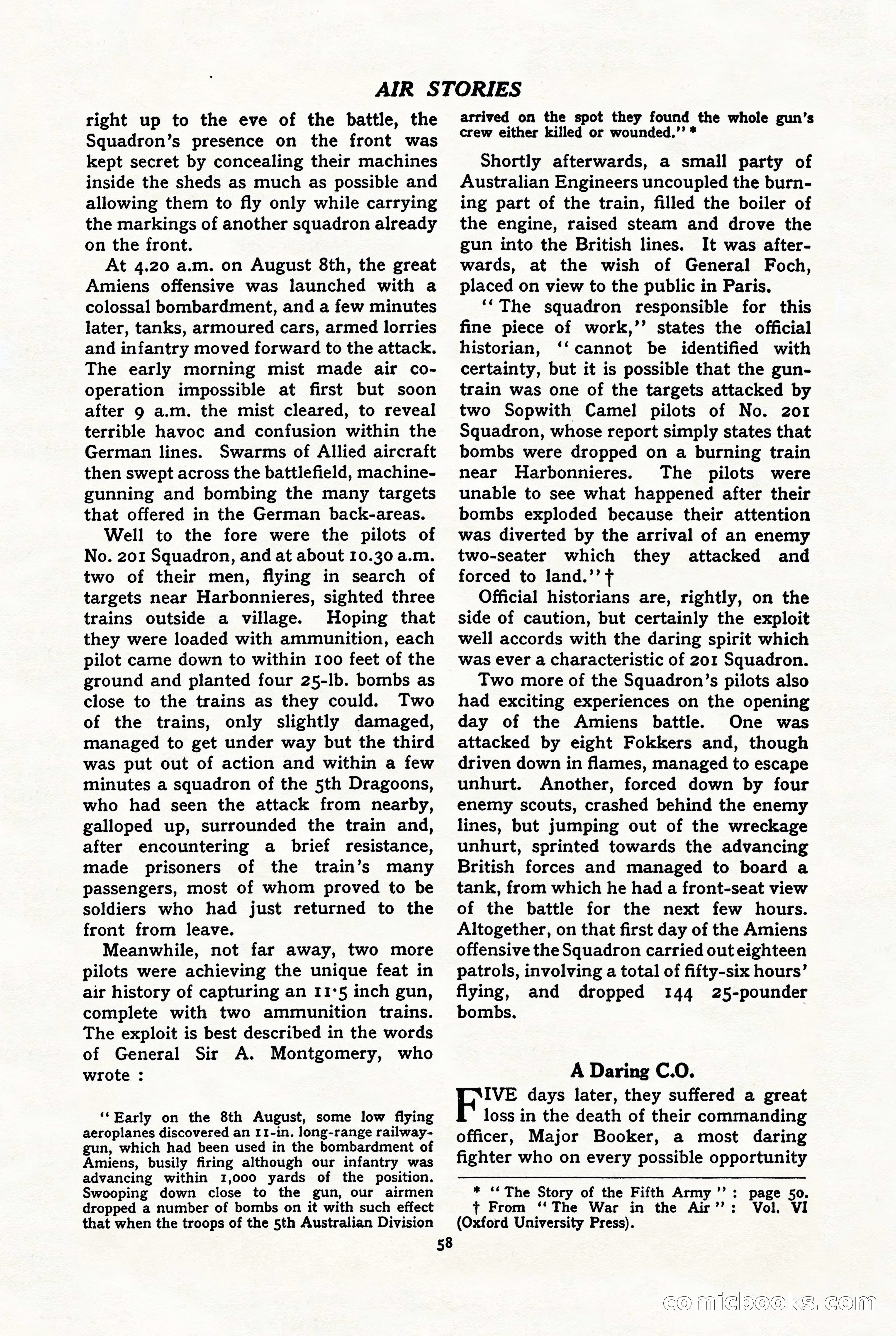
A restored page from Pulp Fiction, 1938. Page through the whole issue in the reader above.
📄 Transcribed text from this page (OCR, searchable)
Machine-transcribed from the original scan — historical spelling and the odd misread are preserved.
AIR STORIES right up to the eve of the battle, the Squadron’s presence on the front was kept secret by concealing their machines inside the sheds as much as possible and allowing them to fly only while carrying the markings of another squadron already on the front. At 4.20 a.m. on August 8th, the great Amiens offensive was launched with a colossal bombardment, and a few minutes later, tanks, armoured cars, armed lorries and infantry moved forward to the attack. The early morning mist made air co- operation impossible at first but soon after 9 a.m. the mist cleared, to reveal terrible havoc and confusion within the German lines. Swarms of Allied aircraft then swept across the battlefield, machine- gunning and bombing the many targets that offered in the German back-areas. Well to the fore were the pilots of No. 201 Squadron, and at about 10.30 a.m. two of their men, flying in search of targets near Harbonnieres, sighted three trains outside a village. Hoping that they were loaded with ammunition, each pilot came down to within 100 feet of the ground and planted four 25-lb. bombs as close to the trains as they could. Two of the trains, only slightly damaged, managed to get under way but the third was put out of action and within a few minutes a squadron of the 5th Dragoons, who had seen the attack from nearby, galloped up, surrounded the train and, after encountering a brief resistance, made prisoners of the train’s many passengers, most of whom proved to be soldiers who had just returned to the front from leave. Meanwhile, not far away, two more pilots were achieving the unique feat in air history of capturing an 11°5 inch gun, complete with two ammunition trains. The exploit is best described in the words of General Sir A. Montgomery, who wrote : ‘‘Early on the 8th August, some low flying aeroplanes discovered an I11-in. long-range railway- gun, which had been used in the bombardment of Amiens, busily firing although our infantry was advancing within 1,000 yards of the position. Swooping down close to the gun, our airmen dropped a number of bombs on it with such effect that when the troops of the 5th Australian Division 58 arrived on the spot they found the whole gun’s crew either killed or wounded.’’ * Shortly afterwards, a small party of Australian Engineers uncoupled the burn- ing part of the train, filled the boiler of the engine, raised steam and drove the gun into the British lines. It was after- wards, at the wish of General Foch, placed on view to the public in Paris. ‘‘The squadron responsible for this fine piece of work,’’ states the official historian, ‘‘cannot be identified with certainty, but it is possible that the gun- train was one of the targets attacked by two Sopwith Camel pilots of No. 201 Squadron, whose report simply states that bombs were dropped on a burning train near Harbonnieres. The pilots were unable to see what happened after their bombs exploded because their attention was diverted by the arrival of an enemy two-seater which they attacked and forced to land.’’ + Official historians are, rightly, on the side of caution, but certainly the exploit well accords with the daring spirit which was ever a characteristic of 201 Squadron. Two more of the Squadron’s pilots also had exciting experiences on the opening day of the Amiens battle. One was attacked by eight Fokkers and, though driven down in flames, managed to escape unhurt. Another, forced down by four enemy scouts, crashed behind the enemy lines, but jumping out of the wreckage unhurt, sprinted towards the advancing British forces and managed to board a tank, from which he had a front-seat view of the battle for the next few hours. Altogether, on that first day of the Amiens offensive the Squadron carried out eighteen patrols, involving a total of fifty-six hours’ flying, and dropped 144 25-pounder bombs. A Daring C.O. IVE days later, they suffered a great loss in the death of their commanding officer, Major Booker, a most daring fighter who on every possible opportunity * “* The Story of the Fifth Army ’’: page 50. ~ From ‘‘ The War in the Air’’: Vol. VI (Oxford University Press). Conmicbookxs.cOm