
Pulp Fiction, 1938 · page 52 of 100
Air Stories — page 52: what you’re looking at
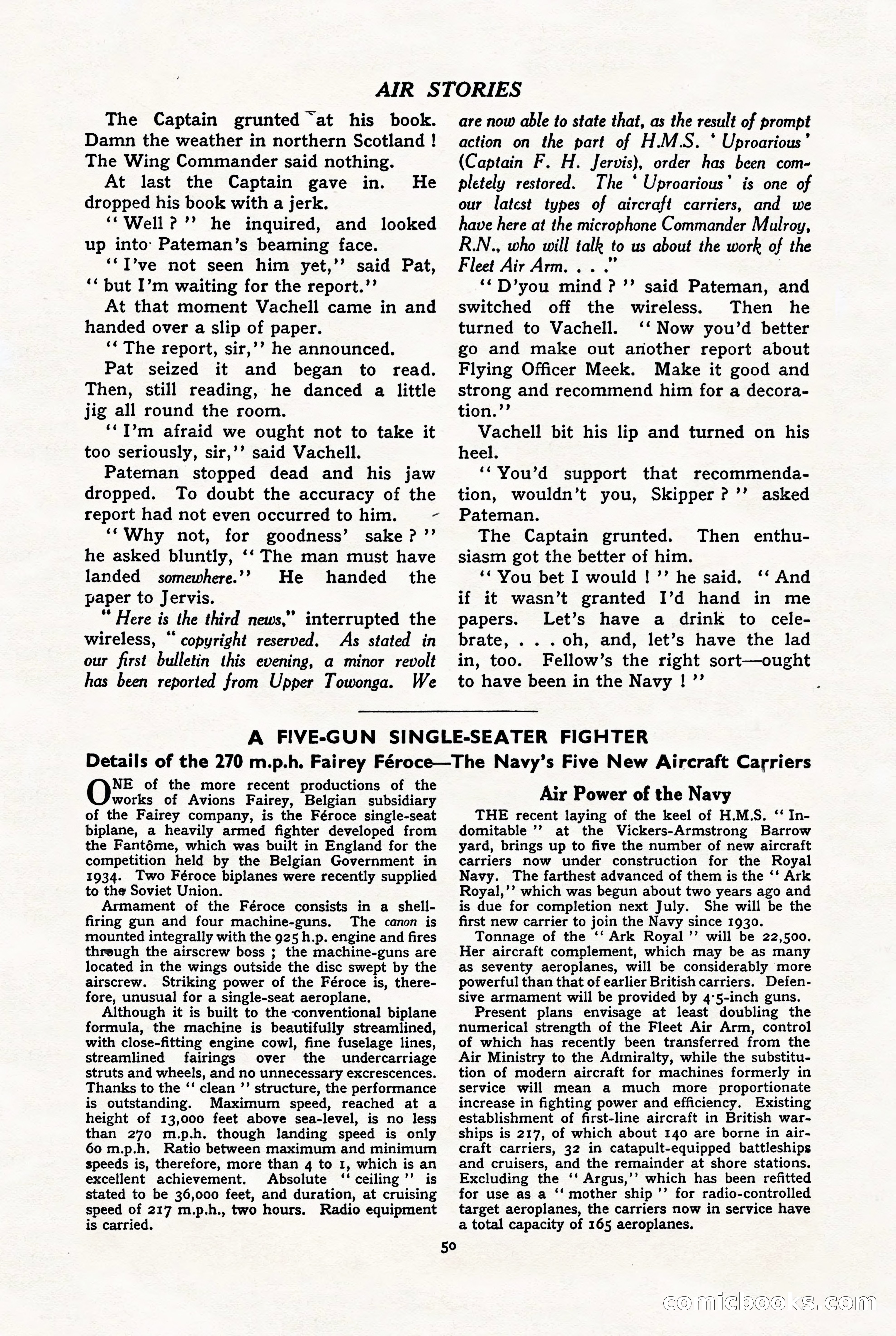
A restored page from Pulp Fiction, 1938. Page through the whole issue in the reader above.
📄 Transcribed text from this page (OCR, searchable)
Machine-transcribed from the original scan — historical spelling and the odd misread are preserved.
AIR STORIES The Captain grunted “at his book. Damn the weather in northern Scotland ! The Wing Commander said nothing. At last the Captain gave in. dropped his book with a jerk. ‘Well? ’’ he inquired, and looked up into: Pateman’s beaming face. ‘‘T’ve not seen him yet,’’ said Pat, ‘* put I’m waiting for the report.’’ At that moment Vachell came in and handed over a slip of paper. ‘* The report, sir,’? he announced. Pat seized it and began to read. Then, still reading, he danced a little jig all round the room. ‘‘T’m afraid we ought not to take it too seriously, sir,’’ said Vachell. Pateman stopped dead and his jaw dropped. To doubt the accuracy of the report had not even occurred to him. ‘‘Why not, for goodness’ sake? ”’ he asked bluntly, ‘‘ The man must have landed somewhere.’? He handed the paper to Jervis. * Here is the third news,” interrupted the wireless, “ copyright reserved. As stated in our first bulletin this evening, a minor revolt has been reported from Upper Towonga. We He are now able to state that, as the result of prompt action on the part of H.M.S. ‘ Uproarious’ (Captain F. H. Jervis), order has been com- pletely restored. The ‘ Uproarious’ is one of our latest types of aircraft carriers, and we have here at the microphone Commander Mulroy, R.N., who will talk to us about the work of the Fleet Air Arm... .” | ‘*D’you mind? ’’ said Pateman, and switched off the wireless. Then he turned to Vachell. ‘‘ Now you’d better go and make out another report about Flying Officer Meek. Make it good and strong and recommend him for a decora- tion.’’ Vachell bit his lip and turned on his heel. ‘‘You’d support that recommenda- tion, wouldn’t you, Skipper? ’’ asked Pateman. The Captain grunted. siasm got the better of him. *“'You bet I would !’’ he said. ‘‘ And if it wasn’t granted I’d hand in me papers. Let’s have a drink to cele- brate, . . . oh, and, let’s have the lad in, too. Fellow’s the right sort—ought to have been in the Navy ! ’’ Then enthu- A FIVE-GUN SINGLE-SEATER FIGHTER Details of the 270 m.p.h. Fairey Féroce—The Navy’s Five New Aircraft Carriers NE of the more recent productions of the works of Avions Fairey, Belgian subsidiary of the Fairey company, is the Féroce single-seat biplane, a heavily armed fighter developed from the Fantéme, which was built in England for the competition held by the Belgian Government in 1934. Two Féroce biplanes were recently supplied to the Soviet Union. Armament of the Féroce consists in a shell- firing gun and four machine-guns. The canon is mounted integrally with the 925 h.p. engine and fires threugh the airscrew boss ; the machine-guns are located in the wings outside the disc swept by the airscrew. Striking power of the Féroce is, there- fore, unusual for a single-seat aeroplane. Although it is built to the conventional biplane formula, the machine is beautifully streamlined, with close-fitting engine cowl, fine fuselage lines, streamlined fairings over the undercarriage struts and wheels, and no unnecessary excrescences. Thanks to the ‘‘ clean ’’ structure, the performance is outstanding. Maximum speed, reached at a height of 13,000 feet above sea-level, is no less than 270 m.p.h. though landing speed is only 60 m.p.h. Ratio between maximum and minimum speeds is, therefore, more than 4 to 1, which is an excellent achievement. Absolute ‘‘ ceiling ’’ is stated to be 36,000 feet, and duration, at cruising speed of 217 m.p.h., two hours. Radio equipment is carried. 50 Air Power of the Navy THE recent laying of the keel of H.M.S. ‘‘ In- domitable ’’ at the Vickers-Armstrong Barrow yard, brings up to five the number of new aircraft carriers now under construction for the Royal Navy. The farthest advanced of them is the ‘‘ Ark Royal,’’ which was begun about two years ago and is due for completion next July. She will be the first new carrier to join the Navy since 1930. Tonnage of the ‘‘ Ark Royal ’’ will be 22,500. Her aircraft complement, which may be as many as seventy aeroplanes, will be considerably more powerful than that of earlier British carriers. Defen- sive armament will be provided by 4°5-inch guns. Present plans envisage at least doubling the numerical strength of the Fleet Air Arm, control of which has recently been transferred from the Air Ministry to the Admiralty, while the substitu- tion of modern aircraft for machines formerly in service will mean a much more proportionate increase in fighting power and efficiency. Existing establishment of first-line aircraft in British war- ships is 217, of which about 140 are borne in air- craft carriers, 32 in catapult-equipped battleships and cruisers, and the remainder at shore stations. Excluding the ‘‘ Argus,’’ which has been refitted for use as a ‘‘ mother ship ’’ for radio-controlled target aeroplanes, the carriers now in service have a total capacity of 165 aeroplanes. Co OO (C (©