
Pulp Fiction, 1936 · page 98 of 98
Air Stories, April 1936 — page 98: what you’re looking at
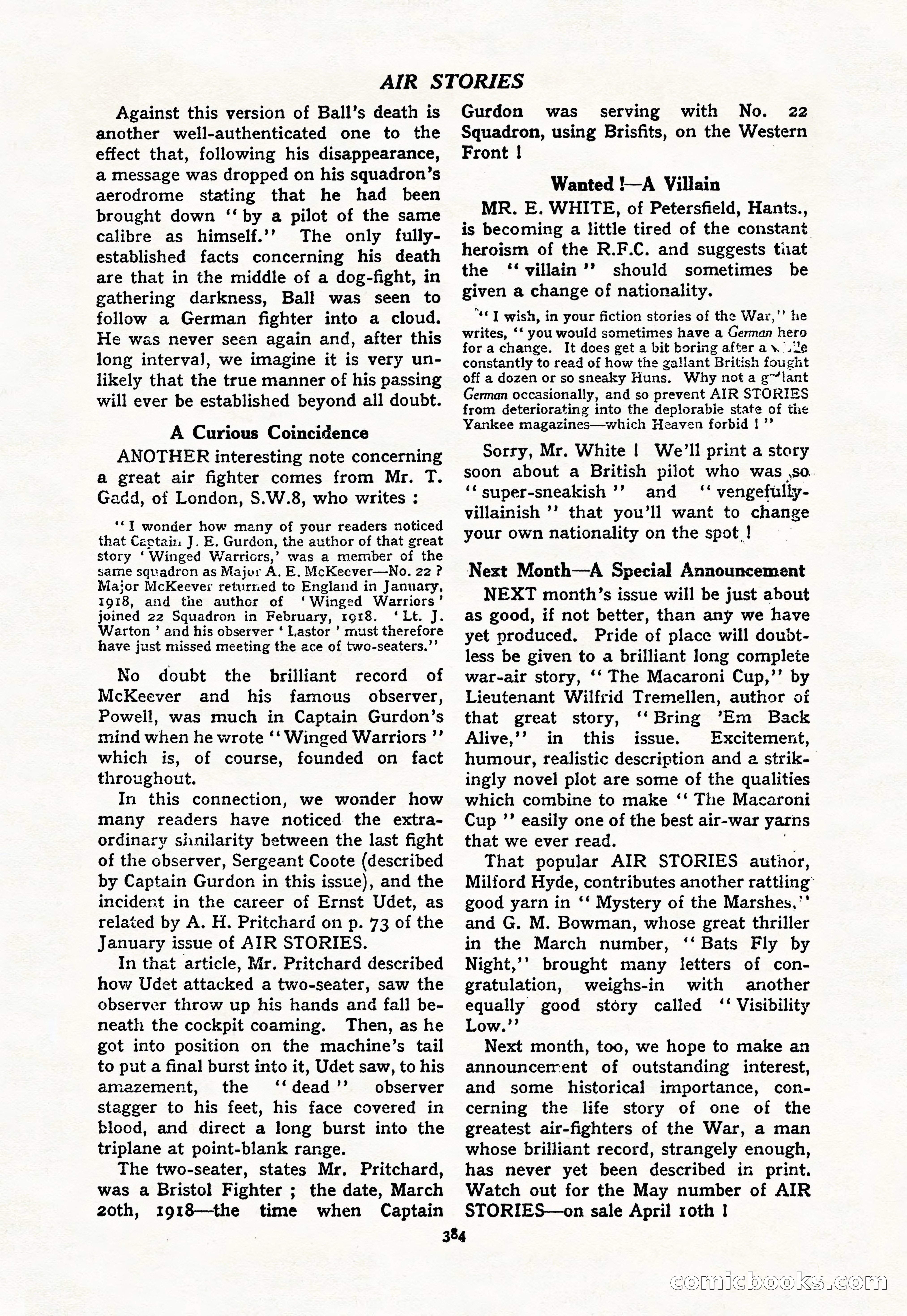
A restored page from Pulp Fiction, 1936. Page through the whole issue in the reader above.
📄 Transcribed text from this page (OCR, searchable)
Machine-transcribed from the original scan — historical spelling and the odd misread are preserved.
AIR STORIES Against this version of Ball’s death is another well-authenticated one to the effect that, following his disappearance, a message was dropped on his squadron’s aerodrome stating that he had been brought down ‘‘ by a pilot of the same calibre as himself.’’ The only fully- established facts concerning his death are that in the middle of a dog-fight, in gathering darkness, Ball was seen to follow a German fighter into a cloud. He was never seen again and, after this long interval, we imagine it is very un- likely that the true manner of his passing will ever be established beyond all doubt. A Curious Coincidence ANOTHER interesting note concerning a great air fighter comes from Mr. T. aad, of London, $.W.8, who writes ; ‘*T wonder how many of your readers noticed that Captain J. E. Gurdon, the author of that great story ‘Winged Warriors,’ was a member of the same squadron as Major A. E. McKeever—No. 22 ? Major McKeever returned to England in January, 1918, and the author of ‘Winged Warriors’ joined 2z Squadron in February, ro18. ‘Lt. J. Warton ’ and his observer ‘ Lastor ’ must therefore have just missed meeting the ace of two-seaters.’’ No doubt the brilliant record of McKeever and his famous observer, Powell, was much in Captain Gurdon’s mind when he wrote ‘‘ Winged Warriors ’’ which is, of course, founded on fact throughout. In this connection, we wonder how many readers have noticed the extra- ordinary sinilarity between the last fight of the observer, Sergeant Coote (described by Captain Gurdon in this issue), and the incident in the career of Ernst Udet, as related by A. H. Pritchard on p. 73 of the January issue of AIR STORIES. In that article, Mr. Pritchard described how Udet attacked a two-seater, saw the observer throw up his hands and fall be- neath the cockpit coaming. Then, as he got into position on the machine’s tail to put a final burst into it, Udet saw, to his amazement, the ‘‘dead’’ observer stagger to his feet, his face covered in blood, and direct a long burst into the triplane at point-blank range. The two-seater, states Mr. Pritchard, was a Bristol Fighter ; the date, March 2oth, 1918—the time when Captain Gurdon was serving with No. 22. Squadron, using Brisfits, on the Western Front ! : | Wanted !—A Villain MR. E. WHITE, of Petersfield, Hants., is becoming a little tired of the constant heroism of the R.F.C. and suggests tiiat the ‘‘ villain ’’ should sometimes be given a change of nationality. “¢] wish, in your fiction stories of the War,’’ he writes, ‘‘ you would sometimes have a German hero forachange. It does get a bit boring after a. ule constantly to read of how the gallant British fought off a dozen or so sneaky Huns. Why nota g™lant German occasionally, and so prevent AIR STORIES from deteriorating into the deplorable state of the Yankee magazines—which Heaven forbid | ’”’ Sorry, Mr. White ! We’ll print a story soon about a British pilot who was so. ‘‘super-sneakish ’’ and ‘‘ vengefully- villainish ’’ that you’ll want to change your own nationality on the spot ! Next Month—A Special Announcement NEXT month’s issue will be just about as good, if not better, than any we have yet produced. Pride of place will doubt- less be given to a brilliant long complete war-air story, ‘‘ The Macaroni Cup,’’ by Lieutenant Wilfrid Tremellen, author of that great story, ‘‘ Bring ’Em Back Alive,’’ in this issue. Excitement, humour, realistic description and a strik- ingly novel plot are some of the qualities which combine to make ‘‘ The Macaroni Cup ’’ easily one of the best air-war yarns that we ever read. = That popular AIR STORIES author, Milford Hyde, contributes another rattling’ good yarn in ‘‘ Mystery of the Marshes,*’ and G. M. Bowman, whose great thriller in the March number, ‘‘ Bats Fly by Night,’’ brought many letters of con- gratulation, weighs-in with another equally good story called ‘‘ Visibility Low.’’ Next month, too, we hope to make an announcerrent of outstanding interest, and some historical importance, con- cerning the life story of one of the greatest air-fighters of the War, a man whose brilliant record, strangely enough, has never yet been described in print. Watch out for the May number of AIR STORIES—on sale April roth ! 384 comilclooolks (CC)