
Pulp Fiction, 1936 · page 97 of 98
Air Stories, April 1936 — page 97: what you’re looking at
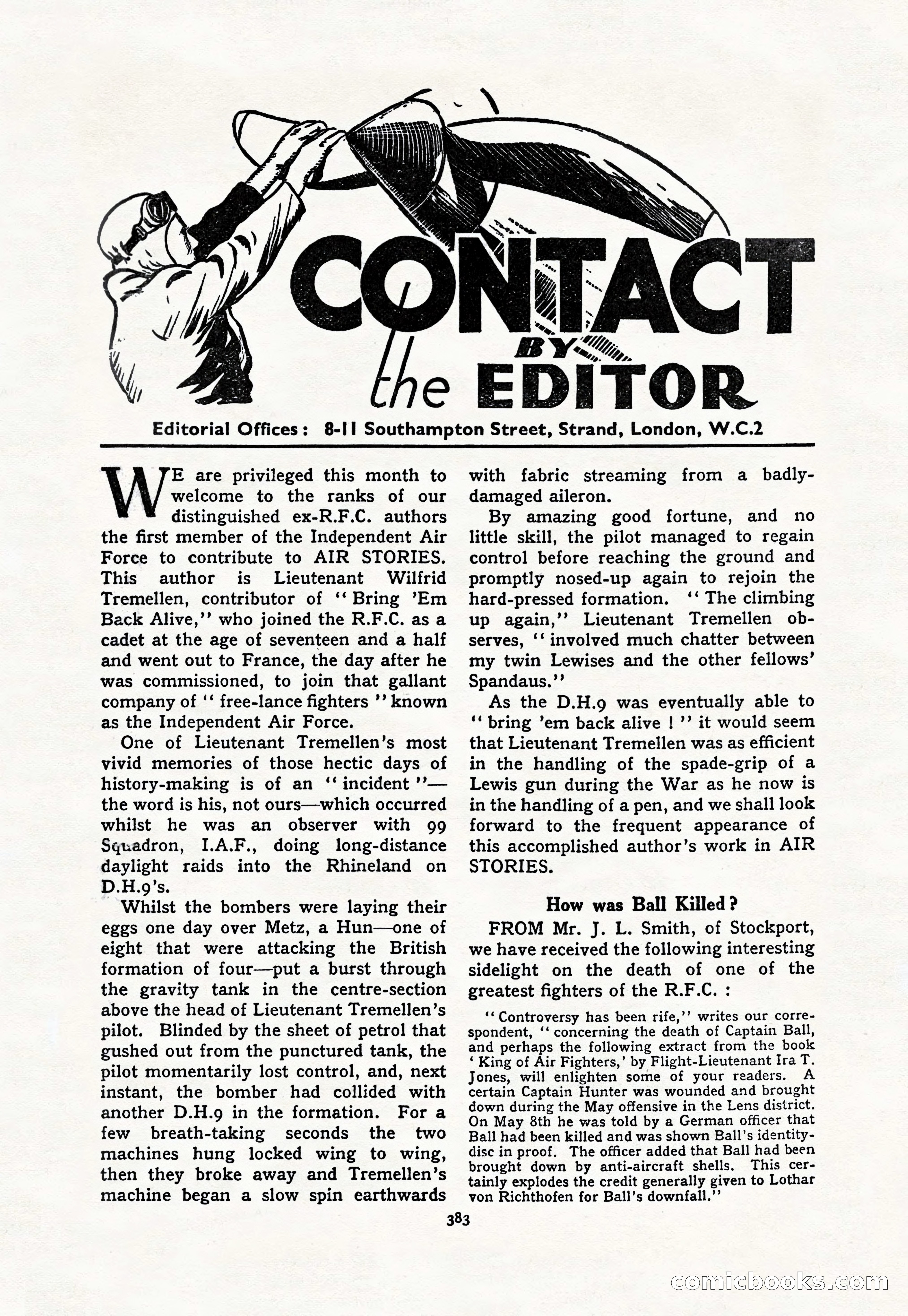
A restored page from Pulp Fiction, 1936. Page through the whole issue in the reader above.
📄 Transcribed text from this page (OCR, searchable)
Machine-transcribed from the original scan — historical spelling and the odd misread are preserved.
: » ITOR Editorial Offices: 8-I1 Southampton Street, Strand, London, W.C.2 E are privileged this month to W cecicomt to the ranks of our distinguished ex-R.F.C. authors the first member of the Independent Air Force to contribute to AIR STORIES. This author is Lieutenant Wilfrid Tremellen, contributor of ‘‘ Bring ’Em Back Alive,’’ who joined the R.F.C. as a cadet at the age of seventeen and a half and went out to France, the day after he was commissioned, to join that gallant company of ‘‘ free-lance fighters ’’ known as the Independent Air Force. One of Lieutenant Tremellen’s most vivid memories of those hectic days of history-making is of an ‘‘ incident ’?— the word is his, not ours—which occurred whilst he was an observer with 99 Squadron, I.A.F., doing long-distance daylight raids into the Rhineland on D.H.9’s. Whilst the bombers were laying their eggs one day over Metz, a Hun—one of eight that were attacking the British formation of four—put a burst through the gravity tank in the centre-section above the head of Lieutenant Tremellen’s pilot. Blinded by the sheet of petrol that gushed out from the punctured tank, the pilot momentarily lost control, and, next instant, the bomber had collided with another D.H.9 in the formation. For a few breath-taking seconds the two machines hung locked wing to wing, then they broke away and Tremellen’s machine began a slow spin earthwards with fabric streaming from a badly- damaged aileron. By amazing good fortune, and no little skill, the pilot managed to regain control before reaching the ground and promptly nosed-up again to rejoin the hard-pressed formation. ‘‘ The climbing up again,’’ Lieutenant Tremellen ob- serves, ‘‘ involved much chatter between my twin Lewises and the other fellows’ Spandaus.’’ As the D.H.9 was eventually able to ‘‘ bring ’em back alive | ’’ it would seem that Lieutenant Tremellen was as efficient in the handling of the spade-grip of a Lewis gun during the War as he now is in the handling of a pen, and we shall look forward to the frequent appearance of this accomplished author’s work in AIR STORIES. How was Ball Killed ? FROM Mr. J. L. Smith, of Stockport, we have received the following interesting sidelight on the death of one of the greatest fighters of the R.F.C. : ‘‘ Controversy has been rife,’’ writes our corre- spondent, ‘‘ concerning the death of Captain Ball, and perhaps the following extract from the book ‘ King of Air Fighters,’ by Flight-Lieutenant Ira T. Jones, will enlighten some of your readers. A certain Captain Hunter was wounded and brought down during the May offensive in the Lens district. On May 8th he was told by a German officer that Ball had been killed and was shown Ball’s identity- disc in proof. The officer added that Ball had been brought down by anti-aircraft shells. This cer- tainly explodes the credit generally given to Lothar von Richthofen for Ball’s downfall.’’ 383 cloook