
Pulp Fiction, 1936 · page 85 of 98
Air Stories, April 1936 — page 85: what you’re looking at
A restored page from Pulp Fiction, 1936. Page through the whole issue in the reader above.
📄 Transcribed text from this page (OCR, searchable)
Machine-transcribed from the original scan — historical spelling and the odd misread are preserved.
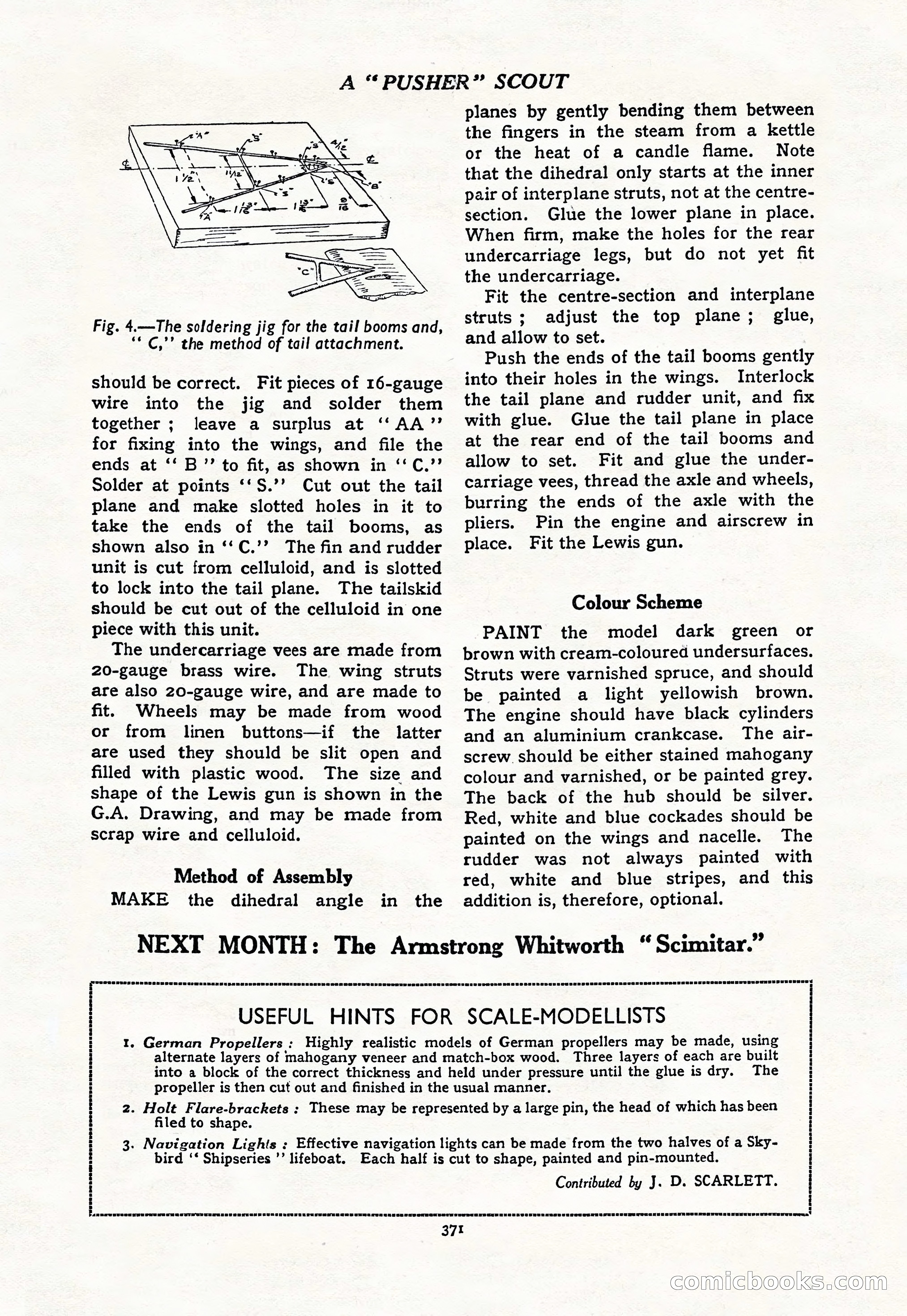
A ** PUSHER” SCOUT Fig. 4.—The soldering jig for the tail booms and, ** C,’’ the method of tail attachment. should be correct. Fit pieces of 16-gauge wire into the jig and solder them together ; leave a surplus at ‘‘ AA”? for fixing into the wings, and file the ends at ‘‘ B’’ to fit, as shown in ‘‘C,’’ solder at points ‘‘S.’’ Cut out the tail plane and make slotted holes in it to take the ends of the tail booms, as shown also in ‘‘C.’’ The fin and rudder unit is cut from celluloid, and is slotted to lock into the tail plane. The tailskid should be cut out of the celluloid in one piece with this unit. The undercarriage vees are made from 20-gauge brass wire. The wing struts are also 20-gauge wire, and are made to fit. Wheels may be made from wood or from linen buttons—if the latter are used they should be slit open and filled with plastic wood. The size and shape of the Lewis gun is shown in the G.A. Drawing, and may be made from scrap wire and celluloid. Method of Assembly MAKE the dihedral angle in the planes by gently bending them between the fingers in the steam from a kettle or the heat of a candle flame. Note that the dihedral only starts at the inner pair of interplane struts, not at the centre- section. Glue the lower plane in place. When firm, make the holes for the rear undercarriage legs, but do not yet fit the undercarriage. Fit the centre-section and interplane struts ; adjust the top plane; glue, and allow to set. Push the ends of the tail booms gently into their holes in the wings. Interlock the tail plane and rudder unit, and fix with glue. Glue the tail plane in place at the rear end of the tail booms and allow to set. Fit and glue the under- carriage vees, thread the axle and wheels, burring the ends of the axle with the pliers. Pin the engine and airscrew in place. Fit the Lewis gun. Colour Scheme PAINT the model dark green or brown with cream-coloured undersurfaces. Struts were varnished spruce, and should be painted a light yellowish brown. The engine should have black cylinders and an aluminium crankcase. The air- screw. should be either stained mahogany colour and varnished, or be painted grey. The back of the hub should be silver. Red, white and blue cockades should be painted on the wings and nacelle. The rudder was not always painted with red, white and blue stripes, and this addition is, therefore, optional. NEXT MONTH: The Armstrong Whitworth “Scimitar.” seapasesanenny, alternate layers of mahogany veneer and into a block of the correct thickness and propeller is then cut out and finished in th filed to shape. 2. Holt Flare-brackets ; These may be represented by a large pin, the head of which has been 3. Navigation Lights : Effective navigation lights can be made from the two halves of a Sky- bird ‘‘ Shipseries ’’ lifeboat. Each half is cut to shape, painted and pin-mounted. Seene nessouansas BOC Cen seen Ee ee SSR es Ree COSC RSn Ses e Sess Ree OSE RE AS ReOR ES ESSER OSs ROMs ESE eens Ose EOESE been see EER SS EAR SSRs ReseReReEs Bae FAEe ES SSeAee See EEUENeEEEE SEE SEESS USEFUL HINTS FOR SCALE-MODELLISTS 1, German Propellers : Highly realistic models of German propellers may be made, using match-box wood. Three layers of each are built held under pressure until the glue is dry. The e usual manner. Contributed by J. D. SCARLETT. ConnicloOolkks (C(C)