
Pulp Fiction, 1936 · page 57 of 98
Air Stories, April 1936 — page 57: what you’re looking at
A restored page from Pulp Fiction, 1936. Page through the whole issue in the reader above.
📄 Transcribed text from this page (OCR, searchable)
Machine-transcribed from the original scan — historical spelling and the odd misread are preserved.
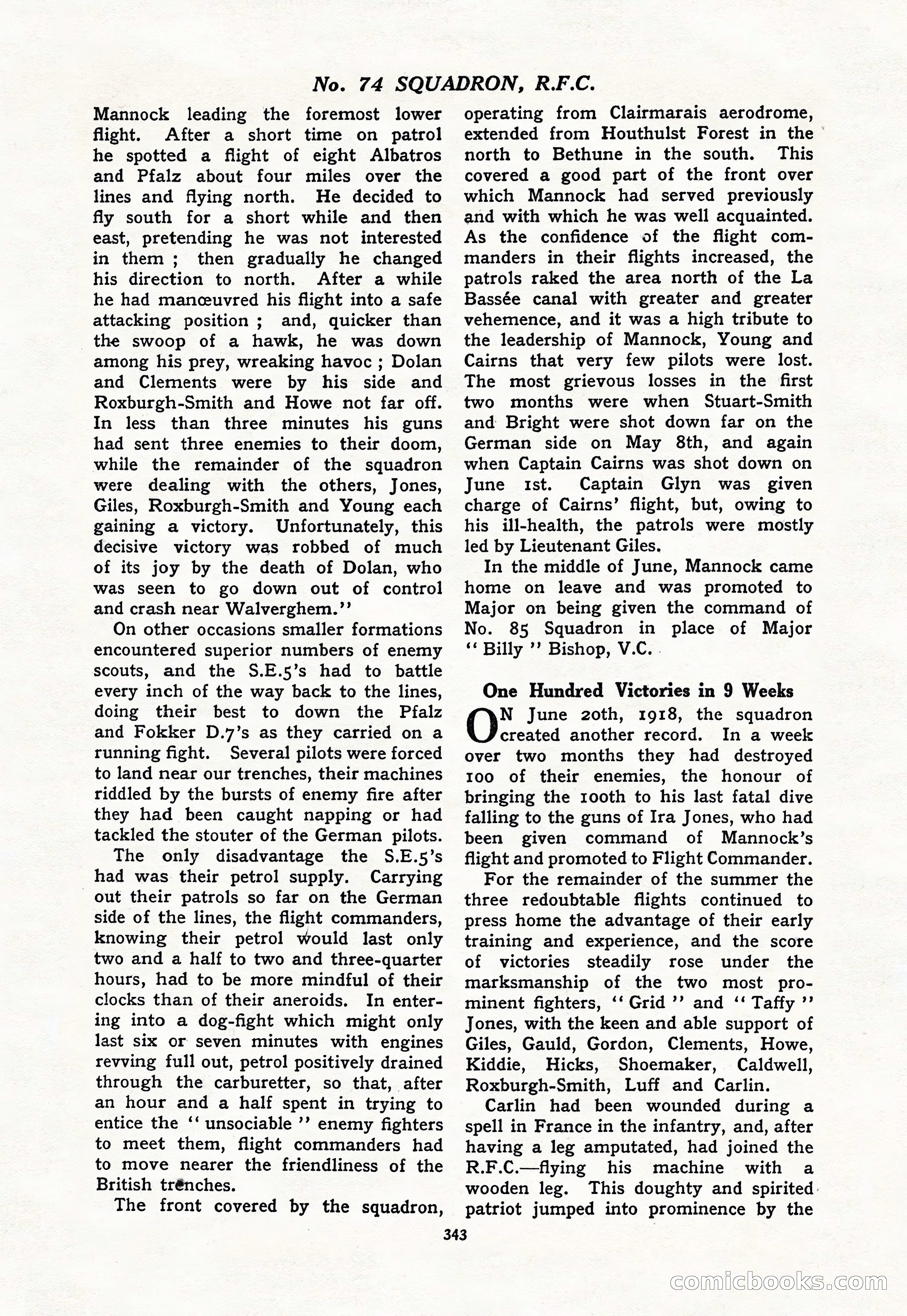
No. 74 SQUADRON, R.F.C. Mannock leading the foremost lower flight. After a short time on patrol he spotted a flight of eight Albatros and Pfalz about four miles over the lines and flying north. He decided to fly south for a short while and then east, pretending he was not interested in them ; then gradually he changed his direction to north. After a while he had manceuvred his flight into a safe attacking position ; and, quicker than the swoop of a hawk, he was down among his prey, wreaking havoc ; Dolan and Clements were by his side and Roxburgh-Smith and Howe not far off. In less than three minutes his guns had sent three enemies to their doom, while the remainder of the squadron were dealing with the others, Jones, Giles, Roxburgh-Smith and Young each gaining a victory. Unfortunately, this decisive victory was robbed of much of its joy by the death of Dolan, who was seen to go down out of control and crash near Walverghem.”’’ On other occasions smaller formations encountered superior numbers of enemy scouts, and the S.E.5’s had to battle every inch of the way back to the lines, doing their best to down the Pfalz and Fokker D.7’s as they carried on a running fight. Several pilots were forced to land near our trenches, their machines riddled by the bursts of enemy fire after they had been caught napping or had tackled the stouter of the German pilots. The only disadvantage the S.E.5’s had was their petrol supply. Carrying out their patrols so far on the German side of the lines, the flight commanders, knowing their petrol would last only two and a half to two and three-quarter hours, had to be more mindful of their clocks than of their aneroids. In enter- ing into a dog-fight which might only last six or seven minutes with engines revving full out, petrol positively drained through the carburetter, so that, after an hour and a half spent in trying to entice the ‘‘ unsociable ’’ enemy fighters to meet them, flight commanders had to move nearer the friendliness of the British trénches. The front covered by the squadron, operating from Clairmarais aerodrome, extended from Houthulst Forest in the north to Bethune in the south. This covered a good part of the front over which Mannock had served previously and with which he was well acquainted. As the confidence of the flight com- manders in their flights increased, the patrols raked the area north of the La Bassée canal with greater and greater vehemence, and it was a high tribute to the leadership of Mannock, Young and Cairns that very few pilots were lost. The most grievous losses in the first two months were when Stuart-Smith and Bright were shot down far on the German side on May 8th, and again when Captain Cairns was shot down on June ist. Captain Glyn was given charge of Cairns’ flight, but, owing to his ill-health, the patrols were mostly led by Lieutenant Giles. In the middle of June, Mannock came home on leave and was promoted to Major on being given the command of No. 85 Squadron in place of Major ‘‘ Billy ’’ Bishop, V.C. . One Hundred Victories in 9 Weeks N June 2oth, 1918, the squadron created another record. In a week over two months they had destroyed 1oo of their enemies, the honour of bringing the rooth to his last fatal dive falling to the guns of Ira Jones, who had been given command of Mannock’s flight and promoted to Flight Commander. For the remainder of the summer the three redoubtable flights continued to press home the advantage of their early training and experience, and the score of victories steadily rose under the marksmanship of the two most pro- minent fighters, ‘‘ Grid ’’ and ‘‘ Taffy ”’ Jones, with the keen and able support of Giles, Gauld, Gordon, Clements, Howe, Kiddie, Hicks, Shoemaker, Caldwell, Roxburgh-Smith, Luff and Carlin. Carlin had been wounded during a spell in France in the infantry, and, after having a leg amputated, had joined the R.F.C.—flying his machine with a wooden leg. This doughty and spirited: patriot jumped into prominence by the 343 (C(O) nn) (e 6) Oy QO) SJ (C(O)