
Pulp Fiction, 1936 · page 56 of 98
Air Stories, April 1936 — page 56: what you’re looking at
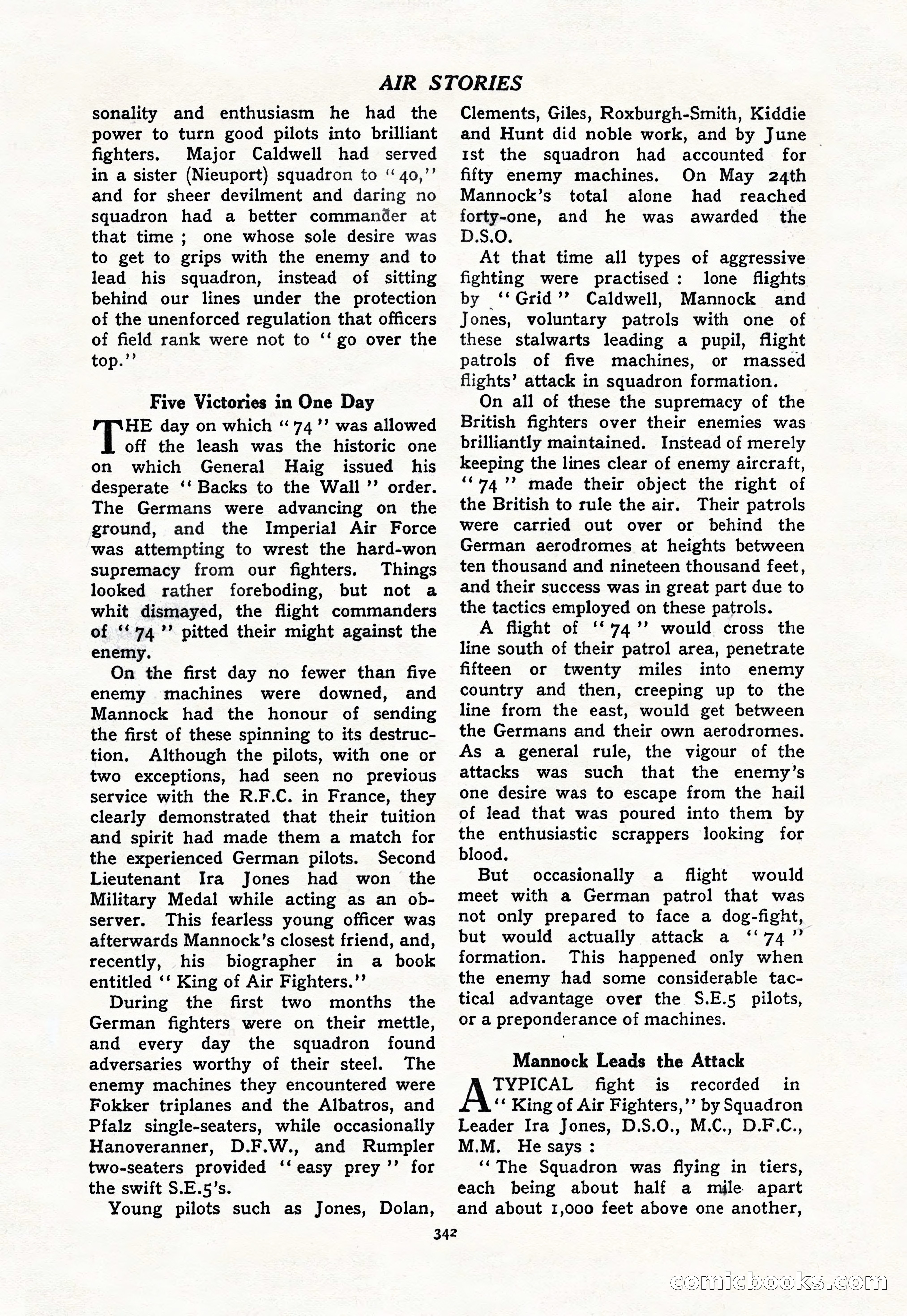
A restored page from Pulp Fiction, 1936. Page through the whole issue in the reader above.
📄 Transcribed text from this page (OCR, searchable)
Machine-transcribed from the original scan — historical spelling and the odd misread are preserved.
AIR STORIES sonality and enthusiasm he had the power to turn good pilots into brilliant fighters. Major Caldwell had served in a sister (Nieuport) squadron to ‘ 4o,’’ and for sheer devilment and daring no squadron had a better commander at that time ; one whose sole desire was to get to grips with the enemy and to lead his squadron, instead of sitting behind our lines under the protection of the unenforced regulation that officers of field rank were not to ‘‘ go over the top.”’ Five Victories in One Day HE day on which ‘74’? was allowed off the leash was the historic one on which General Haig issued his desperate ‘‘ Backs to the Wall ’’ order. The Germans were advancing on the ground, and the Imperial Air Force was attempting to wrest the hard-won supremacy from our fighters. Things looked rather foreboding, but not a whit dismayed, the flight commanders of ‘74’ pitted their might against the enemy. On the first day no fewer than five enemy machines were downed, and Mannock had the honour of sending the first of these spinning to its destruc- tion. Although the pilots, with one or two exceptions, had seen no previous service with the R.F.C. in France, they clearly demonstrated that their tuition and spirit had made them a match for the experienced German pilots. Second Lieutenant Ira Jones had won the Military Medal while acting as an ob- server. This fearless young officer was afterwards Mannock’s closest friend, and, recently, his biographer in a book entitled ‘‘ King of Air Fighters.’’ During the first two months the German fighters were on their mettle, and every day the squadron found adversaries worthy of their steel. The enemy machines they encountered were Fokker triplanes and the Albatros, and Pfalz single-seaters, while occasionally Hanoveranner, D.F.W., and Rumpler two-seaters provided ‘‘ easy prey ’’ for the swift $.E.5’s. Young pilots such as Jones, Dolan, Clements, Giles, Roxburgh-Smith, Kiddie and Hunt did noble work, and by June Ist the squadron had accounted for fifty enemy machines. On May 24th Mannock’s total alone had reached forty-one, and he was awarded the D.S.O. At that time all types of aggressive fighting were practised: lone flights by ‘‘Grid’’ Caldwell, Mannock and Jones, voluntary patrols with one of these stalwarts leading a pupil, flight patrols of five machines, or massed flights’ attack in squadron formation. On all of these the supremacy of the British fighters over their enemies was brilliantly maintained. Instead of merely keeping the lines clear of enemy aircraft, “‘74? made their object the right of the British to rule the air. Their patrols were carried out over or behind the German aerodromes at heights between ten thousand and nineteen thousand feet, and their success was in great part due to the tactics employed on these patrols. A flight of ‘‘'74’’ would cross the line south of their patrol area, penetrate fifteen or twenty miles into enemy country and then, creeping up to the line from the east, would get between the Germans and their own aerodromes. As a general rule, the vigour of the attacks was such that the enemy’s one desire was to escape from the hail of lead that was poured into them by the enthusiastic scrappers looking for blood. But occasionally a flight would meet with a German patrol that was not only prepared to face a dog-fight, but would actually attack a ‘‘74” formation. This happened only when the enemy had some considerable tac- tical advantage over the $.E.5 pilots, or a preponderance of machines. Mannock Leads the Attack TYPICAL fight is recorded in ‘* King of Air Fighters,’’ by Squadron Leader Ira Jones, D.S.O., M.C., D.F.C., M.M. He says : ‘‘The Squadron was flying in tiers, each being about half a mile apart and about 1,000 feet above one another, 342 AMICLOOO@© (S| Q) SJ (Cl Q)