
Pulp Fiction, 1913 · page 74 of 192
Ainslee's Magazine, February 1913 — page 74: what you’re looking at
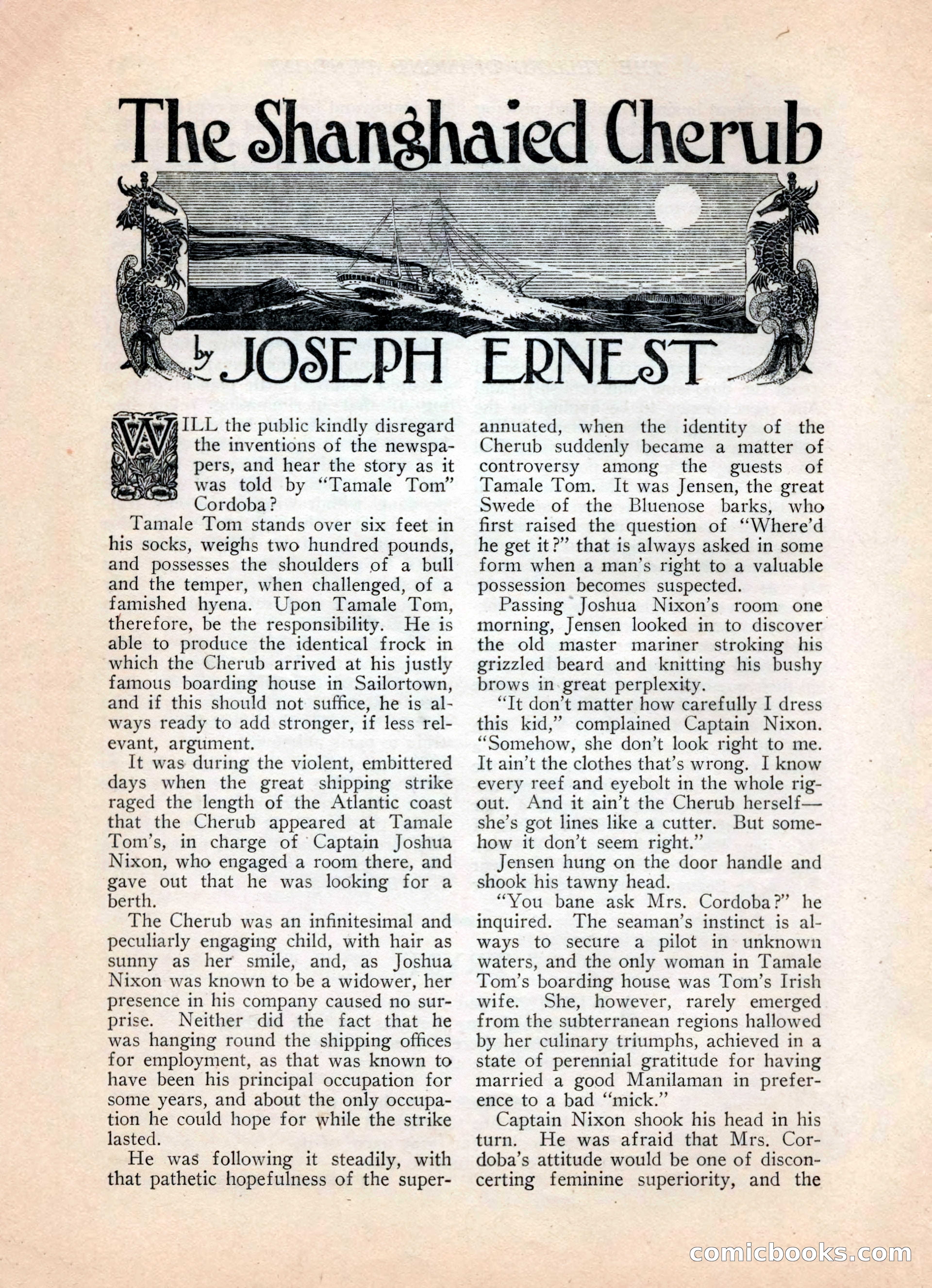
A restored page from Pulp Fiction, 1913. Page through the whole issue in the reader above.
📄 Transcribed text from this page (OCR, searchable)
Machine-transcribed from the original scan — historical spelling and the odd misread are preserved.
Ali the public kindly disregard Q the inventions of the newspa- pers, and hear the story as it was told by “Tamale Tom” Cordoba? Tamale Tom stands over six feet in his socks, weighs two hundred pounds, and possesses the shoulders of a bull and the temper, when challenged, of a famished hyena. Upon Tamale Tom, therefore, be the responsibility. He is able to produce the identical frock in which the Cherub arrived at his justly famous boarding house in Sailortown, and if this should not suffice, he is al- ways ready to add stronger, if less rel- evant, argument. It was during the violent, embittered days when the great shipping strike raged the length of the Atlantic coast that the Cherub appeared at Tamale Tom’s, in charge of Captain Joshua Nixon, who engaged a room there, and gave out that he was looking for a berth. The Cherub was an infinitesimal and peculiarly engaging child, with hair as sunny as her smile, and, as Joshua Nixon was known to be a widower, her presence in his company caused no sur- prise. Neither did the fact that he was hanging round the shipping offices for employment, as that was known to have been his principal occupation for some years, and about the only occupa- tion he could hope for while the strike lasted. He was following it steadily, with that pathetic hopefulness of the super- The he dhanghaied C Cherub annuated, when the identity of the Cherub suddenly became a matter of controversy among the guests. of Tamale Tom. It was Jensen, the great Swede of the Bluenose barks, who first raised the question of “Where'd he get it?” that is always asked in some form when a man’s right to a valuable possession becomes suspected. Passing Joshua Nixon’s room one morning, Jensen looked in to discover the old master mariner stroking his grizzled beard and knitting his bushy brows in. great perplexity. “It don’t matter how carefully I dress this kid,’ complained Captain Nixon. “Somehow, she don’t look right to me. It ain’t the clothes that’s wrong. I know every reef and eyebolt in the whole rig- out. And it ain’t the Cherub herself— she’s got lines like a cutter. But some- how it don’t seem right.” Jensen hung on the door handle and shook his tawny head. “You bane ask Mrs. Cordoba?” he inquired. The seaman’s instinct is al- ways to secure a pilot in unknown waters, and the only woman in Tamale Tom’s boarding house was Tom’s Irish wife. She, however, rarely emerged from the subterranean regions hallowed by her culinary triumphs, achieved in a state of perennial gratitude for having married a good Manilaman in prefer- ence to a bad “mick.” Captain Nixon shook his head in his turn. He was afraid that Mrs. Cor- doba’s attitude would be one of discon- certing feminine superiority, and the (C@) OOK (C@