
Pulp Fiction, 1913 · page 73 of 192
Ainslee's Magazine, February 1913 — page 73: what you’re looking at
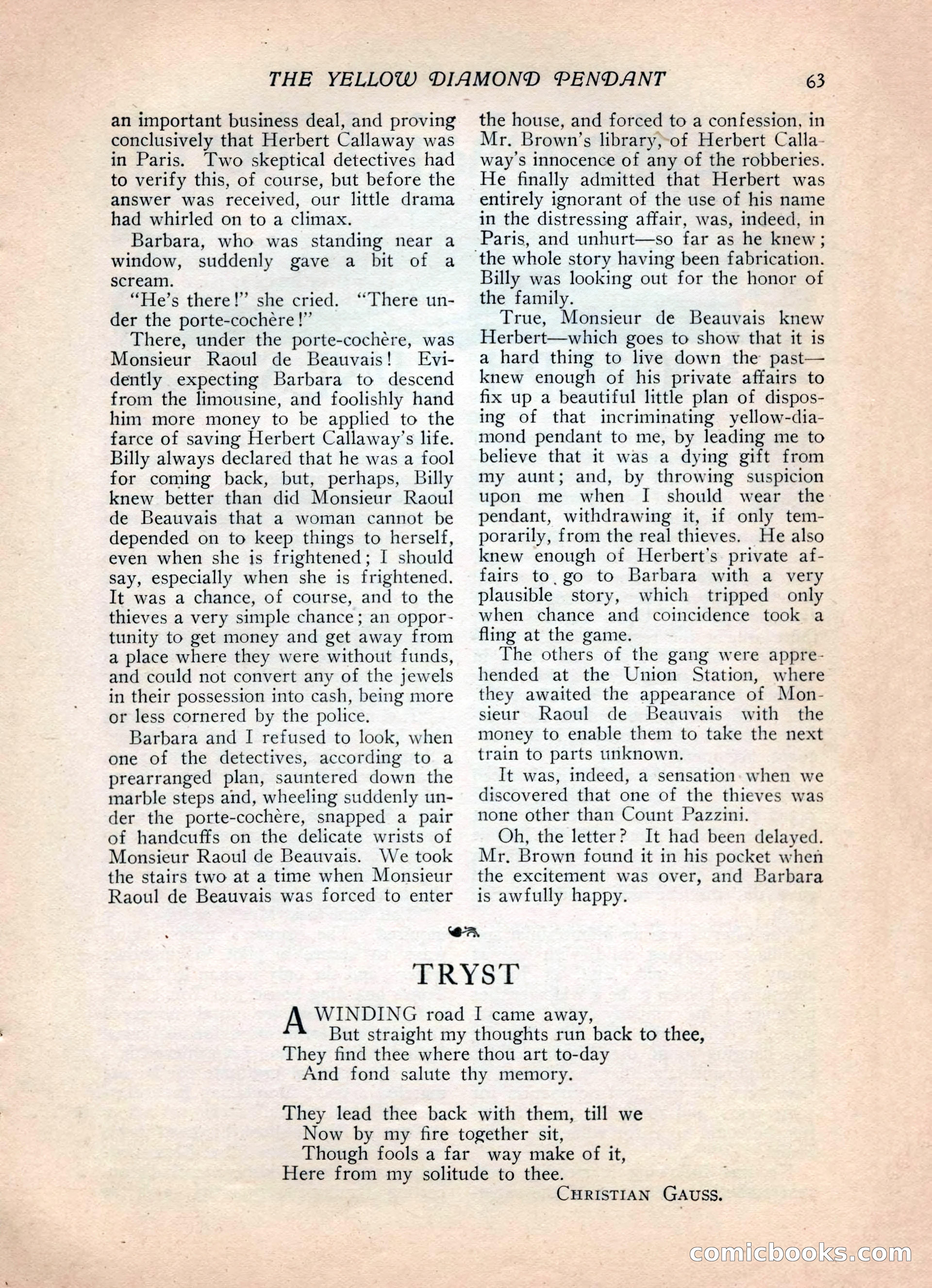
A restored page from Pulp Fiction, 1913. Page through the whole issue in the reader above.
📄 Transcribed text from this page (OCR, searchable)
Machine-transcribed from the original scan — historical spelling and the odd misread are preserved.
THE YELLOW DIAMOND PENDANT an important business deal, and proving conclusively that Herbert Callaway was in Paris. Two skeptical detectives had to verify this, of course, but before the answer was received, our little drama had whirled on to a climax. Barbara, who was standing near a window, suddenly gave a bit of a scream. “He’s there!” she cried. der the porte-cochere !” There, under the porte-cochere, was Monsieur Raoul de Beauvais! Evi- dently expecting Barbara to descend from the limousine, and foolishly hand him more money to be applied to the farce of saving Herbert Callaway’s life. Billy always declared that he was a fool for coming back, but, perhaps, Billy knew better than did Monsieur Raoul de Beauvais that a woman cannot be depended on to keep things to herself, even when she is frightened; I should say, especially when she is frightened. It was a chance, of course, and to the thieves a very simple chance; an oppor- tunity to get money and get away from a place where they were without funds, and could not convert any of the jewels in their possession into cash, being more or less cornered by the police. Barbara and I refused to look, when one of the detectives, according to a prearranged plan, sauntered down the marble steps and, wheeling suddenly un- der the porte-cochere, snapped a pair of handcuffs on the delicate wrists of Monsieur Raoul de Beauvais. We took the stairs two at a time when Monsieur Raoul de Beauvais was forced to enter “There un- 63 the house, and forced to a confession, in Mr. Brown’s library,-of Herbert Calla- way's innocence of any of the robberies. He finally admitted that Herbert was entirely ignorant of the use of his name in the distressing affair, was, indeed, in Paris, and unhurt—so far as he knew; ‘the whole story having been fabrication. Billy was looking out for the honor of the family. True, Monsieur de Beauvais knew Herbert—which goes to show that it is a hard thing to live down the past— knew enough of his private affairs to fix up a beautiful little plan of dispos- ing of that incriminating yellow-dia- mond pendant to me, by leading me to believe that it was a dying gift from my aunt; and, by throwing suspicion upon me when I should wear the pendant, withdrawing it, if only tem- porarily, from the real thieves. He also knew enough of Herbert’s private af- fairs to, go to Barbara with a very plausible story, which tripped only when chance and coincidence took a fling at the game. The others of the gang were appre- hended at the Union Station, where they awaited the appearance of Mon- sieur Raoul de Beauvais with the money to enable them to take the next train to parts unknown. It was, indeed, a sensation. when we discovered that one of the thieves was none other than Count Pazzini. Oh, the letter? It had been delayed. Mr. Brown found it in his pocket when the excitement was over, and Barbara is awfully happy. SA. TRYST A WINDING road I came away, But straight my thoughts run back to thee, They find thee where thou art to-day And fond salute thy memory. They lead thee back with them, till we Now by my fire together sit, Though fools a far way make of it, Here from my solitude to thee. CHRISTIAN GAUSS. (E@) IOOK (E@)