
Pulp Fiction, 1913 · page 144 of 192
Ainslee's Magazine, February 1913 — page 144: what you’re looking at
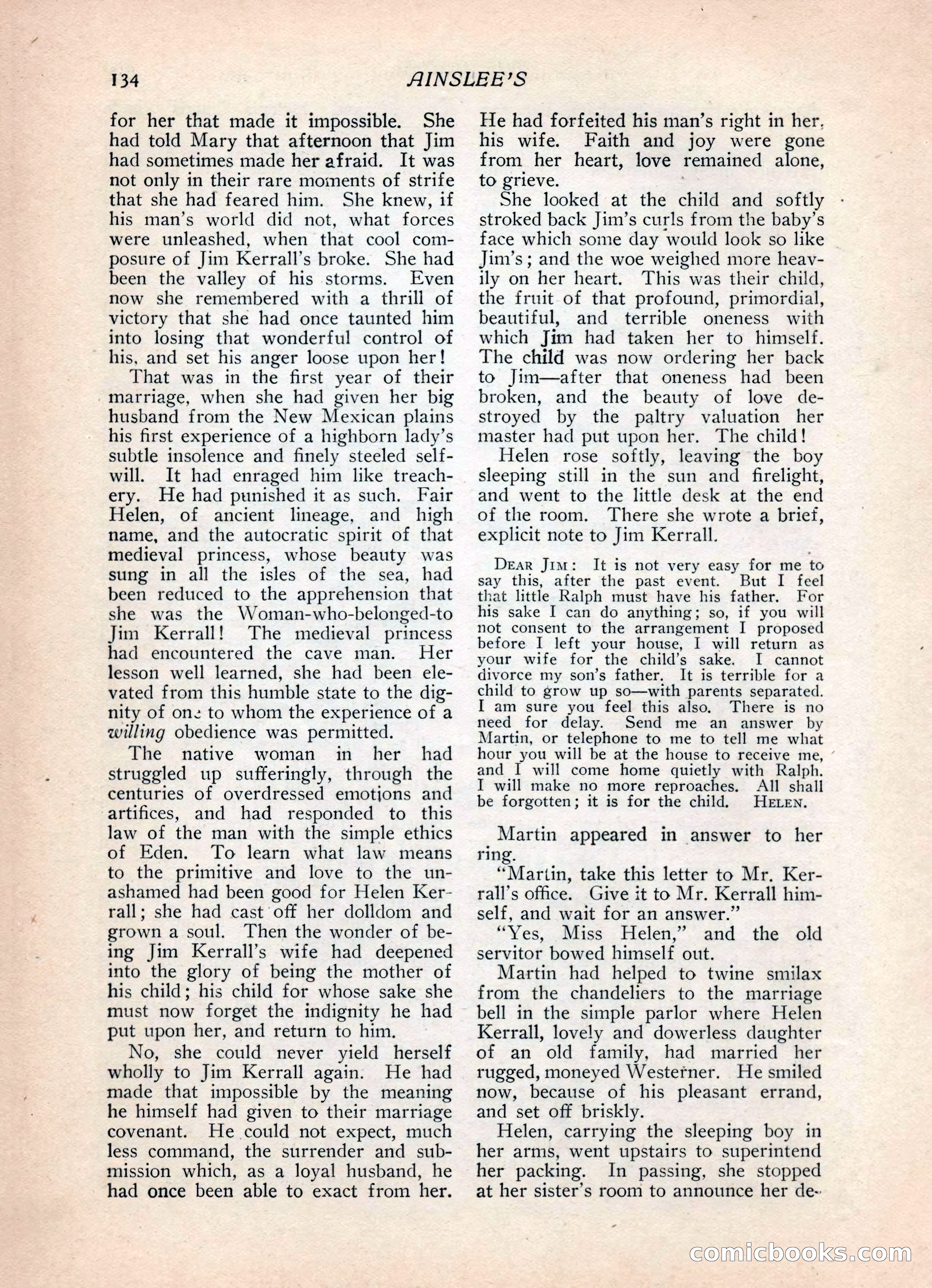
A restored page from Pulp Fiction, 1913. Page through the whole issue in the reader above.
📄 Transcribed text from this page (OCR, searchable)
Machine-transcribed from the original scan — historical spelling and the odd misread are preserved.
134 for her that made it impossible. She had told Mary that afternoon that Jim had sometimes made her afraid. It was not only in their rare moments of strife that she had feared him. She knew, if his man’s world did not, what forces were unleashed, when that cool com- posure of Jim Kerrall’s broke. She had been the valley of his storms. Even now she remembered with a thrill of victory that she had once taunted him into losing that wonderful control of his, and set his anger loose upon her! That was in the first year of their marriage, when she had given her big husband from the New Mexican plains his first experience of a highborn lady’s subtle insolence and finely steeled self- will. It had enraged him like treach- ery. He had punished it as such. Fair Helen, of ancient lineage, and high name, and the autocratic spirit of that medieval princess, whose beauty was sung in all the isles of the sea, had been reduced to the apprehension that she was the Woman-who-belonged-to Jim Kerrall! The medieval princess had encountered the cave man. Her lesson well learned, she had been ele- vated from this humble state to the dig- nity of one to whom the experience of a willing obedience was permitted. The native woman in her had struggled up sufferingly, through the centuries of overdressed emotions and artifices, and had responded to this law of the man with the simple ethics of Eden. To learn what law means to the primitive and love to the un- ashamed had been good for Helen Ker- rall; she had cast off her dolldom and grown a soul. Then the wonder of be- ing Jim Kerrall’s wife had deepened into the glory of being the mother of his child; his child for whose sake she must now forget the indignity he had put upon her, and return to him. No, she could never yield herself wholly to Jim Kerrall again. He had made that impossible by the meaning he himself had given to their marriage covenant. He could not expect, much less command, the surrender and sub- mission which, as a loyal husband, he had once been able to exact from her. AINSLEE’S He had forfeited his man’s right in her, his wife. Faith and joy were gone from her heart, love remained alone, to grieve. She looked at the child and softly stroked back Jim’s curls from the baby’s face which some day would look so like Jim’s; and the woe weighed more heay- ily on her heart. This was their child, the fruit of that profound, primordial, beautiful, and terrible oneness with which Jim had taken her to himself. The child was now ordering her back to Jim—after that oneness had been broken, and the beauty of love de- stroyed by the paltry valuation her master had put upon her. The child! Helen rose softly, leaving the boy sleeping still in the sun and firelight, and went to the little desk at the end of the room. There she wrote a brief, explicit note to Jim Kerrall. Dear Jim: It is not very easy for me to say this, after the past event. But I feel that little Ralph must have his father. For his sake I can do anything; so, if you will not consent to the arrangement I proposed before I left your house, I will return as your wife for the child’s sake. I cannot divorce my son’s father. It is terrible for a child to grow up so—with parents separated. I am sure you feel this also. There is no need for delay. Send me an answer by Martin, or telephone to me to tell me what hour you will be at the house to receive me, and I will come home quietly with Ralph. I will make no more reproaches. All shall be forgotten; it is for the child. He ten. Martin appeared in answer to her ring. “Martin, take this letter to Mr. Ker- rall’s office. Give it to Mr. Kerrall him- self, and wait for an answer.” “Yes, Miss Helen,” and the old servitor bowed himself out. Martin had helped to twine smilax from the chandeliers to the marriage bell in the simple parlor where Helen Kerrall, lovely and dowerless daughter of an old family, had married her rugged, moneyed Westerner. He smiled now, because of his pleasant errand, and set off briskly. Helen, carrying the sleeping boy in her arms, went upstairs to superintend her packing. In passing, she stopped at her sister's room to announce her de- COMMUC OO) KK (C@