
Pulp Fiction, 1913 · page 143 of 192
Ainslee's Magazine, February 1913 — page 143: what you’re looking at
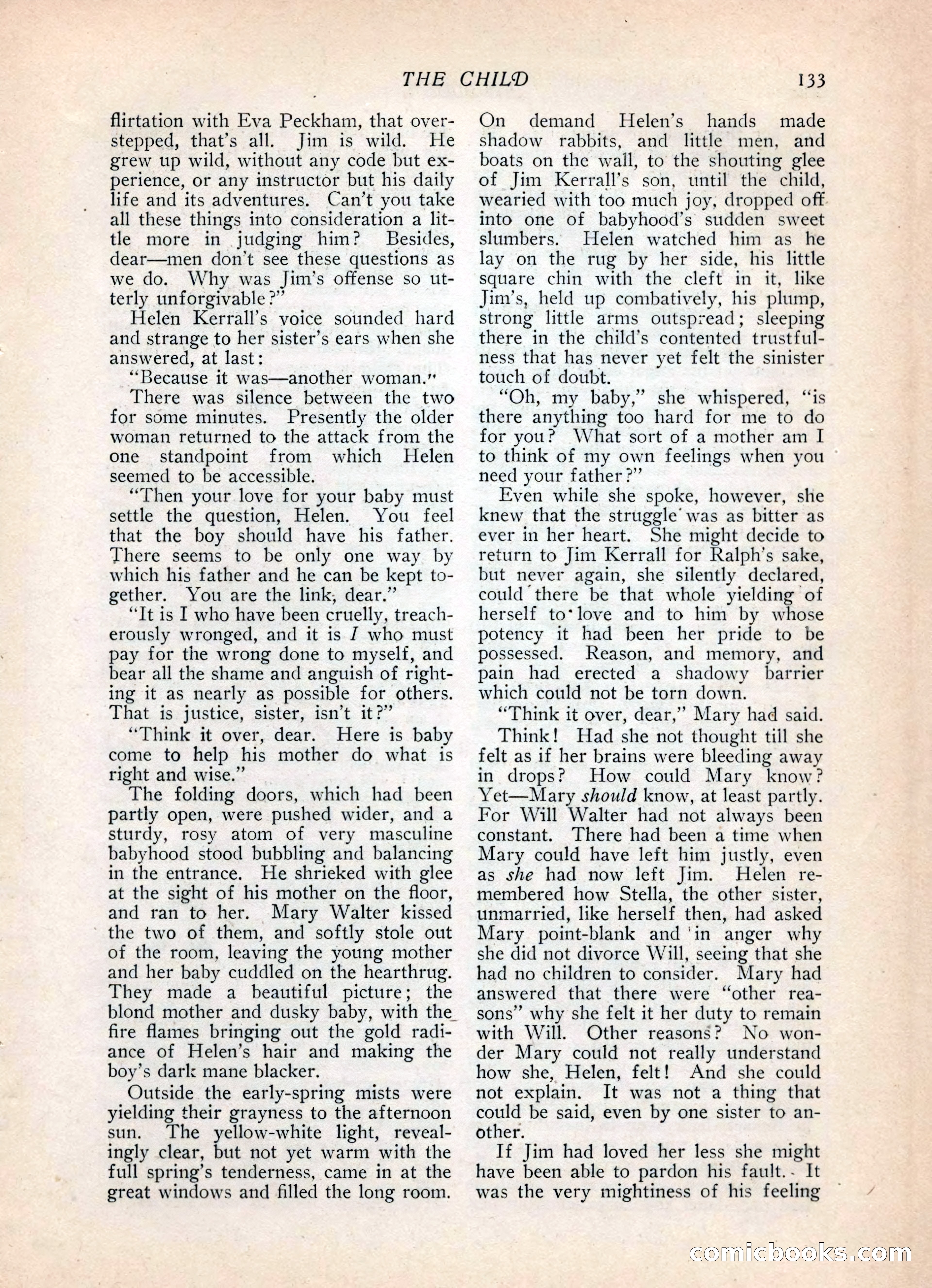
A restored page from Pulp Fiction, 1913. Page through the whole issue in the reader above.
📄 Transcribed text from this page (OCR, searchable)
Machine-transcribed from the original scan — historical spelling and the odd misread are preserved.
THE CHILD flirtation with Eva Peckham, that over- stepped, that’s all. Jim is wild. He grew up wild, without any code but ex- perience, or any instructor but his daily life and its adventures. Can’t you take all these things into consideration a lit- tle more in judging him? Besides, dear—men don’t see these questions as we do. Why was Jim’s offense so ut- terly unforgivable?” Helen Kerrall’s voice sounded hard and strange to her sister’s ears when she answered, at last: “Because it was—another woman.” There was silence between the two for some minutes. Presently the older woman returned to the attack from the one standpoint from which Helen seemed to be accessible. “Then your love for your baby must settle the question, Helen. You feel that the boy should have his father. There seems to be only one way by which his father and he can be kept to- gether. You are the link, dear.” “It is I who have been cruelly, treach- erously wronged, and it is J who must pay for the wrong done to myself, and bear all the shame and anguish of right- ing it as nearly as possible for others. That is justice, sister, isn’t it?” “Think it over, dear. Here is baby come to help his mother do what is right and wise.” The folding doors, which had been partly open, were pushed wider, and a sturdy, rosy atom of very masculine babyhood stood bubbling and balancing in the entrance. He shrieked with glee at the sight of his mother on the floor, and ran to her. Mary Walter kissed the two of them, and softly stole out of the room, leaving the young mother and her baby cuddled on the hearthrug. They made a beautiful picture; the blond mother and dusky baby, with the. fire flames bringing out the gold radi- ance of Helen’s hair and making the boy’s dark mane blacker. Outside the early-spring mists were yielding their grayness to the afternoon sun. The yellow-white light, reveal- ingly clear, but not yet warm with the full spring’s tenderness, came in at the great windows and filled the long room. 133 On demand Helen’s hands made shadow rabbits, and little men, and boats on the wail, to the shouting glee of Jim Kerrall’s son, until the child, wearied with too much joy, dropped off. into one of babyhood’s sudden sweet slumbers. Helen watched him as he lay on the rug by her side, his little square chin with the cleft in it, like Jim’s, held up combatively, his plump, strong little arms outspread; sleeping there in the child’s contented trustful- ness that has never yet felt the sinister touch of doubt. “Oh, my baby,” she whispered, “‘is there anything too hard for me to do for you? What sort of a mother am I to think of my own feelings when you need your father?” Even while she spoke, however, she knew that the struggle was as bitter as ever in her heart. She might decide to return to Jim Kerrall for Ralph’s sake, but never again, she silently declared, could there be that whole yielding of herself to*love and to him by whose potency it had been her pride to be possessed. Reason, and memory, and pain had erected a shadowy barrier which could not be torn down. “Think it over, dear,” Mary had said. Think! Had she not thought till she felt as if her brains were bleeding away in drops? How could Mary know? Yet—Mary should know, at least partly. For Will Walter had not always been constant. There had been a time when Mary could have left him justly, even as she had now left Jim. Helen re- membered how Stella, the other sister, unmarried, like herself then, had asked Mary point-blank and ‘in anger why she did not divorce Will, seeing that she had no children to consider. Mary had answered that there were “other rea- sons” why she felt it her duty to remain with Will. Other reasons? No won- der Mary could not really understand how she, Helen, felt! And she could not explain. It was not a thing that could be said, even by one sister to an- other. If Jim had loved her less she might have been able to pardon his fault.- It was the very mightiness of his feeling (C@ ANUC DOOLK (C@