
Pulp Fiction, 1913 · page 115 of 192
Ainslee's Magazine, February 1913 — page 115: what you’re looking at
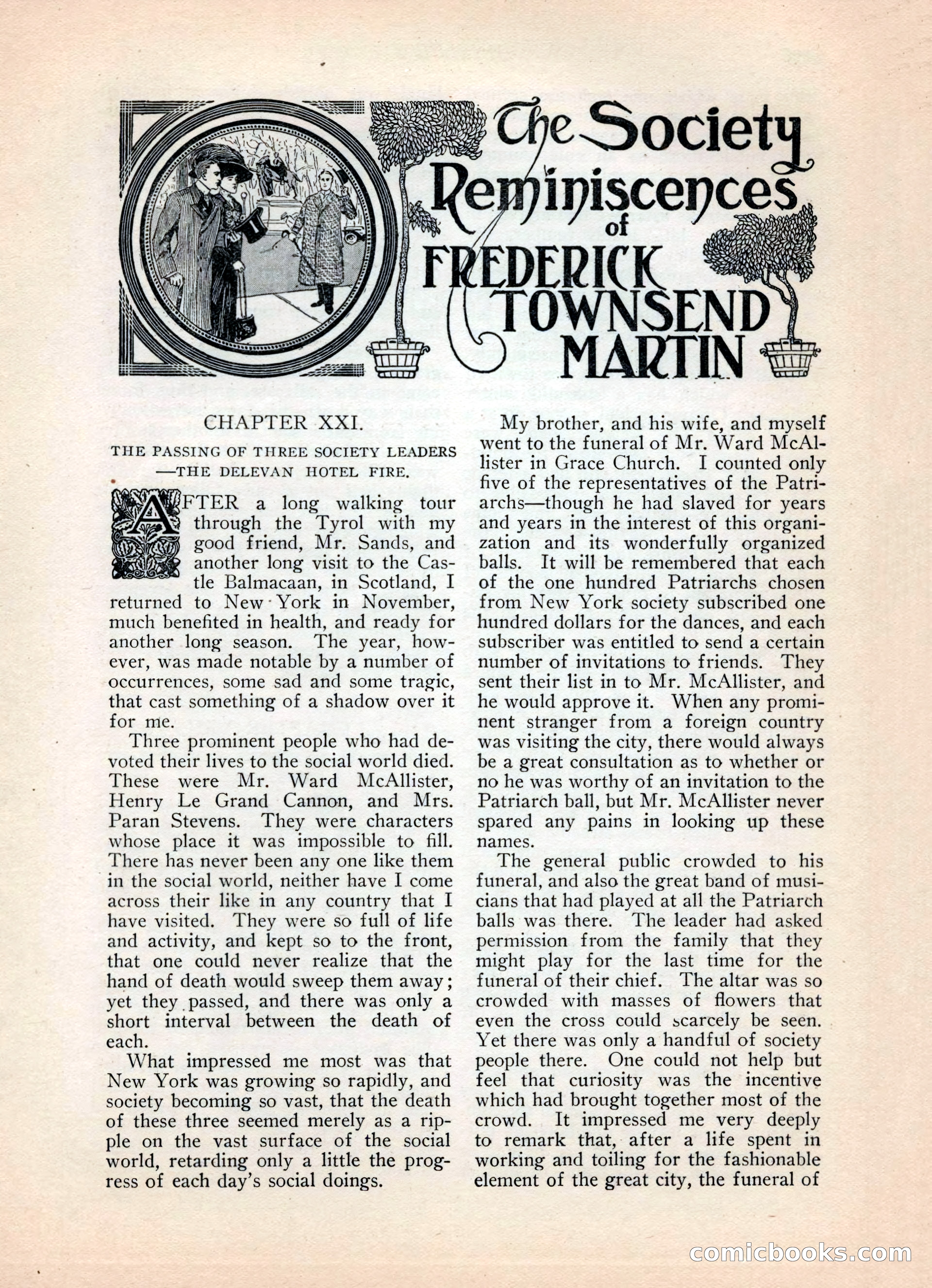
A restored page from Pulp Fiction, 1913. Page through the whole issue in the reader above.
📄 Transcribed text from this page (OCR, searchable)
Machine-transcribed from the original scan — historical spelling and the odd misread are preserved.
CHAPTER XXI. THE PASSING OF THREE SOCIETY LEADERS —THE DELEVAN HOTEL FIRE, through the Tyrol with my good friend, Mr. Sands, and another long visit to the Cas- tle Balmacaan, in Scotland, I returned to New York in November, much benefited in health, and ready for another long season. The year, how- ever, was made notable by a number of occurrences, some sad and some tragic, that cast something of a shadow over it for me. Three prominent people who had de- voted their lives to the social world died. These were Mr. Ward McAllister, Henry Le Grand Cannon, and Mrs. Paran Stevens. They were characters whose place it was impossible to fill. There has never been any one like them in the social world, neither have I come across their like in any country that I have visited. They were so full of life and activity, and kept so to the front, that one could never realize that the hand of death would sweep them away; yet they passed, and there was only a short interval between the death of each. What impressed me most was that New York was growing so rapidly, and society becoming so vast, that the death of these three seemed merely as a rip- ple on the vast surface of the social world, retarding only a little the prog- ress of each day’s social doings. My brother, and his wife, and myself went to the funeral of Mr. Ward McAI- lister in Grace Church. I counted only five of the representatives of the Patri- archs—though he had slaved for years and years in the interest of this organi- zation and its wonderfully organized balls. It will be remembered that each of the one hundred Patriarchs chosen from New York society subscribed one hundred dollars for the dances, and each subscriber was entitled to send a certain number of invitations to friends. They sent their list in to Mr. McAllister, and he would approve it. When any promi- nent stranger from a foreign country was visiting the city, there would always be a great consultation as to whether or no he was worthy of an invitation to the Patriarch ball, but Mr. McAllister never spared any pains in looking up these names. The general public crowded to his funeral, and also the great band of musi- cians that had played at all the Patriarch balls was there. The leader had asked permission from the family that they might play for the last time for the funeral of their chief. The altar was so crowded with masses of flowers that even the cross could scarcely be seen. Yet there was only a handful of society people there. One could not help but feel that curiosity was the incentive which had brought together most of the crowd. It impressed me very deeply to remark that, after a life spent in working and toiling for the fashionable element of the great city, the funeral of CORNICLOOO© ) S