
Pulp Fiction, 1913 · page 114 of 192
Ainslee's Magazine, February 1913 — page 114: what you’re looking at
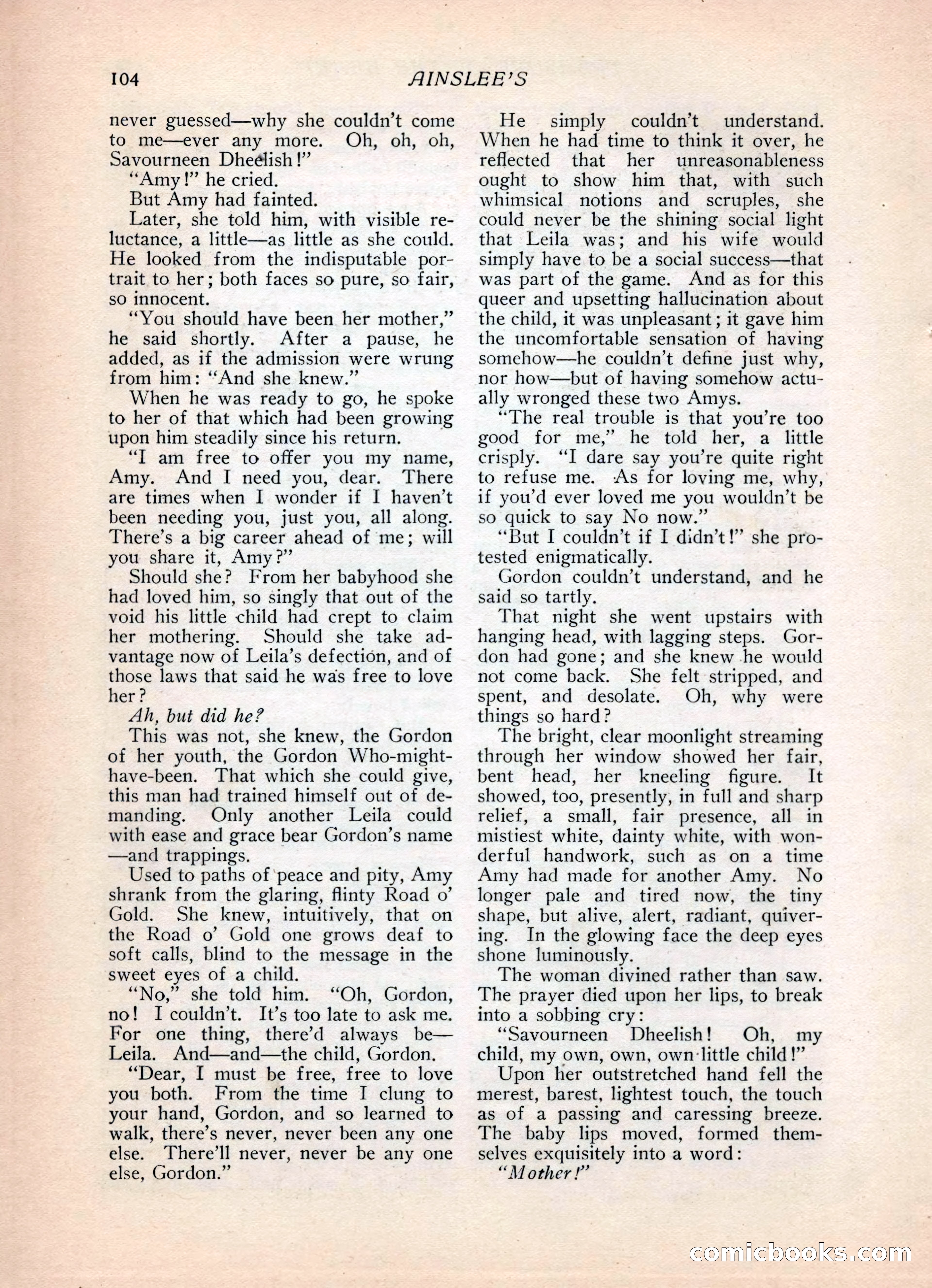
A restored page from Pulp Fiction, 1913. Page through the whole issue in the reader above.
📄 Transcribed text from this page (OCR, searchable)
Machine-transcribed from the original scan — historical spelling and the odd misread are preserved.
104 never guessed—why she couldn’t come to me—ever any more. Oh, oh, oh, Savourneen Dheélish!” “Amy!” he cried. But Amy had fainted. Later, she told him, with visible re- luctance, a little—as little as she could. He looked from the indisputable por- trait to her; both faces so pure, so fair, so innocent. “You should have been her mother,” he said shortly. After a pause, he added, as if the admission were wrung from him: “And she knew.” When he was ready to go, he spoke to her of that which had been growing upon him steadily since his return. “I am free to offer you my name, Amy. And I need you, dear. There are times when I wonder if I haven't been needing you, just you, all along. There’s a big career ahead of me; will you share it, Amy?” Should she? From her babyhood she had loved him, so singly that out of the void his little child had crept to claim her mothering. Should she take ad- vantage now of Leila’s defection, and of those laws that said he was free to love her? Ah, but did he? This was not, she knew, the Gordon of her youth, the Gordon Who-might- have-been. That which she could give, this man had trained himself out of de- manding. Only another Leila could with ease and grace bear Gordon’s name —and trappings. Used to paths of ‘peace and pity, Amy shrank from the glaring, flinty Road o’ Gold. She knew, intuitively, that on the Road o’ Gold one grows deaf to soft calls, blind to the message in the sweet eyes of a child. “No,” she told him. ‘Oh, Gordon, no! I couldn’t. It’s too late to ask me. For one thing, there’d always be— Leila. And—and—the child, Gordon. “Dear, I must be free, free to love you both. From the time I clung to your hand, Gordon, and so learned to walk, there’s never, never been any one else. There’ll never, never be any one else, Gordon.” AINSLEE’S He simply couldn’t understand. When he had time to think it over, he reflected that her unreasonableness ought to show him that, with such whimsical notions and scruples, she could never be the shining social light that Leila was; and his wife would simply have to be a social success—that was part of the game. And as for this queer and upsetting hallucination about the child, it was unpleasant; it gave him the uncomfortable sensation of having somehow—he couldn’t define just why, nor how—but of having somehow actu- ally wronged these two Amys. “The real trouble is that you’re too good for me,” he told her, a little crisply. “I dare say you’re quite right to refuse me. ‘As for loving me, why, if you’d ever loved me you wouldn’t be so quick to say No now.” “But I couldn’t if I didn’t!” she pro- tested enigmatically. Gordon couldn’t understand, and he said so tartly. That night she went upstairs with hanging head, with lagging steps. Gor- don had gone; and she knew he would not come back. She felt stripped, and spent, and desolate. Oh, why were things so hard? The bright, clear moonlight streaming through her window showed her fair, bent head, her kneeling figure. It showed, too, presently, in full and sharp relief, a small, fair presence, all in mistiest white, dainty white, with won- derful handwork, such as on a time Amy had made for another Amy. No longer pale and tired now, the tiny shape, but alive, alert, radiant, quiver- ing. In the glowing face the deep eyes shone luminously. The woman divined rather than saw. The prayer died upon her lips, to break into a sobbing cry: “Savourneen Dheelish! Oh, my child, my own, own, own little child!” Upon her outstretched hand fell the merest, barest, lightest touch, the touch as of a passing and caressing breeze. The baby lips moved, formed them- selves exquisitely into a word: “Mother!” (C@ VOLK (C@