
Pulp Fiction, 1926 · page 21 of 212
Adventure Magazine Cover — page 21: what you’re looking at
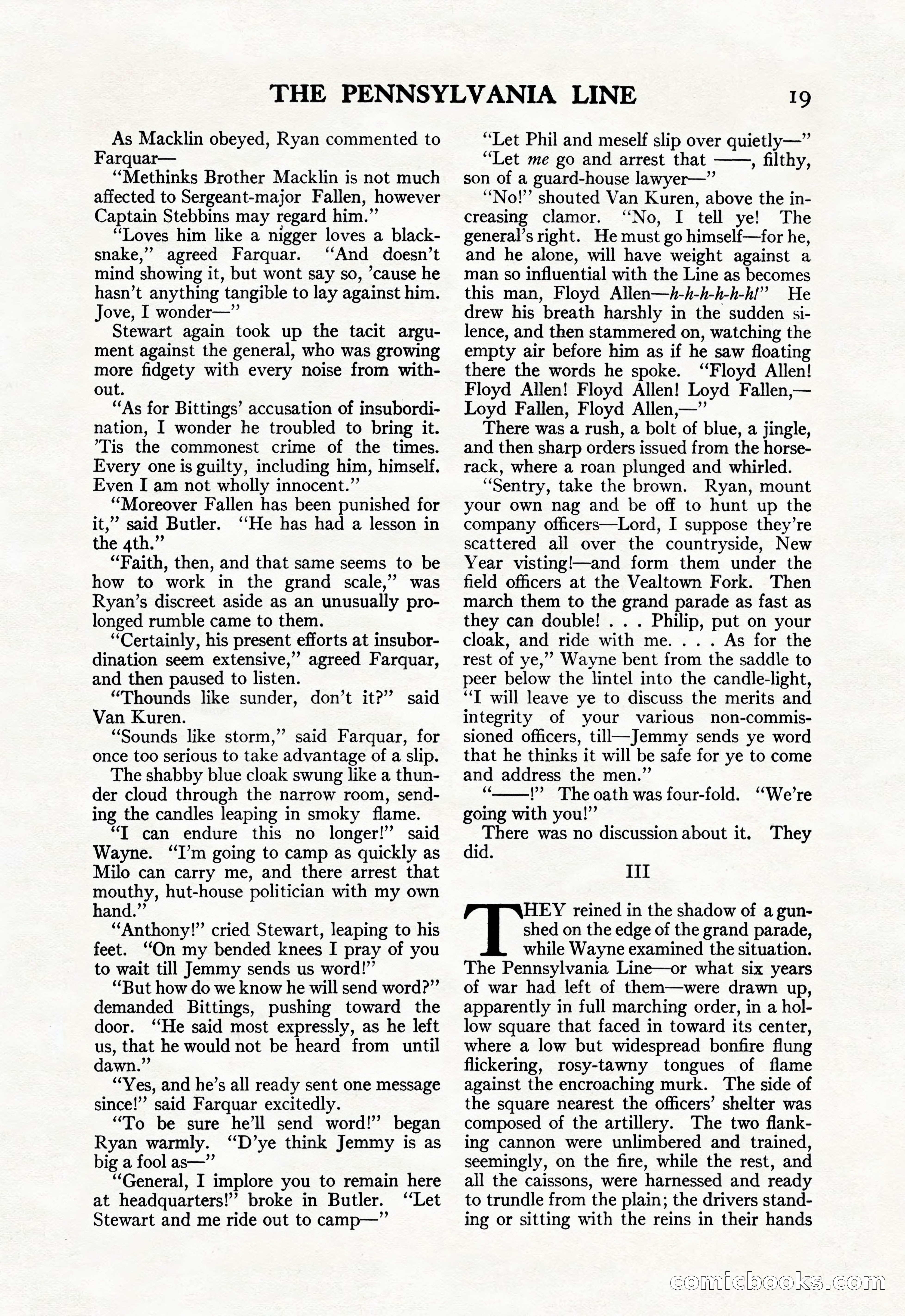
A restored page from Pulp Fiction, 1926. Page through the whole issue in the reader above.
📄 Transcribed text from this page (OCR, searchable)
Machine-transcribed from the original scan — historical spelling and the odd misread are preserved.
THE PENNSYLVANIA LINE As Macklin obeyed, Ryan commented to Farquar— “Methinks Brother Macklin is not much affected to Sergeant-major Fallen, however Captain Stebbins may regard him.”’ “Loves him like a nigger loves a black- snake,” agreed Farquar. ‘“‘And doesn’t mind showing it, but wont say so, ’cause he hasn’t anything tangible to lay against him. Jove, I wonder—”’ Stewart again took up the tacit argu- ment against the general, who was growing more fidgety with every noise from with- out. “As for Bittings’ accusation of insubordi- nation, I wonder he troubled to bring it. "Tis the commonest crime of the times. Every one is guilty, including him, himself. Even I am not wholly innocent.”’ “Moreover Fallen has been punished for it,” said Butler. ‘He has had a lesson in the 4th.” “Faith, then, and that same seems to be how to work in the grand scale,” was Ryan’s discreet aside as an unusually pro- longed rumble came to them. “Certainly, his present efforts at insubor- dination seem extensive,” agreed Farquar, and then paused to listen. “Thounds like sunder, don’t it?” said Van Kuren. “Sounds like storm,” said Farquar, for once too serious to take advantage of a slip. The shabby blue cloak swung like a thun- der cloud through the narrow room, send- ing the candles leaping in smoky flame. “T can endure this no longer!” said Wayne. “I’m going to camp as quickly as Milo can carry me, and there arrest that mouthy, hut-house politician with my own hand.” “Anthony!” cried Stewart, leaping to his feet. “On my bended knees I pray of you to wait till Jemmy sends us word!”’ “But how do we know he will send word?” demanded Bittings, pushing toward the door. ‘‘He said most expressly, as he left us, that he would not be heard from until dawn.” “Yes, and he’s all ready sent one message since!’’ said Farquar excitedly. “To be sure he’ll send word!’ began Ryan warmly. “D’ye think Jemmy is as big a fool as—”’ “General, I implore you to remain here at headquarters!” broke in Butler. ‘Let Stewart and me ride out to camp—”’ 2) 19 “Let Phil and meself slip over quietly—”’ “Let me go and arrest that , filthy, son of a guard-house lawyer—”’ ‘No!’ shouted Van Kuren, above the in- creasing clamor. “No, I tell ye! The general’s right. He must go himself—for he, and he alone, will have weight against a man so influential with the Line as becomes this man, Floyd Allen—h-h-h-h-h-h!l” He drew his breath harshly in the sudden si- lence, and then stammered on, watching the empty air before him as if he saw floating there the words he spoke. ‘Floyd Allen! Floyd Allen! Floyd Allen! Loyd Fallen,— Loyd Fallen, Floyd Allen,—” There was a rush, a bolt of blue, a jingle, and then sharp orders issued from the horse- rack, where a roan plunged and whirled. “Sentry, take the brown. Ryan, mount your own nag and be off to hunt up the company officers—Lord, I suppose they’re scattered all over the countryside, New Year visting!—and form them under the field officers at the Vealtown Fork. Then march them to the grand parade as fast as they can double! . . . Philip, put on your cloak, and ride with me. .. . As for the rest of ye,”” Wayne bent from the saddle to peer below the lintel into the candle-light, “T will leave ye to discuss the merits and integrity of your various non-commis- sioned officers, tilli—Jemmy sends ye word that he thinks it will be safe for ye to come and address the men.”’ “|? The oath was four-fold. “‘We’re going with you!” There was no discussion about it. They did. Iil HEY reined in the shadow of a gun- I shed on the edge of the grand parade, while Wayne examined the situation. The Pennsylvania Line—or what six years of war had left of them—were drawn up, apparently in full marching order, in a hol- low square that faced in toward its center, where a low but widespread bonfire flung flickering, rosy-tawny tongues of flame against the encroaching murk. The side of the square nearest the officers’ shelter was composed of the artillery. The two flank- ing cannon were unlimbered and trained, seemingly, on the fire, while the rest, and all the caissons, were harnessed and ready to trundle from the plain; the drivers stand- ing or sitting with the reins in their hands COMICLO© S CO