
Pulp Fiction, 1926 · page 20 of 212
Adventure Magazine Cover — page 20: what you’re looking at
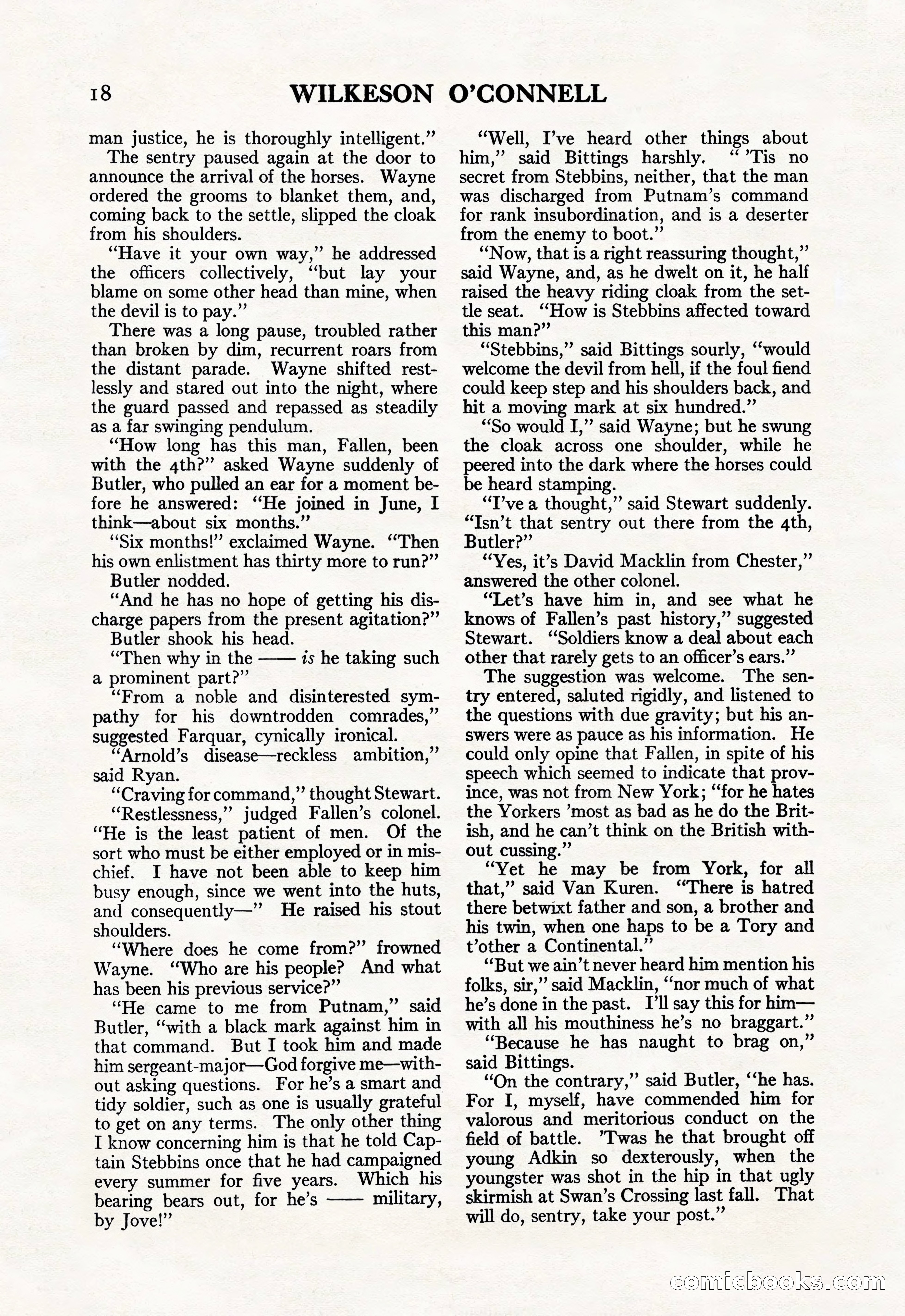
A restored page from Pulp Fiction, 1926. Page through the whole issue in the reader above.
📄 Transcribed text from this page (OCR, searchable)
Machine-transcribed from the original scan — historical spelling and the odd misread are preserved.
18 WILKESON man justice, he is thoroughly intelligent.” The sentry paused again at the door to announce the arrival of the horses. Wayne ordered the grooms to blanket them, and, coming back to the settle, slipped the cloak from his shoulders. “Have it your own way,” he addressed the officers collectively, “but lay your blame on some other head than mine, when the devil is to pay.” There was a long pause, troubled rather than broken by dim, recurrent roars from the distant parade. Wayne shifted rest- lessly and stared out into the night, where the guard passed and repassed as steadily as a far swinging pendulum. “How long has this man, Fallen, been with the 4th?” asked Wayne suddenly of Butler, who pulled an ear for a moment be- fore he answered: ‘He joined in June, I think—about six months.” ‘Six months!” exclaimed Wayne. “Then his own enlistment has thirty more to run?” Butler nodded. ‘“‘And he has no hope of getting his dis- charge papers from the present agitation?” Butler shook his head. “Then why in the a prominent part?” “From a noble and disinterested sym- pathy for his downtrodden comrades,” suggested Farquar, cynically ironical. “Arnold’s disease—reckless ambition,” said Ryan. “Craving for command,” thought Stewart. ‘“Restlessness,” judged Fallen’s colonel. “He is the least patient of men. Of the sort who must be either employed or in mis- chief. I have not been able to keep him busy enough, since we went into the huts, and consequently—” He raised his stout shoulders. ‘Where does he come from?” frowned Wayne. “Who are his people? And what has been his previous service?” ‘He came to me from Putnam,” said Butler, “with a black mark against him in that command. But I took him and made him sergeant-major—God forgive me—with- out asking questions. For he’s a smart and tidy soldier, such as one is usually grateful to get on any terms. The only other thing I know concerning him is that he told Cap- tain Stebbins once that he had campaigned every summer for five years. Which his bearing bears out, for he’s —— military, by Jove!” is he taking such O’CONNELL “Well, I’ve heard other things about him,” said Bittings harshly. “’Tis no secret from Stebbins, neither, that the man was discharged from Putnam’s command for rank insubordination, and is a deserter from the enemy to boot.” “Now, that is a right reassuring thought,”’ said Wayne, and, as he dwelt on it, he half raised the heavy riding cloak from the set- tle seat. “How is Stebbins affected toward this man?” “Stebbins,” said Bittings sourly, “would welcome the devil from hell, if the foul fiend could keep step and his shoulders back, and hit a moving mark at six hundred.” ‘So would I,” said Wayne; but he swung the cloak across one shoulder, while he peered into the dark where the horses could be heard stamping. “T’ve a thought,” said Stewart suddenly. “Isn’t that sentry out there from the 4th, Butler?” “Yes, it’s David Macklin from Chester,” answered the other colonel. “Let’s have him in, and see what he knows of Fallen’s past history,” suggested Stewart. ‘Soldiers know a deal about each other that rarely gets to an officer’s ears.” The suggestion was welcome. The sen- try entered, saluted rigidly, and listened to the questions with due gravity; but his an- swers were as pauce as his information. He could only opine that Fallen, in spite of his speech which seemed to indicate that prov- ince, was not from New York; “‘for he hates the Yorkers ’most as bad as he do the Brit- ish, and he can’t think on the British with- out cussing.” “Vet he may be from York, for all that,” said Van Kuren. “There is hatred there betwixt father and son, a brother and his twin, when one haps to be a Tory and t’other a Continental.” “But we ain’t never heard him mention his folks, sir,” said Macklin, ‘‘nor much of what he’s done in the past. I'll say this for him— with all his mouthiness he’s no braggart.”’ “Because he has naught to brag on,” said Bittings. “On the contrary,’’ said Butler, ‘‘he has. For I, myself, have commended him for valorous and meritorious conduct on the field of battle. "Twas he that brought off young Adkin so dexterously, when the youngster was shot in the hip in that ugly skirmish at Swan’s Crossing last fall. That will do, sentry, take your post.” COmiclbool CO