
Pulp Fiction, 1926 · page 191 of 212
Adventure Magazine Cover — page 191: what you’re looking at
A restored page from Pulp Fiction, 1926. Page through the whole issue in the reader above.
📄 Transcribed text from this page (OCR, searchable)
Machine-transcribed from the original scan — historical spelling and the odd misread are preserved.
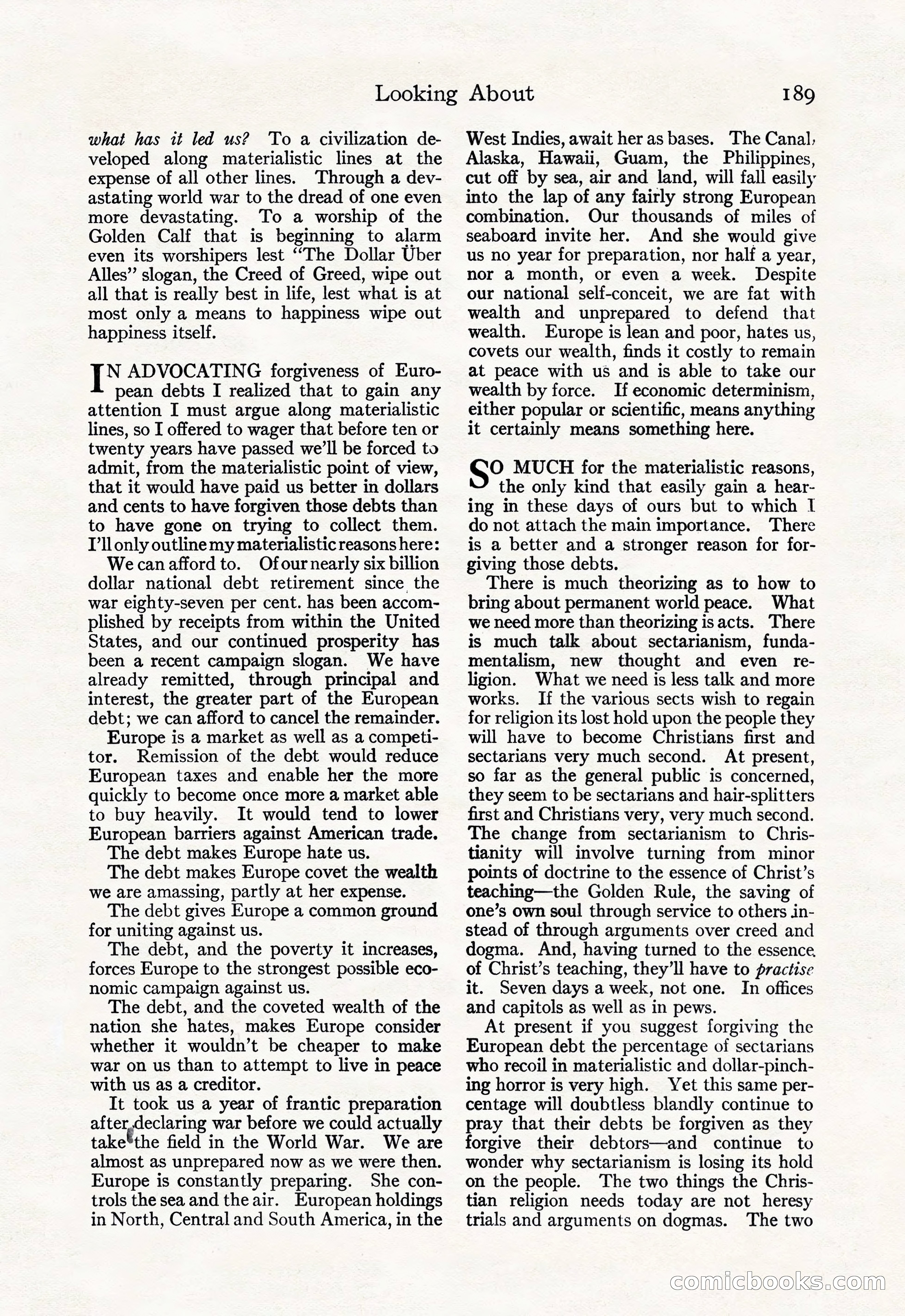
Looking About what has it led us? To a civilization de- veloped along materialistic lines at the expense of all other lines. Through a dev- astating world war to the dread of one even more devastating. To a worship of the Golden Calf that is beginning to alarm even its worshipers lest ‘““The Dollar Uber Alles” slogan, the Creed of Greed, wipe out all that is really best in life, lest what is at most only a means to happiness wipe out happiness itself. 1. ADVOCATING forgiveness of Euro- pean debts I realized that to gain any attention I must argue along materialistic lines, so I offered to wager that before ten or twenty years have passed we’ll be forced to admit, from the materialistic point of view, that it would have paid us better in dollars and cents to have forgiven those debts than to have gone on trying to collect them. T’llonly outline my materialistic reasons here: We can afford to. Ofournearly six billion dollar national debt retirement since the war eighty-seven per cent. has been accom- plished by receipts from within the United States, and our continued prosperity has been a recent campaign slogan. We have already remitted, through principal and interest, the greater part of the European debt; we can afford to cancel the remainder. Europe is a market as well as a competi- tor. Remission of the debt would reduce European taxes and enable her the more quickly to become once more a market able to buy heavily. It would tend to lower European barriers against American trade. The debt makes Europe hate us. The debt makes Europe covet the wealth we are amassing, partly at her expense. The debt gives Europe a common ground for uniting against us. The debt, and the poverty it increases, forces Europe to the strongest possible eco- nomic campaign against us. The debt, and the coveted wealth of the nation she hates, makes Europe consider whether it wouldn’t be cheaper to make war on us than to attempt to live in peace with us as a creditor. It took us a year of frantic preparation after.declaring war before we could actually take*the field in the World War. We are almost as unprepared now as we were then. Europe is constantly preparing. She con- trols the sea and the air. European holdings in North, Central and South America, in the 189 West Indies, await her as bases. The Canal, Alaska, Hawaii, Guam, the Philippines, cut off by sea, air and land, will fall easily into the lap of any fairly strong European combination. Our thousands of miles of seaboard invite her. And she would give us no year for preparation, nor half a year, nor a month, or even a week. Despite our national self-conceit, we are fat with wealth and unprepared to defend that wealth. Europe is lean and poor, hates us, covets our wealth, finds it costly to remain at peace with us and is able to take our wealth by force. If economic determinism, either popular or scientific, means anything it certainly means something here. O MUCH for the materialistic reasons, the only kind that easily gain a hear- ing in these days of ours but to which I do not attach the main importance. There is a better and a stronger reason for for- giving those debts. There is much theorizing as to how to bring about permanent world peace. What we need more than theorizing is acts. There is much talk about sectarianism, funda- mentalism, new thought and even re- ligion. What we need is less talk and more works. If the various sects wish to regain for religion its lost hold upon the people they will have to become Christians first and sectarians very much second. At present, so far as the general public is concerned, they seem to be sectarians and hair-splitters first and Christians very, very much second. The change from sectarianism to Chris- tianity will involve turning from minor points of doctrine to the essence of Christ’s teaching—the Golden Rule, the saving of one’s own soul through service to others .in- stead of through arguments over creed and dogma. And, having turned to the essence. of Christ’s teaching, they’ll have to practise it. Seven days a week, not one. In offices and capitols as well as in pews. At present if you suggest forgiving the European debt the percentage of sectarians who recoil in materialistic and dollar-pinch- ing horror is very high. Yet this same per- centage will doubtless blandly continue to pray that their debts be forgiven as they forgive their debtors—and continue to wonder why sectarianism is losing its hold on the people. The two things the Chris- tian religion needs today are not heresy trials and arguments on dogmas. The two CORMICLO© S CO