
Pulp Fiction, 1926 · page 190 of 212
Adventure Magazine Cover — page 190: what you’re looking at
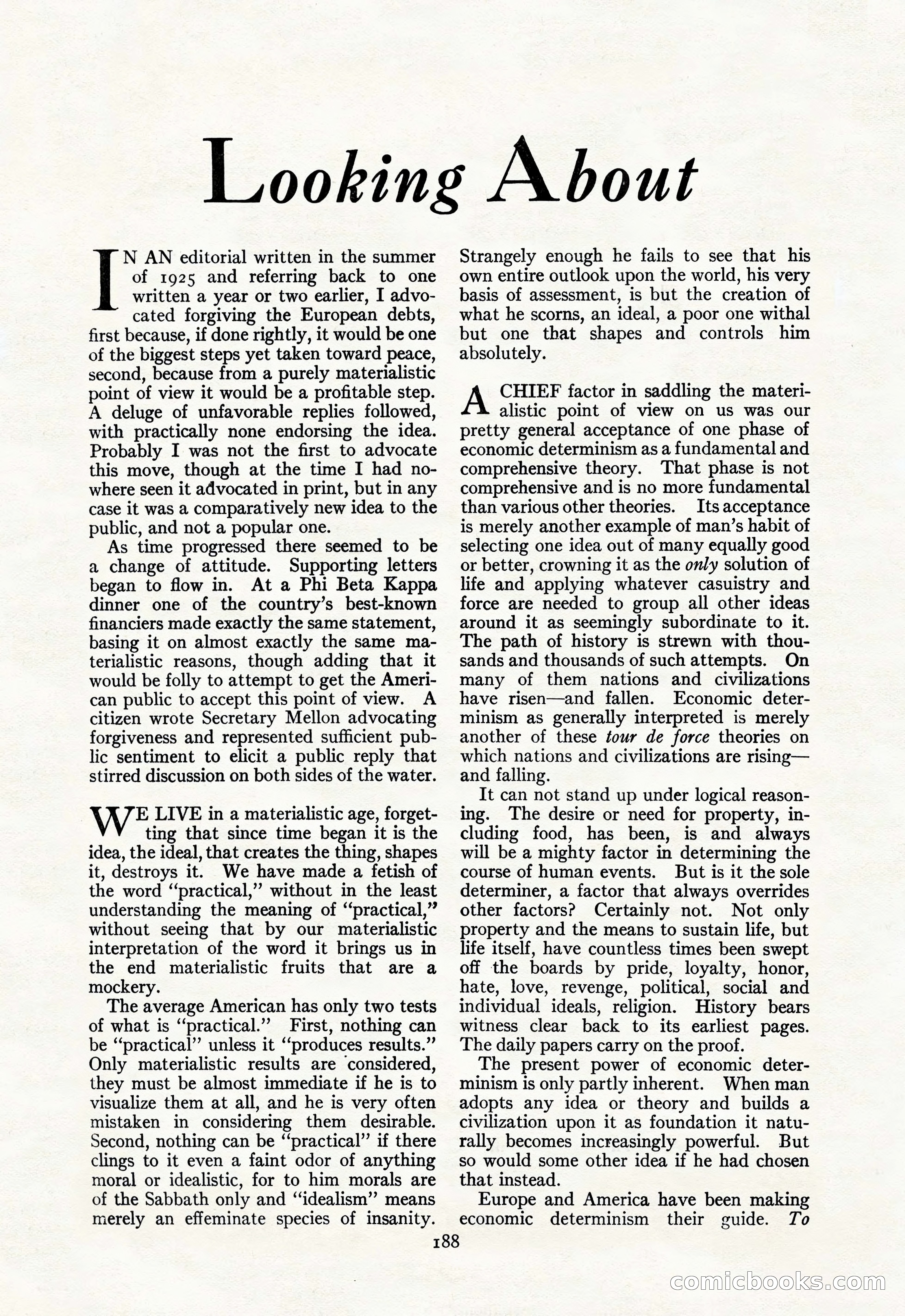
A restored page from Pulp Fiction, 1926. Page through the whole issue in the reader above.
📄 Transcribed text from this page (OCR, searchable)
Machine-transcribed from the original scan — historical spelling and the odd misread are preserved.
Looking A bout N AN editorial written in the summer of 1925 and referring back to one written a year or two earlier, I advo- cated forgiving the European debts, first because, if done rightly, it would be one of the biggest steps yet taken toward peace, second, because from a purely materialistic point of view it would be a profitable step. A deluge of unfavorable replies followed, with practically none endorsing the idea. Probably I was not the first to advocate this move, though at the time I had no- where seen it advocated in print, but in any case it was a comparatively new idea to the public, and not a popular one. As time progressed there seemed to be a change of attitude. Supporting letters began to flow in. At a Phi Beta Kappa dinner one of the country’s best-known financiers made exactly the same statement, basing it on almost exactly the same ma- terialistic reasons, though adding that it would be folly to attempt to get the Ameri- can public to accept this point of view. A citizen wrote Secretary Mellon advocating forgiveness and represented sufficient pub- lic sentiment to elicit a public reply that stirred discussion on both sides of the water. WE LIVE in a materialistic age, forget- ting that since time began it is the idea, the ideal, that creates the thing, shapes it, destroys it. We have made a fetish of the word ‘“‘practical,’’ without in the least understanding the meaning of “practical,” without seeing that by our materialistic interpretation of the word it brings us in the end materialistic fruits that are a mockery. The average American has only two tests of what is “practical.” First, nothing can be “‘practical’’ unless it “‘produces results.” Only materialistic results are considered, they must be almost immediate if he is to visualize them at all, and he is very often mistaken in considering them desirable. Second, nothing can be “‘practical”’ if there clings to it even a faint odor of anything moral or idealistic, for to him morals are of the Sabbath only and ‘“‘idealism”’ means merely an effeminate species of insanity. Strangely enough he fails to see that his own entire outlook upon the world, his very basis of assessment, is but the creation of what he scorns, an ideal, a poor one withal but one that shapes and controls him absolutely. CHIEF factor in saddling the materi- alistic point of view on us was our pretty general acceptance of one phase of economic determinism as a fundamental and comprehensive theory. That phase is not comprehensive and is no more fundamental than various other theories. Its acceptance is merely another example of man’s habit of selecting one idea out of many equally good or better, crowning it as the only solution of life and applying whatever casuistry and force are needed to group all other ideas around it as seemingly subordinate to it. The path of history is strewn with thou- sands and thousands of such attempts. On many of them nations and civilizations have risen—and fallen. Economic deter- minism as generally interpreted is merely another of these tour de force theories on which nations and civilizations are rising— and falling. It can not stand up under logical reason- ing. The desire or need for property, in- cluding food, has been, is and always will be a mighty factor in determining the course of human events. But is it the sole determiner, a factor that always overrides other factors? Certainly not. Not only property and the means to sustain life, but life itself, have countless times been swept off the boards by pride, loyalty, honor, hate, love, revenge, political, social and individual ideals, religion. History bears witness clear back to its earliest pages. The daily papers carry on the proof. The present power of economic deter- minism is only partly inherent. When man adopts any idea or theory and builds a civilization upon it as foundation it natu- rally becomes increasingly powerful. But so would some other idea if he had chosen that instead. Europe and America have been making economic determinism their guide. To 188 COMICLOOO S CO