
Pulp Fiction, 1926 · page 18 of 212
Adventure Magazine Cover — page 18: what you’re looking at
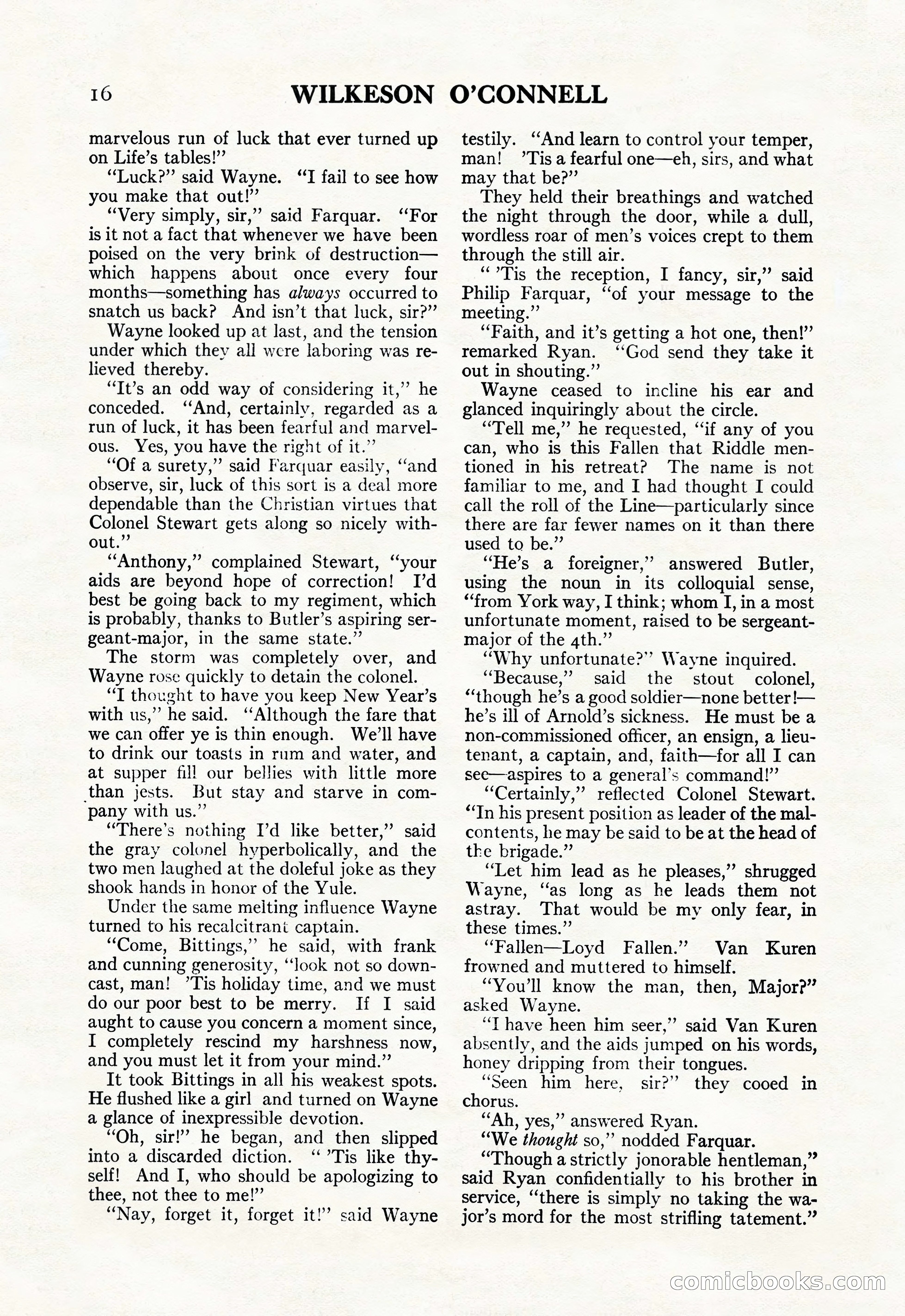
A restored page from Pulp Fiction, 1926. Page through the whole issue in the reader above.
📄 Transcribed text from this page (OCR, searchable)
Machine-transcribed from the original scan — historical spelling and the odd misread are preserved.
16 WILKESON marvelous run of luck that ever turned up on Life’s tables!” “Luck?” said Wayne. “T fail to see how you make that out!” “Very simply, sir,” said Farquar. ‘For is it not a fact that whenever we have been poised on the very brink of destruction— which happens about once every four months—something has always occurred to snatch us back? And isn’t that luck, sir?” Wayne looked up at last, and the tension under which thev all were laboring was re- lieved thereby. “It’s an odd way of considering it,’ he conceded. ‘And, certainly, regarded as a run of luck, it has been fearful and marvel- ous. Yes, you have the right of it.” “Of a surety,” said Farquar easily, ‘and observe, sir, luck of this sort is a deal more dependable than the Christian virtues that Colonel Stewart gets along so nicely with- out.” “Anthony,” complained Stewart, “your aids are beyond hope of correction! I’d best be going back to my regiment, which is probably, thanks to Butler’s aspiring ser- geant-major, in the same state.” The storm was completely over, and Wayne rose quickly to detain the colonel. “T thought to have you keep New Year’s with us,” he said. ‘Although the fare that we can offer ye is thin enough. We'll have to drink our toasts in rum and water, and at supper fil! our bellies with little more than jests. But stay and starve in com- pany with us.” “There’s nothing I’d like better,” said the gray colonel hyperbolically, and the two men laughed at the doleful joke as they shook hands in honor of the Yule. Under the same melting influence Wayne turned to his recalcitrant captain. “Come, Bittings,’ he said, with frank and cunning generosity, “look not so down- cast, man! ’Tis holiday time, and we must do our poor best to be merry. If I said aught to cause you concern a moment since, I completely rescind my harshness now, and you must let it from your mind.” It took Bittings in all his weakest spots. He flushed like a girl and turned on Wayne a glance of inexpressible devotion. “Oh, sir!’ he began, and then slipped into a discarded diction. ‘‘’Tis like thy- self! And I, who should be apologizing to thee, not thee to me!”’ “Nay, forget it, forget it!’ said Wayne O’CONNELL testily. “And learn to control your temper, man! ’Tisa fearful one—eh, sirs, and what may that be?” They held their breathings and watched the night through the door, while a dull, wordless roar of men’s voices crept to them through the still air. “°Tis the reception, I fancy, sir,” said Philip Farquar, “of your message to the meeting.” “Faith, and it’s getting a hot one, then!” remarked Ryan. ‘‘God send they take it out in shouting.” Wayne ceased to incline his ear and glanced inquiringly about the circle. ‘Tell me,” he requested, “‘if any of you can, who is this Fallen that Riddle men- tioned in his retreat? The name is not familiar to me, and I had thought I could call the roll of the Line—particularly since there are far fewer names on it than there used to be.” ““He’s a foreigner,’ answered Butler, using the noun in its colloquial sense, “from York way, I think; whom I, in a most unfortunate moment, raised to be sergeant- major of the 4th.” “Why unfortunate?” Wayne inquired. “Because,” said the stout colonel, “though he’s a good soldier—none better !— he’s ill of Arnold’s sickness. He must be a non-commissioned officer, an ensign, a lieu- tenant, a captain, and, faith—for all I can see—aspires to a general’s command!”’ “Certainly,” reflected Colonel Stewart. “In his present position as leader of the mal- contents, he may be said to be at the head of the brigade.” ‘“‘Let him lead as he pleases,” shrugged Wayne, “as long as he leads them not astray. That would be my only fear, in these times.” “Fallen—Loyd Fallen.” Van Kuren frowned and muttered to himself. “You'll know the man, then, Major?” asked Wayne. ‘“T have heen him seer,” said Van Kuren absently, and the aids jumped on his words, honey dripping from their tongues. “Seen him here, sir?” they cooed in chorus. ‘Ah, yes,” answered Ryan. “We thought so,” nodded Farquar. “Though a strictly jonorable hentleman,” said Ryan confidentially to his brother in service, “there is simply no taking the wa- jor’s mord for the most strifling tatement.” b) COmiclbooks CO