
Pulp Fiction, 1926 · page 17 of 212
Adventure Magazine Cover — page 17: what you’re looking at
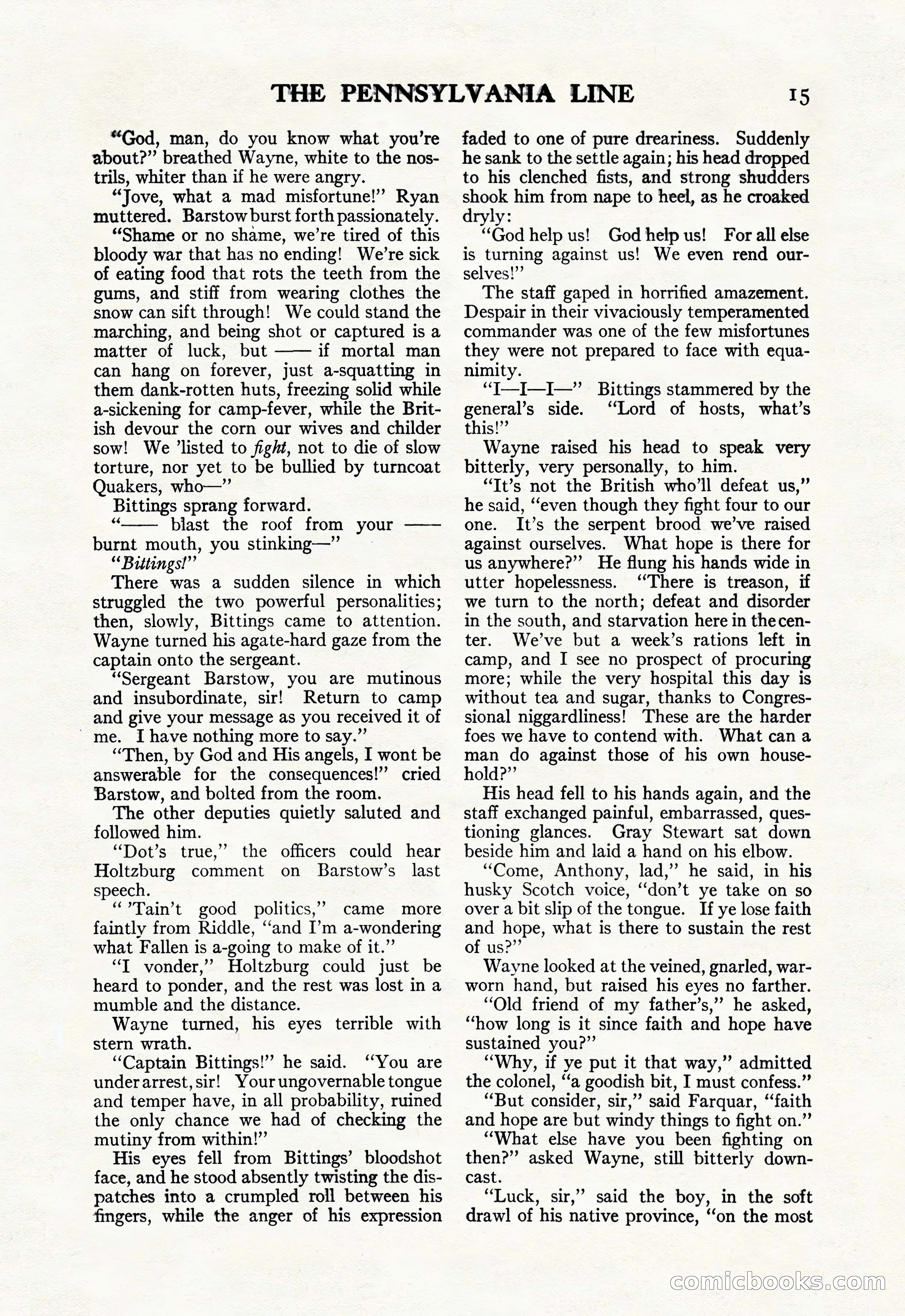
A restored page from Pulp Fiction, 1926. Page through the whole issue in the reader above.
📄 Transcribed text from this page (OCR, searchable)
Machine-transcribed from the original scan — historical spelling and the odd misread are preserved.
THE PENNSYLVANIA LINE “God, man, do you know what you’re about?” breathed Wayne, white to the nos- trils, whiter than if he were angry. “Jove, what a mad misfortune!”’ Ryan muttered. Barstow burst forth passionately. “Shame or no shame, we’re tired of this bloody war that has no ending! We’re sick of eating food that rots the teeth from the gums, and stiff from wearing clothes the snow can sift through! We could stand the marching, and being shot or captured is a matter of luck, but if mortal man can hang on forever, just a-squatting in them dank-rotten huts, freezing solid while a-sickening for camp-fever, while the Brit- ish devour the corn our wives and childer sow! We ’listed to fight, not to die of slow torture, nor yet to be bullied by turncoat Quakers, who—’”’ Bittings sprang forward. “_____ blast the roof from your —— burnt mouth, you stinking—” “Bittings!”’ There was a sudden silence in which struggled the two powerful personalities; then, slowly, Bittings came to attention. Wayne turned his agate-hard gaze from the captain onto the sergeant. “Sergeant Barstow, you are mutinous and insubordinate, sir! Return to camp and give your message as you received it of ~me. I have nothing more to say.” “Then, by God and His angels, I wont be answerable for the consequences!” cried Barstow, and bolted from the room. The other deputies quietly saluted and followed him. “Dot’s true,” the officers could hear Holtzburg comment on Barstow’s last speech. “°?Tain’t good politics,’ came more faintly from Riddle, “and I’m a-wondering what Fallen is a-going to make of it.”’ “T vonder,”’ Holtzburg could just be heard to ponder, and the rest was lost in a mumble and the distance. Wayne turned, his eyes terrible with stern wrath. “Captain Bittings!”’ he said. “You are underarrest, sir! Yourungovernable tongue and temper have, in all probability, ruined the only chance we had of checking the mutiny from within!”’ His eyes fell from Bittings’ bloodshot face, and he stood absently twisting the dis- patches into a crumpled roll between his fingers, while the anger of his expression I5 faded to one of pure dreariness. Suddenly he sank to the settle again; his head dropped to his clenched fists, and strong shudders shook him from nape to heel, as he croaked dryly: “God help us! God help us! For all else is turning against us! We even rend our- selves!” The staff gaped in horrified amazement. Despair in their vivaciously temperamented commander was one of the few misfortunes they were not prepared to face with equa- nimity. ‘““T—J—I—” Bittings stammered by the general’s side. “Lord of hosts, what’s this!” Wayne raised his head to speak very bitterly, very personally, to him. “It’s not the British who'll defeat us,” he said, “even though they fight four to our one. It’s the serpent brood we’ve raised against ourselves. What hope is there for us anywhere?” He flung his hands wide in utter hopelessness. ‘“There is treason, if we turn to the north; defeat and disorder in the south, and starvation here in thecen- ter. We’ve but a week’s rations left in camp, and I see no prospect of procuring more; while the very hospital this day is without tea and sugar, thanks to Congres- sional niggardliness! These are the harder foes we have to contend with. What cana man do against those of his own house- hold?”’ His head fell to his hands again, and the staff exchanged painful, embarrassed, ques- tioning glances. Gray Stewart sat down beside him and laid a hand on his elbow. “Come, Anthony, lad,” he said, in his husky Scotch voice, “don’t ye take on so over a bit slip of the tongue. If ye lose faith and hope, what is there to sustain the rest of us?” Wayne looked at the veined, gnarled, war- worn hand, but raised his eyes no farther. “Old friend of my father’s,” he asked, “how long is it since faith and hope have sustained you?” “Why, if ye put it that way,” admitted the colonel, “‘a goodish bit, I must confess.” “But consider, sir,” said Farquar, “faith and hope are but windy things to fight on.” “What else have you been fighting on then?” asked Wayne, still bitterly down- cast. “Luck, sir,’ said the boy, in the soft drawl of his native province, ‘“‘on the most COMMICLOO© <S) CO