
Pulp Fiction, 1926 · page 11 of 212
Adventure Magazine Cover — page 11: what you’re looking at
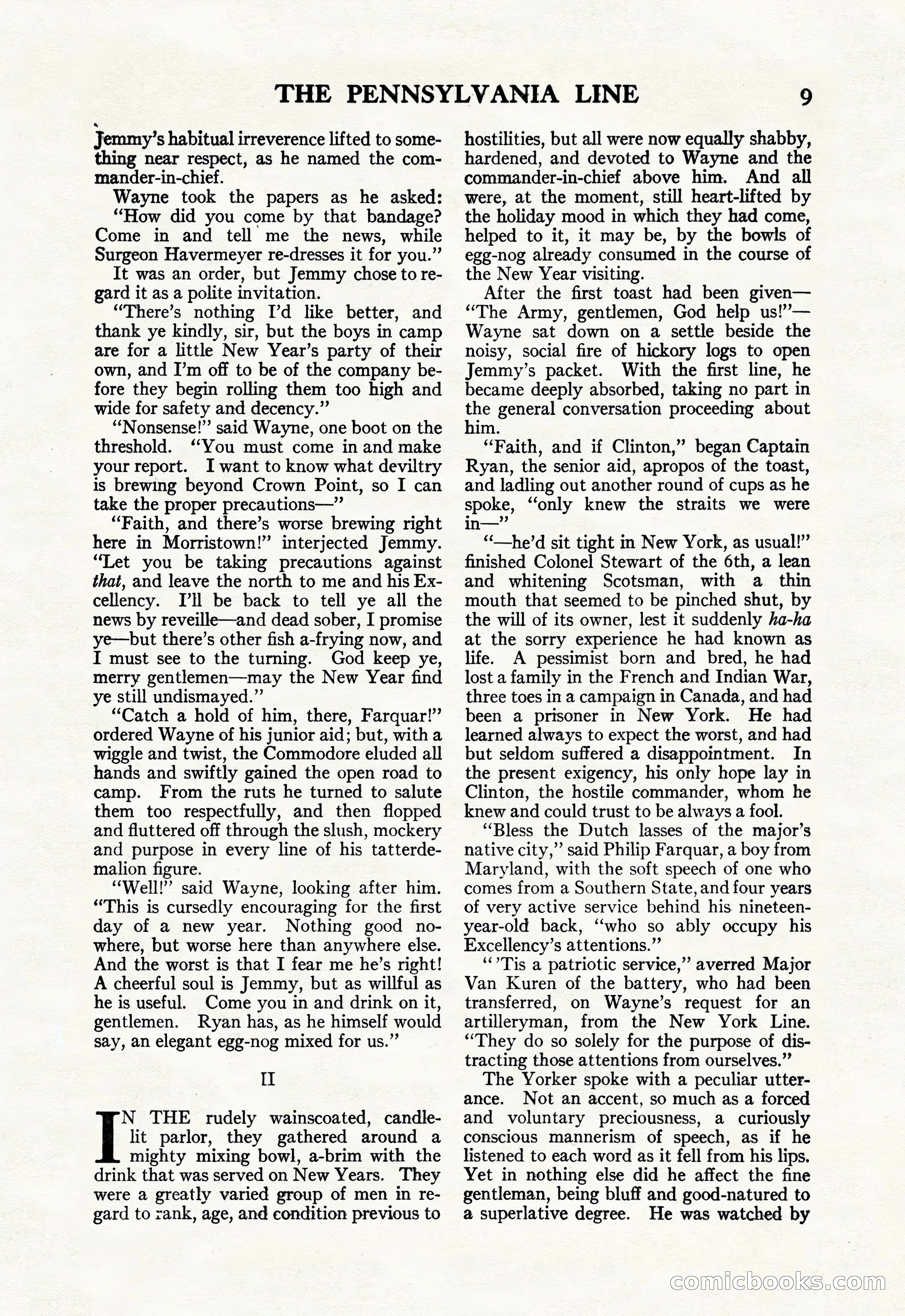
A restored page from Pulp Fiction, 1926. Page through the whole issue in the reader above.
📄 Transcribed text from this page (OCR, searchable)
Machine-transcribed from the original scan — historical spelling and the odd misread are preserved.
THE PENNSYLVANIA LINE 9 Jemmy’s habitual irreverence lifted to some- thing near respect, as he named the com- mander-in-chief. Wayne took the papers as he asked: “How did you come by that bandage? Come in and tell me the news, while Surgeon Havermeyer re-dresses it for you.” It was an order, but Jemmy chose to re- gard it as a polite invitation. “There’s nothing I’d like better, and thank ye kindly, sir, but the boys in camp are for a little New Year’s party of their own, and I’m off to be of the company be- fore they begin rolling them too high and wide for safety and decency.” ‘“‘Nonsense!”’ said Wayne, one boot on the threshold. ‘‘You must come in and make your report. I want to know what deviltry is brewing beyond Crown Point, so I can take the proper precautions—”’ “Faith, and there’s worse brewing right here in Morristown!” interjected Jemmy. “Let you be taking precautions against that, and leave the north to me and his Ex- cellency. Il be back to tell ye all the news by reveille—and dead sober, I promise ye—but there’s other fish a-frying now, and I must see to the turning. God keep ye, merry gentlemen—may the New Year find ye still undismayed.”’ “Catch a hold of him, there, Farquar!’’ ordered Wayne of his junior aid; but, witha wiggle and twist, the Commodore eluded all hands and swiftly gained the open road to camp. From the ruts he turned to salute them too respectfully, and then flopped and fluttered off through the slush, mockery and purpose in every line of his tatterde- malion figure. ‘Well!’ said Wayne, looking after him. “This is cursedly encouraging for the first day of a new year. Nothing good no- where, but worse here than anywhere else. And the worst is that I fear me he’s right! A cheerful soul is Jemmy, but as willful as he is useful. Come you in and drink on it, gentlemen. Ryan has, as he himself would say, an elegant egg-nog mixed for us.” IT lit parlor, they gathered around a mighty mixing bowl, a-brim with the drink that was served on New Years. They were 2 greatly varied group of men in re- gard to rank, age, and condition previous to T: THE rudely wainscoated, candle- hostilities, but all were now equally shabby, hardened, and devoted to Wayne and the commander-in-chief above him. And all were, at the moment, still heart-lifted by the holiday mood in which they had come, helped to it, it may be, by the bowls of egg-nog already consumed in the course of the New Year visiting. After the first toast had been given— “The Army, gentlemen, God help us!’’— Wayne sat down on a settle beside the noisy, social fire of hickory logs to open Jemmy’s packet. With the first line, he became deeply absorbed, taking no part in the general conversation proceeding about him. “Faith, and if Clinton,” began Captain Ryan, the senior aid, apropos of the toast, and ladling out another round of cups as he spoke, “‘only knew the straits we were in—” “‘__he’d sit tight in New York, as usual!”’ finished Colonel Stewart of the 6th, a lean and whitening Scotsman, with a thin mouth that seemed to be pinched shut, by the will of its owner, lest it suddenly ha-ha at the sorry experience he had known as life. A pessimist born and bred, he had lost a family in the French and Indian War, three toes in a campaign in Canada, and had been a prisoner in New York. He had learned always to expect the worst, and had but seldom suffered a disappointment. In the present exigency, his only hope lay in Clinton, the hostile commander, whom he knew and could trust to be always a fool. “Bless the Dutch lasses of the major’s native city,” said Philip Farquar, a boy from Maryland, with the soft speech of one who comes from a Southern State, and four years of very active service behind his nineteen- year-old back, “‘who so ably occupy his Excellency’s attentions.” ‘“°Tis a patriotic service,” averred Major Van Kuren of the battery, who had been transferred, on Wayne’s request for an artilleryman, from the New York Line. “They do so solely for the purpose of dis- tracting those attentions from ourselves.” The Yorker spoke with a peculiar utter- ance. Not an accent, so much as a forced and voluntary preciousness, a curiously conscious mannerism of speech, as if he listened to each word as it fell from his lips. Yet in nothing else did he affect the fine gentleman, being bluff and good-natured to a superlative degree. He was watched by Gomicsoo S CO