
Pulp Fiction, 1926 · page 10 of 212
Adventure Magazine Cover — page 10: what you’re looking at
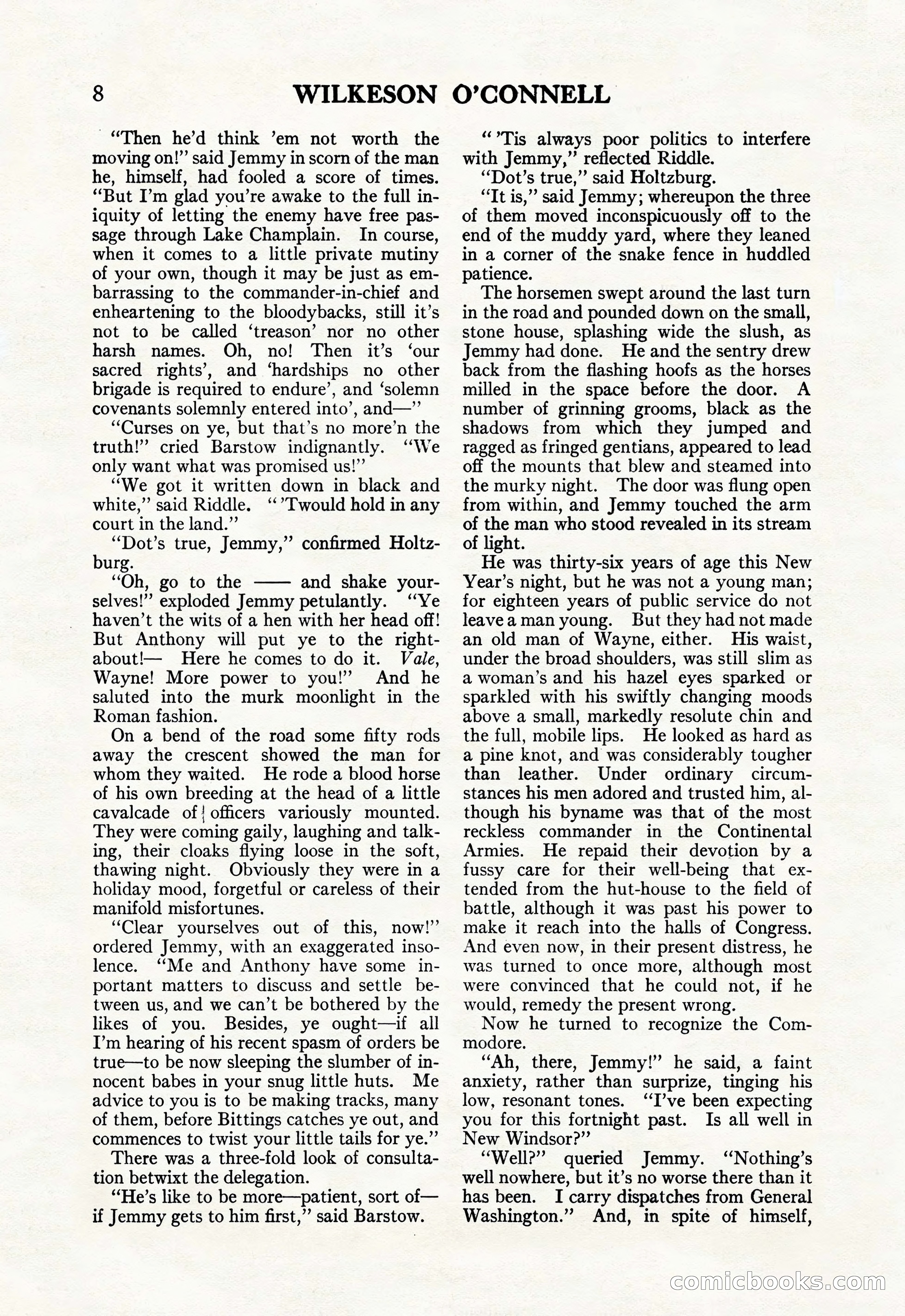
A restored page from Pulp Fiction, 1926. Page through the whole issue in the reader above.
📄 Transcribed text from this page (OCR, searchable)
Machine-transcribed from the original scan — historical spelling and the odd misread are preserved.
8 WILKESON “Then he’d think ’em not worth the moving on!” said Jemmy in scorn of the man he, himself, had fooled a score of times. “But I’m glad you’re awake to the full in- iquity of letting the enemy have free pas- sage through Lake Champlain. In course, when it comes to a little private mutiny of your own, though it may be just as em- barrassing to the commander-in-chief and enheartening to the bloodybacks, still it’s not to be called ‘treason’ nor no other harsh names. Oh, no! Then it’s ‘our sacred rights’, and ‘hardships no other brigade is required to endure’, and ‘solemn covenants solemnly entered into’, and—”’ “Curses on ye, but that’s no more’n the truth!” cried Barstow indignantly. ‘We only want what was promised us!”’ ‘We got it written down in black and white,” said Riddle. “’Twould hold in any court in the land.”’ “Dot’s true, Jemmy,” confirmed Holtz- burg. “Oh, go to the —— and shake your- selves!’ exploded Jemmy petulantly. ‘Ye haven’t the wits of a hen with her head off! But Anthony will put ye to the right- about!— Here he comes to do it. Vale, Wayne! More power to you!’ And he saluted into the murk moonlight in the Roman fashion. On a bend of the road some fifty rods away the crescent showed the man for whom they waited. He rode a blood horse of his own breeding at the head of a little cavalcade of! officers variously mounted. They were coming gaily, laughing and talk- ing, their cloaks flying loose in the soft, thawing night. Obviously they were in a holiday mood, forgetful or careless of their manifold misfortunes. “Clear yourselves out of this, now ordered Jemmy, with an exaggerated inso- lence. ‘‘Me and Anthony have some in- portant matters to discuss and settle be- tween us, and we can’t be bothered by the likes of you. Besides, ye ought—if all I’m hearing of his recent spasm of orders be true—to be now sleeping the slumber of in- nocent babes in your snug little huts. Me advice to you is to be making tracks, many of them, before Bittings catches ye out, and commences to twist your little tails for ye.”’ There was a three-fold look of consulta- tion betwixt the delegation. “‘He’s like to be more—patient, sort of— if Jemmy gets to him first,”’ said Barstow. !?? O’CONNELL “°*Tis always poor politics to interfere with Jemmy,” reflected Riddle. “Dot’s true,” said Holtzburg. “It is,’ said Jemmy; whereupon the three of them moved inconspicuously off to the end of the muddy yard, where they leaned in a corner of the snake fence in huddled patience. The horsemen swept around the last turn in the road and pounded down on the small, stone house, splashing wide the slush, as Jemmy had done. He and the sentry drew back from the flashing hoofs as the horses milled in the space before the door. A number of grinning grooms, black as the shadows from which they jumped and ragged as fringed gentians, appeared to lead off the mounts that blew and steamed into the murky night. The door was flung open from within, and Jemmy touched the arm of the man who stood revealed in its stream of light. He was thirty-six years of age this New Year’s night, but he was not a young man; for eighteen years of public service do not leavea man young. But they had not made an old man of Wayne, either. His waist, under the broad shoulders, was still slim as a woman’s and his hazel eyes sparked or sparkled with his swiftly changing moods above a small, markedly resolute chin and the full, mobile lips. He looked as hard as a pine knot, and was considerably tougher than leather. Under ordinary circum- stances his men adored and trusted him, al- though his byname was that of the most reckless commander in the Continental Armies. He repaid their devotion by a fussy care for their well-being that ex- tended from the hut-house to the field of battle, although it was past his power to make it reach into the halls of Congress. And even now, in their present distress, he was turned to once more, although most were convinced that he could not, if he would, remedy the present wrong. Now he turned to recognize the Com- modore. “Ah, there, Jemmy!” he said, a faint anxiety, rather than surprize, tinging his low, resonant tones. “I’ve been expecting you for this fortnight past. Is all well in New Windsor?” “Well?” queried Jemmy. “Nothing’s well nowhere, but it’s no worse there than it has been. I carry dispatches from General Washington.” And, in spite of himself, COMICLOO <S) CO