
Pulp Fiction, 1926 · page 59 of 232
Adventure Magazine Cover — page 59: what you’re looking at
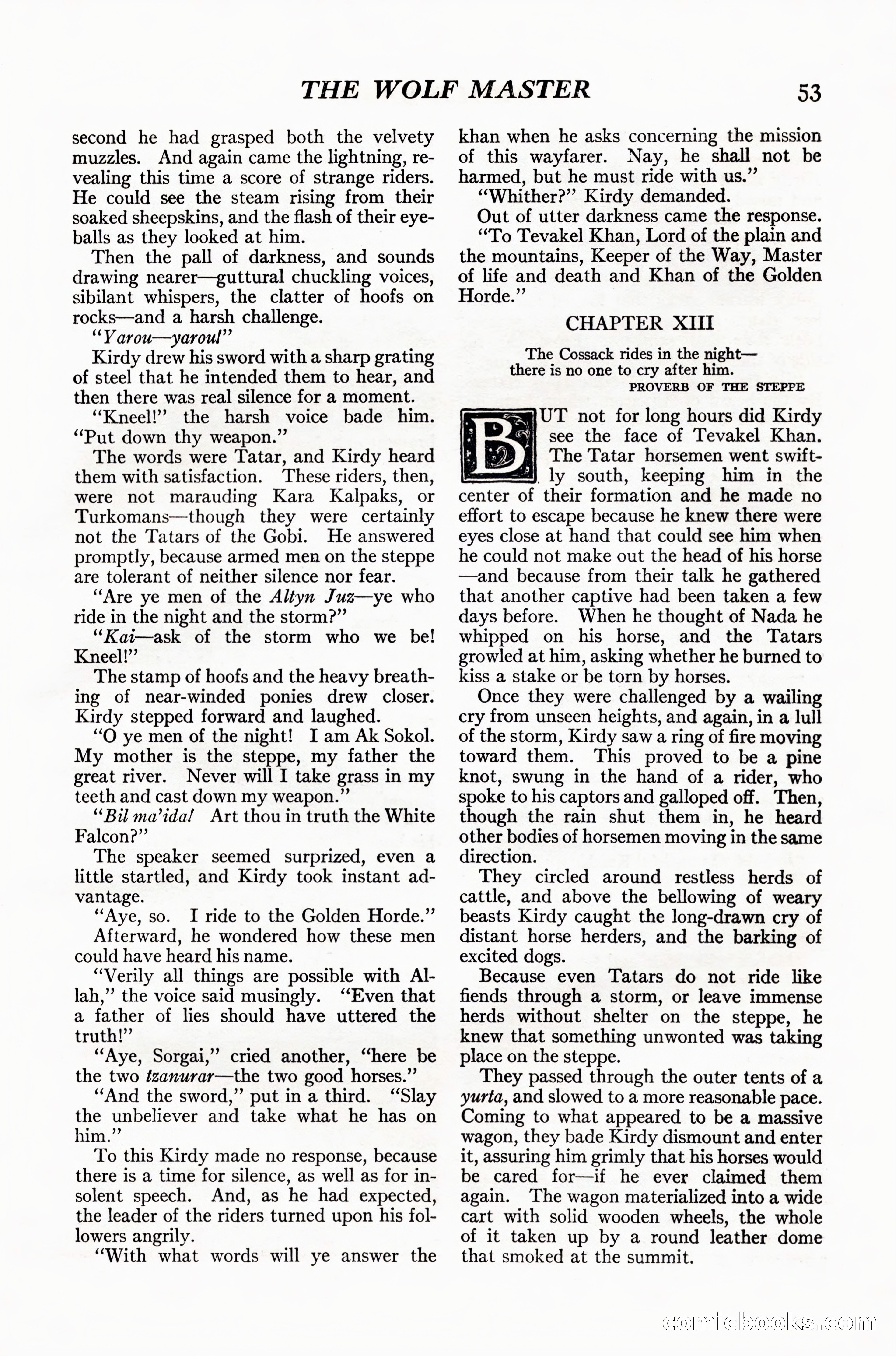
A restored page from Pulp Fiction, 1926. Page through the whole issue in the reader above.
📄 Transcribed text from this page (OCR, searchable)
Machine-transcribed from the original scan — historical spelling and the odd misread are preserved.
THE WOLF MASTER 53 second he had grasped both the velvety muzzles. And again came the lightning, re- vealing this time a score of strange riders. He could see the steam rising from their soaked sheepskins, and the flash of their eye- balls as they looked at him. Then the pall of darkness, and sounds drawing nearer—guttural chuckling voices, sibilant whispers, the clatter of hoofs on rocks—and a harsh challenge. “YVarou—yaroul”’ Kirdy drew his sword with a sharp grating of steel that he intended them to hear, and then there was real silence for a moment. “Kneel!”? the harsh voice bade him. “Put down thy weapon.” The words were Tatar, and Kirdy heard them with satisfaction. These riders, then, were not marauding Kara Kalpaks, or Turkomans—though they were certainly not the Tatars of the Gobi. He answered promptly, because armed men on the steppe are tolerant of neither silence nor fear. “Are ye men of the Altyn Juz—ye who ride in the night and the storm?” ““Kai—ask of the storm who we be! Kneel!”’ The stamp of hoofs and the heavy breath- ing of near-winded ponies drew closer. Kirdy stepped forward and laughed. “O ye men of the night! I am Ak Sokol. My mother is the steppe, my father the great river. Never will I take grass in my teeth and cast down my weapon.”’ “Bil maida! Art thou in truth the White Falcon?” The speaker seemed surprized, even a little startled, and Kirdy took instant ad- vantage. “Aye, so. I ride to the Golden Horde.” Afterward, he wondered how these men could have heard his name. “Verily all things are possible with Al- lah,” the voice said musingly. ‘‘Even that a father of lies should have uttered the truth!” ‘“‘Aye, Sorgai,” cried another, “here be the two /zanurar—the two good horses.”’ ‘“‘And the sword,” put ina third. “Slay the unbeliever and take what he has on him.” To this Kirdy made no response, because there is a time for silence, as well as for in- solent speech. And, as he had expected, the leader of the riders turned upon his fol- lowers angrily. “With what words will ye answer the khan when he asks concerning the mission of this wayfarer. Nay, he shall not be harmed, but he must ride with us.” “Whither?” Kirdy demanded. Out of utter darkness came the response. “To Tevakel Khan, Lord of the plain and the mountains, Keeper of the Way, Master of life and death and Khan of the Golden Horde.” CHAPTER XIII The Cossack rides in the night— there is no one to cry after him. PROVERB OF THE STEPPE aq) UT not for long hours did Kirdy see the face of Tevakel Khan. The Tatar horsemen went swift- #4) ly south, keeping him in the center of their formation and he made no effort to escape because he knew there were eyes close at hand that could see him when he could not make out the head of his horse —and because from their talk he gathered that another captive had been taken a few days before. When he thought of Nada he whipped on his horse, and the Tatars growled at him, asking whether he burned to kiss a stake or be torn by horses. Once they were challenged by a wailing cry from unseen heights, and again, in a lull of the storm, Kirdy saw a ring of fire moving toward them. This proved to be a pine knot, swung in the hand of a rider, who spoke to his captors and galloped off. Then, though the rain shut them in, he heard other bodies of horsemen moving in the same direction. They circled around restless herds of cattle, and above the bellowing of weary beasts Kirdy caught the long-drawn cry of distant horse herders, and the barking of excited dogs. Because even Tatars do not ride like fiends through a storm, or leave immense herds without shelter on the steppe, he knew that something unwonted was taking place on the steppe. They passed through the outer tents of a yurta, and slowed to a more reasonable pace. Coming to what appeared to be a massive wagon, they bade Kirdy dismount and enter it, assuring him grimly that his horses would be cared for—if he ever claimed them again. The wagon materialized into a wide cart with solid wooden wheels, the whole of it taken up by a round leather dome that smoked at the summit. cCoOmiclbooks C©