
Pulp Fiction, 1926 · page 58 of 232
Adventure Magazine Cover — page 58: what you’re looking at
A restored page from Pulp Fiction, 1926. Page through the whole issue in the reader above.
📄 Transcribed text from this page (OCR, searchable)
Machine-transcribed from the original scan — historical spelling and the odd misread are preserved.
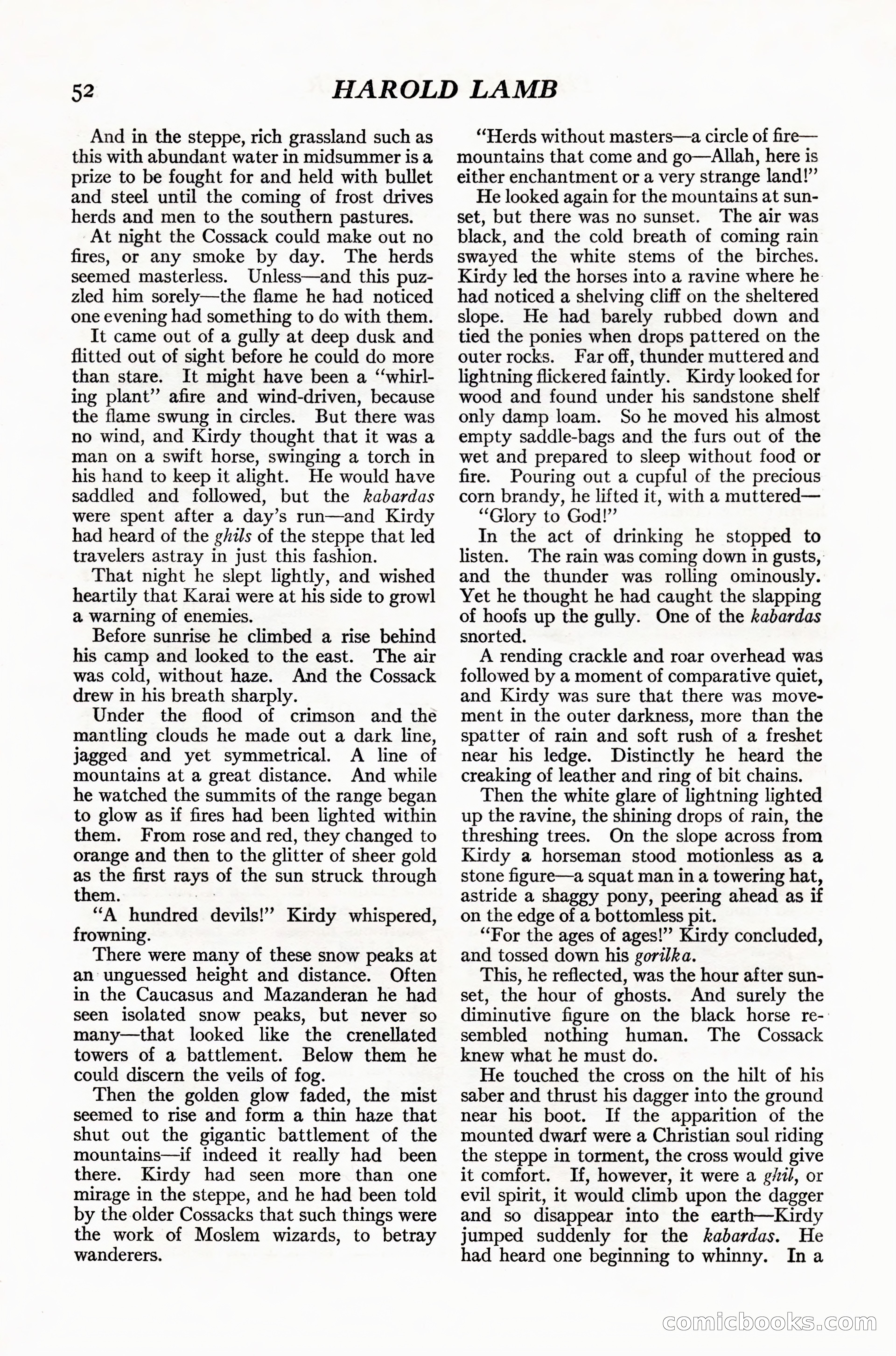
52 HAROLD LAMB And in the steppe, rich grassland such as this with abundant water in midsummer is a prize to be fought for and held with bullet and steel until the coming of frost drives herds and men to the southern pastures. At night the Cossack could make out no fires, or any smoke by day. The herds seemed masterless. Unless—and this puz- zled him sorely—the flame he had noticed one evening had something to do with them. It came out of a gully at deep dusk and flitted out of sight before he could do more than stare. It might have been a ‘‘whirl- ing plant” afire and wind-driven, because the flame swung in circles. But there was no wind, and Kirdy thought that it was a man on a swift horse, swinging a torch in his hand to keep it alight. He would have saddled and followed, but the kabardas were spent after a day’s run—and Kirdy had heard of the ghzls of the steppe that led travelers astray in just this fashion. That night he slept lightly, and wished heartily that Karai were at his side to growl a warning of enemies. Before sunrise he climbed a rise behind his camp and looked to the east. The air was cold, without haze. And the Cossack drew in his breath sharply. Under the flood of crimson and the mantling clouds he made out a dark line, jagged and yet symmetrical. A line of mountains at a great distance. And while he watched the summits of the range began to glow as if fires had been lighted within them. From rose and red, they changed to orange and then to the glitter of sheer gold as the first rays of the sun struck through them. oe “A hundred devils!’’ Kirdy whispered, frowning. There were many of these snow peaks at an unguessed height and distance. Often in the Caucasus and Mazanderan he had seen isolated snow peaks, but never so many—that looked like the crenellated towers of a battlement. Below them he could discern the veils of fog. Then the golden glow faded, the mist seemed to rise and form a thin haze that shut out the gigantic battlement of the mountains—if indeed it really had been there. Kirdy had seen more than one mirage in the steppe, and he had been told by the older Cossacks that such things were the work of Moslem wizards, to betray wanderers. “Herds without masters—a circle of fire— mountains that come and go—Allah, here is either enchantment or a very strange land!” He looked again for the mountains at sun- set, but there was no sunset. The air was black, and the cold breath of coming rain swayed the white stems of the birches. Kirdy led the horses into a ravine where he had noticed a shelving cliff on the sheltered slope. He had barely rubbed down and tied the ponies when drops pattered on the outer rocks. Far off, thunder muttered and lightning flickered faintly. Kirdy looked for wood and found under his sandstone shelf only damp loam. So he moved his almost empty saddle-bags and the furs out of the wet and prepared to sleep without food or fire. Pouring out a cupful of the precious corn brandy, he lifted it, with a muttered— “Glory to God!” In the act of drinking he stopped to listen. and the thunder was rolling ominously. Yet he thought he had caught the slapping of hoofs up the gully. One of the kabardas snorted. A rending crackle and roar overhead was followed by a moment of comparative quiet, and Kirdy was sure that there was move- ment in the outer darkness, more than the spatter of rain and soft rush of a freshet near his ledge. Distinctly he heard the creaking of leather and ring of bit chains. Then the white glare of lightning lighted up the ravine, the shining drops of rain, the threshing trees. On the slope across from Kirdy a horseman stood motionless as a stone figure—a squat man in a towering hat, astride a shaggy pony, peering ahead as if on the edge of a bottomless pit. “For the ages of ages!’ Kirdy concluded, and tossed down his gorilka. This, he reflected, was the hour after sun- set, the hour of ghosts. And surely the diminutive figure on the black horse re- sembled nothing human. The Cossack knew what he must do. He touched the cross on the hilt of his saber and thrust his dagger into the ground near his boot. If the apparition of the mounted dwarf were a Christian soul riding the steppe in torment, the cross would give it comfort. If, however, it were a g/l, or evil spirit, it would climb upon the dagger and so disappear into the earth—Kirdy jumped suddenly for the kabardas. He had heard one beginning to whinny. Ina COmiclboooks.cO The rain was coming down in gusts, 5}