
Pulp Fiction, 1926 · page 18 of 232
Adventure Magazine Cover — page 18: what you’re looking at
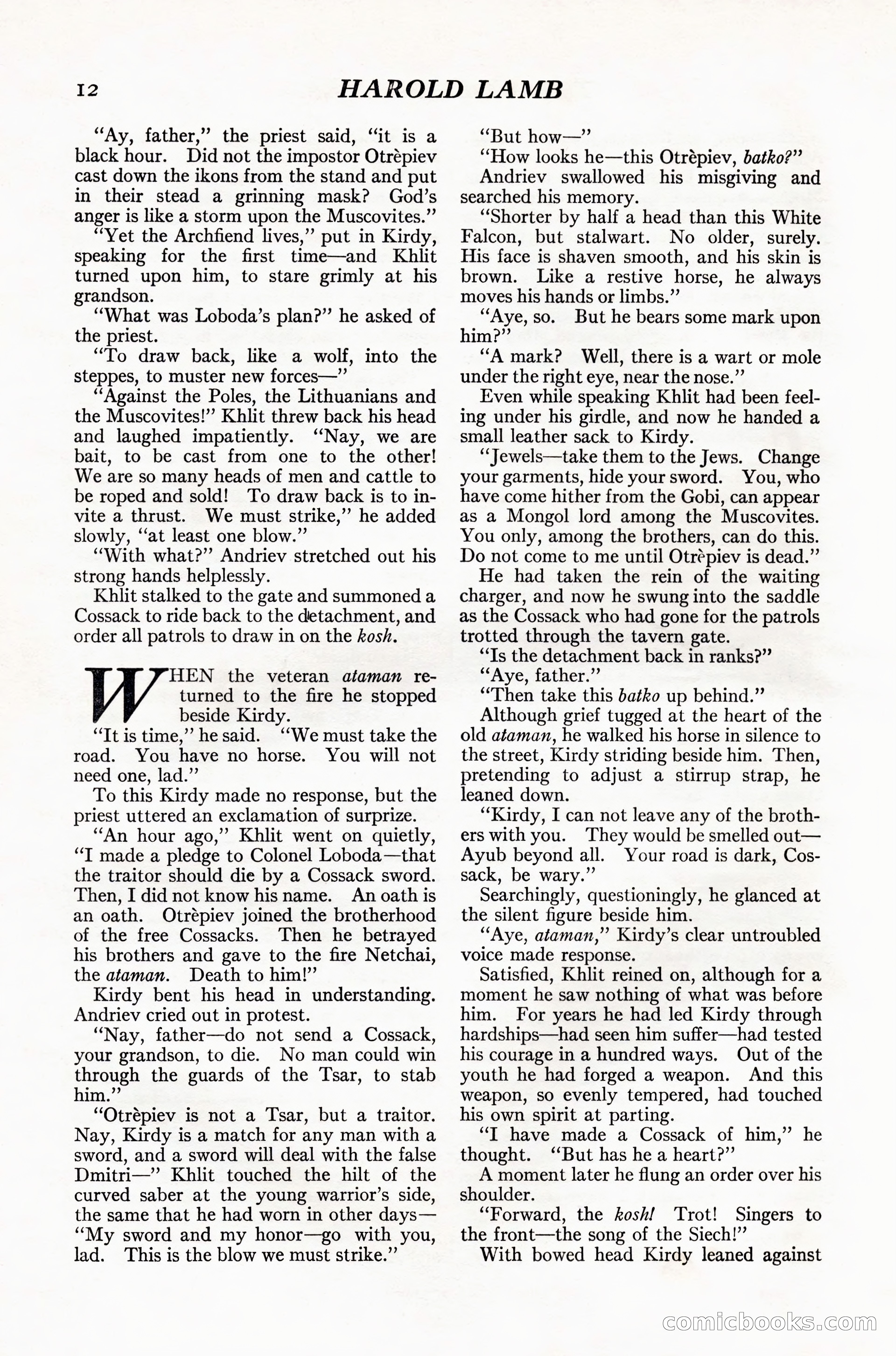
A restored page from Pulp Fiction, 1926. Page through the whole issue in the reader above.
📄 Transcribed text from this page (OCR, searchable)
Machine-transcribed from the original scan — historical spelling and the odd misread are preserved.
I2 “‘Ay, father,” the priest said, “it is a black hour. Did not the impostor Otrépiev cast down the ikons from the stand and put in their stead a grinning mask? God’s anger is like a storm upon the Muscovites.”’ “Yet the Archfiend lives,” put in Kirdy, speaking for the first time—and Khlit turned upon him, to stare grimly at his grandson. ‘‘What was Loboda’s plan?” he asked of the priest. “To draw back, like a wolf, into the steppes, to muster new forces—”’ “‘Against the Poles, the Lithuanians and the Muscovites!’’ Khlit threw back his head and laughed impatiently. “Nay, we are bait, to be cast from one to the other! We are so many heads of men and cattle to be roped and sold! To draw back is to in- vite a thrust. We must strike,’’ he added slowly, “‘at least one blow.” ‘With what?” Andriev stretched out his strong hands helplessly. Khlit stalked to the gate and summoned a Cossack to ride back to the detachment, and order all patrols to draw in on the kosh. W “Tt is time,” he said. road. You have no horse. need one, lad.” To this Kirdy made no response, but the priest uttered an exclamation of surprize. ‘“‘An hour ago,” Khlit went on quietly, “T made a pledge to Colonel Loboda—that the traitor should die by a Cossack sword. Then, I did not know hisname. An oath is an oath. Otrépiev joined the brotherhood of the free Cossacks. Then he betrayed his brothers and gave to the fire Netchai, the ataman. Death to him!’ Kirdy bent his head in understanding. Andriev cried out in protest. “Nay, father—do not send a Cossack, your grandson, to die. No man could win through the guards of the Tsar, to stab him.”’ “Otrépiev is not a Tsar, but a traitor. Nay, Kirdy is a match for any man with a sword, and a sword will deal with the false Dmitri—”’ Khlit touched the hilt of the curved saber at the young warrior’s side, the same that he had worn in other days— “My sword and my honor—go with you, lad. This is the blow we must strike.” HEN the veteran ataman re- turned to the fire he stopped beside Kirdy. ‘‘We must take the You will not HAROLD LAMB “But how—” ‘‘How looks he—this Otrépiev, batko?”’ Andriev swallowed his misgiving and searched his memory. “Shorter by half a head than this White Falcon, but stalwart. No older, surely. His face is shaven smooth, and his skin is brown. Like a restive horse, he always moves his hands or limbs.” “Aye, so. But he bears some mark upon him?” “A mark? Well, there is a wart or mole under the right eye, near the nose.” Even while speaking Khlit had been feel- ing under his girdle, and now he handed a small leather sack to Kirdy. ‘“Jewels—take them to the Jews. Change your garments, hide your sword. You, who have come hither from the Gobi, can appear as a Mongol lord among the Muscovites. You only, among the brothers, can do this. Do not come to me until Otrépiev is dead.” He had taken the rein of the waiting charger, and now he swung into the saddle as the Cossack who had gone for the patrols trotted through the tavern gate. “Is the detachment back in ranks?” ‘Aye, father.” ‘Then take this batko up behind.” Although grief tugged at the heart of the old ataman, he walked his horse in silence to the street, Kirdy striding beside him. Then, pretending to adjust a stirrup strap, he leaned down. “Kirdy, I can not leave any of the broth- ers with you. They would be smelled out— Ayub beyond all. Your road is dark, Cos- sack, be wary.” Searchingly, questioningly, he glanced at the silent figure beside him. “Aye, ataman,”’ Kirdy’s clear untroubled voice made response. Satisfied, Khlit reined on, although for a moment he saw nothing of what was before him. For years he had led Kirdy through hardships—had seen him suffer—had tested his courage in a hundred ways. Out of the youth he had forged a weapon. And this weapon, so evenly tempered, had touched his own spirit at parting. “IT have made a Cossack of him,” he thought. ‘But has he a heart?” A moment later he flung an order over his shoulder. “Forward, the kosh! Trot! Singers to the front—the song of the Siech!” With bowed head Kirdy leaned against COMmiclboooks C©