
Pulp Fiction, 1926 · page 17 of 232
Adventure Magazine Cover — page 17: what you’re looking at
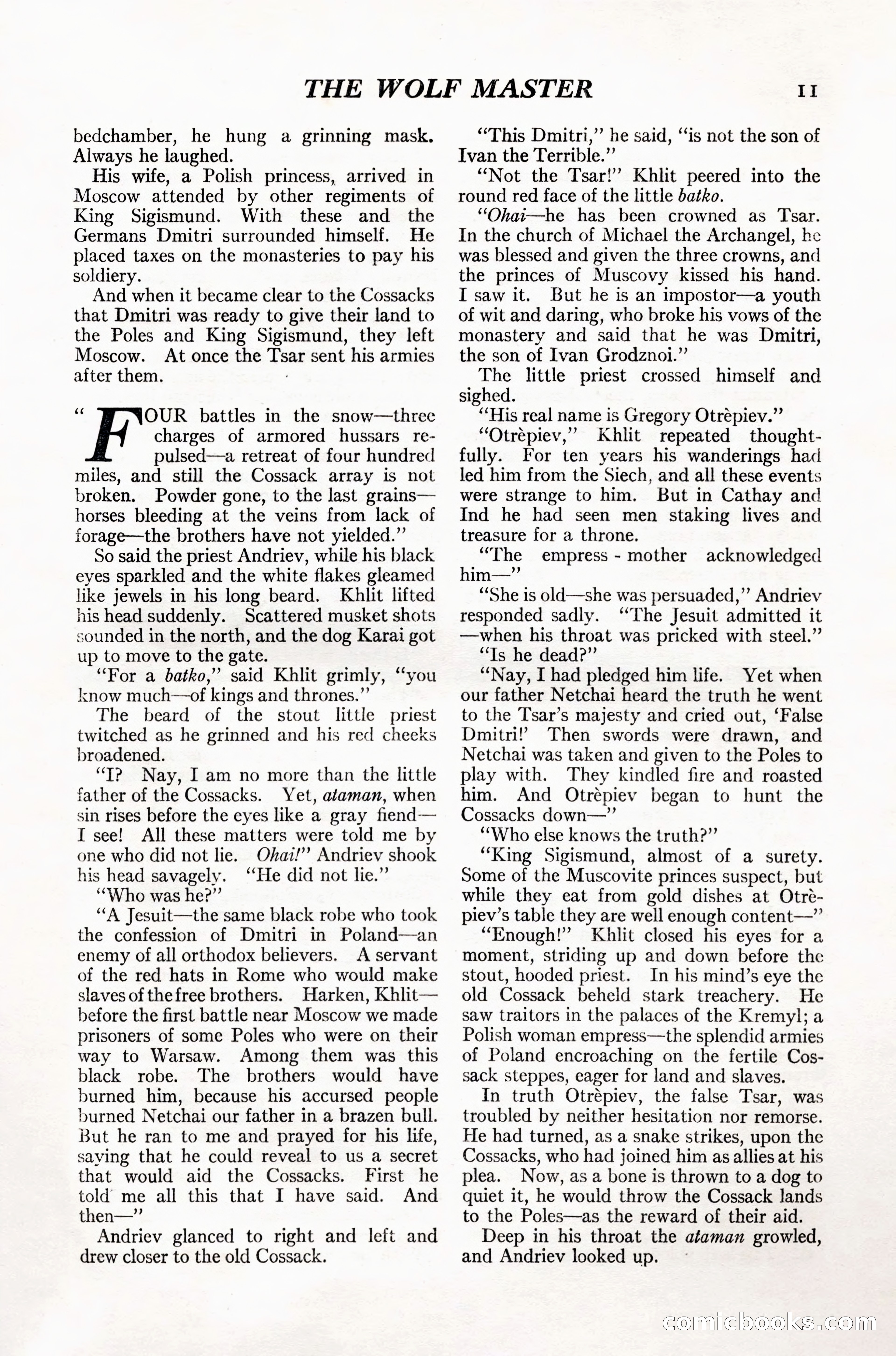
A restored page from Pulp Fiction, 1926. Page through the whole issue in the reader above.
📄 Transcribed text from this page (OCR, searchable)
Machine-transcribed from the original scan — historical spelling and the odd misread are preserved.
THE WOLF MASTER II bedchamber, he hung a grinning mask, Always he laughed. His wife, a Polish princess, arrived in Moscow attended by other regiments of King Sigismund. With these and the Germans Dmitri surrounded himself. He placed taxes on the monasteries to pay his soldiery. And when it became clear to the Cossacks that Dmitri was ready to give their land to the Poles and King Sigismund, they left Moscow. At once the Tsar sent his armies after them. . a OUR battles in the snow—three RF charges of armored hussars re- pulsed—a retreat of four hundred miles, and still the Cossack array is not broken. Powder gone, to the last grains— horses bleeding at the veins from lack of forage—the brothers have not yielded.”’ So said the priest Andriev, while his black eyes sparkled and the white flakes gleamed like jewels in his long beard. Kuhlit lifted his head suddenly. Scattered musket shots sounded in the north, and the dog Karai got up to move to the gate. “For a batko,” said Khlit grimly, “you know much—of kings and thrones.”’ The beard of the stout little priest twitched as he grinned and his red cheeks broadened. “T? Nay, I am no more than the little father of the Cossacks. Yet, ataman, when sin rises before the eyes like a gray fiend— I see! All these matters were told me by one who did not lie. Ofaz!’’ Andriev shook his head savagely. ‘He did not lie.” “Who was her” ‘““A Jesuit—the same black robe who took the confession of Dmitri in Poland—an enemy of all orthodox believers. A servant of the red hats in Rome who would make slaves of thefree brothers. Harken, Khlit— before the first battle near Moscow we made prisoners of some Poles who were on their way to Warsaw. Among them was this black robe. The brothers would have burned him, because his accursed people burned Netchai our father in a brazen bull. But he ran to me and prayed for his life, saving that he could reveal to us a secret that would aid the Cossacks. First he told me all this that I have said. And then—” Andriev glanced to right and left and drew closer to the old Cossack. ‘This Dmitri,” he said, “is not the son of Ivan the Terrible.”’ “Not the Tsar!” Khlit peered into the round red face of the little batko. “Ohai—he has been crowned as Tsar. In the church of Michael the Archangel, he was blessed and given the three crowns, and the princes of Muscovy kissed his hand. I saw it. But he is an impostor—a youth of wit and daring, who broke his vows of the monastery and said that he was Dmitri, the son of Ivan Grodznoi.”’ The little priest crossed himself and sighed. ‘His real name is Gregory Otrépiev.” “Otrépiev,” Khlit repeated thought- fully. For ten years his wanderings had led him from the Siech, and all these events were strange to him. But in Cathay and Ind he had seen men staking lives and treasure for a throne. “The empress - mother acknowledged him—” “She is old—she was persuaded,”’ Andriev responded sadly. ‘“‘The Jesuit admitted it —when his throat was pricked with steel.” “Ts he dead?” “Nay, I had pledged him life. Yet when our father Netchai heard the truth he went to the Tsar’s majesty and cried out, ‘False Dmitri!’ Then swords were drawn, and Netchai was taken and given to the Poles to play with. They kindled fire and roasted him. And Otrépiev began to hunt the Cossacks down—”’ ‘Who else knows the truth?” “King Sigismund, almost of a surety. some of the Muscovite princes suspect, but while they eat from gold dishes at Otré- plev’s table they are well enough content—”’ “Enough!” Knhlit closed his eyes for a moment, striding up and down before the stout, hooded priest. In his mind’s eye the old Cossack beheld stark treachery. He saw traitors in the palaces of the Kremyl; a Polish woman empress—the splendid armies of Poland encroaching on the fertile Cos- sack steppes, eager for land and slaves. In truth Otrépiev, the false Tsar, was troubled by neither hesitation nor remorse. He had turned, as a snake strikes, upon the Cossacks, who had joined him as allies at his plea. Now, as a bone is thrown to a dog to quiet it, he would throw the Cossack lands to the Poles—as the reward of their aid. Deep in his throat the ataman growled, and Andriev looked up. COnmiICLOOOkKS. CGO S|