
Pulp Fiction, 1926 · page 173 of 232
Adventure Magazine Cover — page 173: what you’re looking at
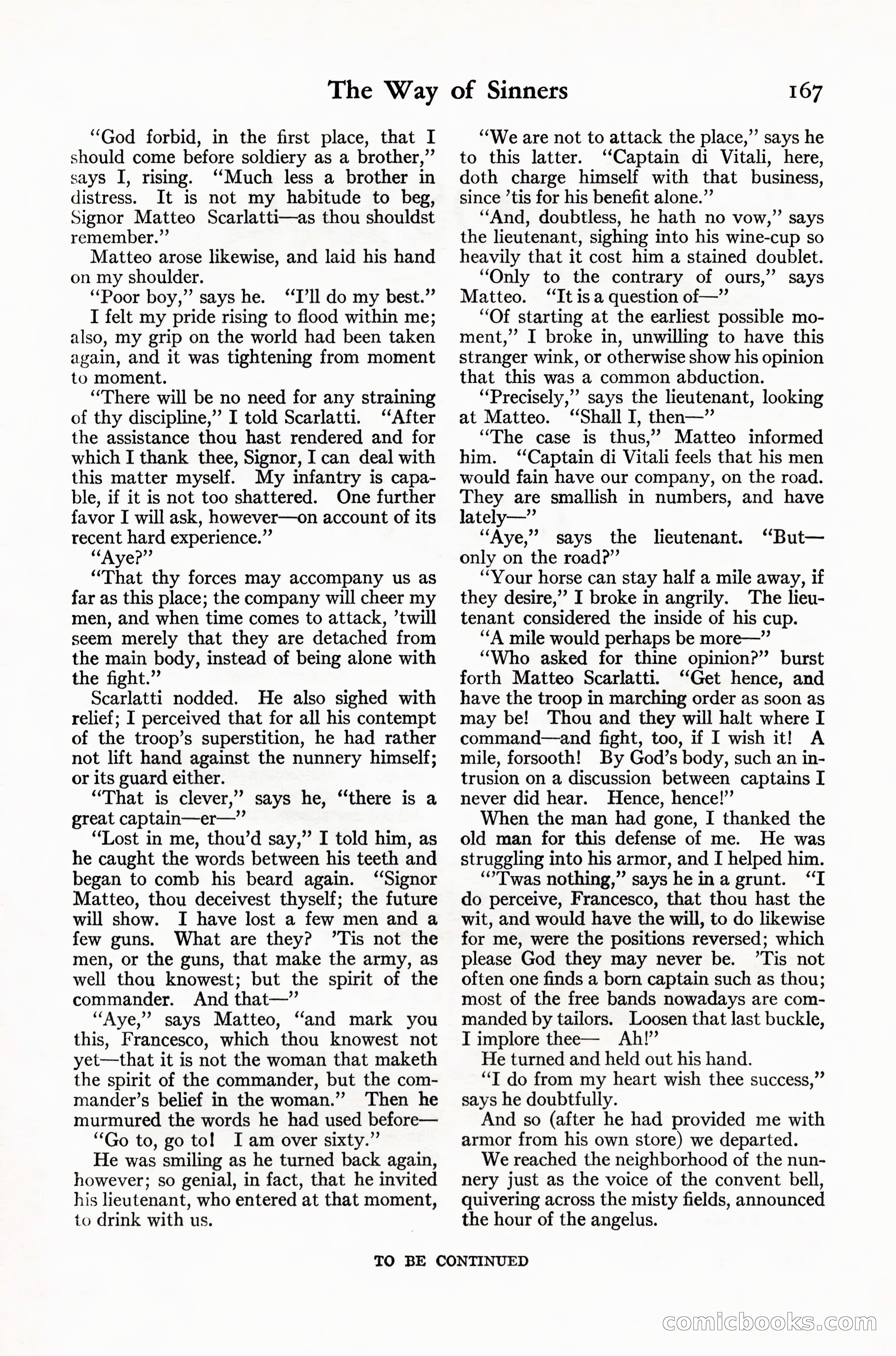
A restored page from Pulp Fiction, 1926. Page through the whole issue in the reader above.
📄 Transcribed text from this page (OCR, searchable)
Machine-transcribed from the original scan — historical spelling and the odd misread are preserved.
The Way of Sinners “God forbid, in the first place, that I should come before soldiery as a brother,” says I, rising. ‘Much less a brother in distress. It is not my habitude to beg, Signor Matteo Scarlatti—as thou shouldst remember.” Matteo arose likewise, and laid his hand on my shoulder. “Poor boy,” says he. “T’ll do my best.” I felt my pride rising to flood within me; also, my grip on the world had been taken again, and it was tightening from moment to moment. “There will be no need for any straining of thy discipline,” I told Scarlatti. ‘After the assistance thou hast rendered and for which I thank thee, Signor, I can deal with this matter myself. My infantry is capa- ble, if it is not too shattered. One further favor I will ask, however—on account of its recent hard experience.” 6“ Aye?” “That thy forces may accompany us as far as this place; the company will cheer my men, and when time comes to attack, ’twill seem merely that they are detached from the main body, instead of being alone with the fight.” Scarlatti nodded. He also sighed with relief; I perceived that for all his contempt of the troop’s superstition, he had rather not lift hand against the nunnery himself; or its guard either. “That is clever,’ says he, “there is a great captain—er—” “Lost in me, thou’d say,” I told him, as he caught the words between his teeth and began to comb his beard again. ‘Signor Matteo, thou deceivest thyself; the future will show. I have lost a few men and a few guns. What are they? ’Tis not the men, or the guns, that make the army, as well thou knowest; but the spirit of the commander. And that—” “Aye,” says Matteo, “and mark you this, Francesco, which thou knowest not yet—that it is not the woman that maketh the spirit of the commander, but the com- mander’s belief in the woman.” Then he murmured the words he had used before— “Go to, go to! I am over sixty.” He was smiling as he turned back again, however; so genial, in fact, that he invited his heutenant, who entered at that moment, to drink with us. 167 ‘“‘We are not to attack the place,” says he to this latter. ‘‘Captain di Vitali, here, doth charge himself with that business, since ’tis for his benefit alone.” ‘‘And, doubtless, he hath no vow,” says the lieutenant, sighing into his wine-cup so heavily that it cost him a stained doublet. “Only to the contrary of ours,” says Matteo. “Itisa question of—” “Of starting at the earliest possible mo- ment,” I broke in, unwilling to have this stranger wink, or otherwise show his opinion that this was a common abduction. “Precisely,” says the lieutenant, looking at Matteo. ‘Shall I, then—” “The case is thus,” Matteo informed him. “Captain di Vitali feels that his men would fain have our company, on the road. They are smallish in numbers, and have lately—” “Aye,” says the lieutenant. only on the road?” “Your horse can stay half a mile away, if they desire,” I broke in angrily. The lieu- tenant considered the inside of his cup. ‘“‘A mile would perhaps be more—” ‘“‘Who asked for thine opinion?” burst forth Matteo Scarlatti. ‘“‘Get hence, and have the troop in marching order as soon as may be! Thou and they will halt where I command—and fight, too, if I wish it! A mile, forsooth! By God’s body, such an in- trusion on a discussion between captains I never did hear. Hence, hence!” When the man had gone, I thanked the old man for this defense of me. He was struggling into his armor, and I helped him. ‘°Twas nothing,” says he ina grunt. “I do perceive, Francesco, that thou hast the wit, and would have the will, to do likewise for me, were the positions reversed; which please God they may never be. ’Tis not often one finds a born captain such as thou; most of the free bands nowadays are com- manded by tailors. Loosen that last buckle, I implore thee— Ah!” He turned and held out his hand. “T do from my heart wish thee success,” says he doubtfully. And so (after he had provided me with armor from his own store) we departed. We reached the neighborhood of the nun- nery just as the voice of the convent bell, quivering across the misty fields, announced the hour of the angelus. “But— TO BE CONTINUED COnmiclboooks.c©