
Pulp Fiction, 1926 · page 172 of 232
Adventure Magazine Cover — page 172: what you’re looking at
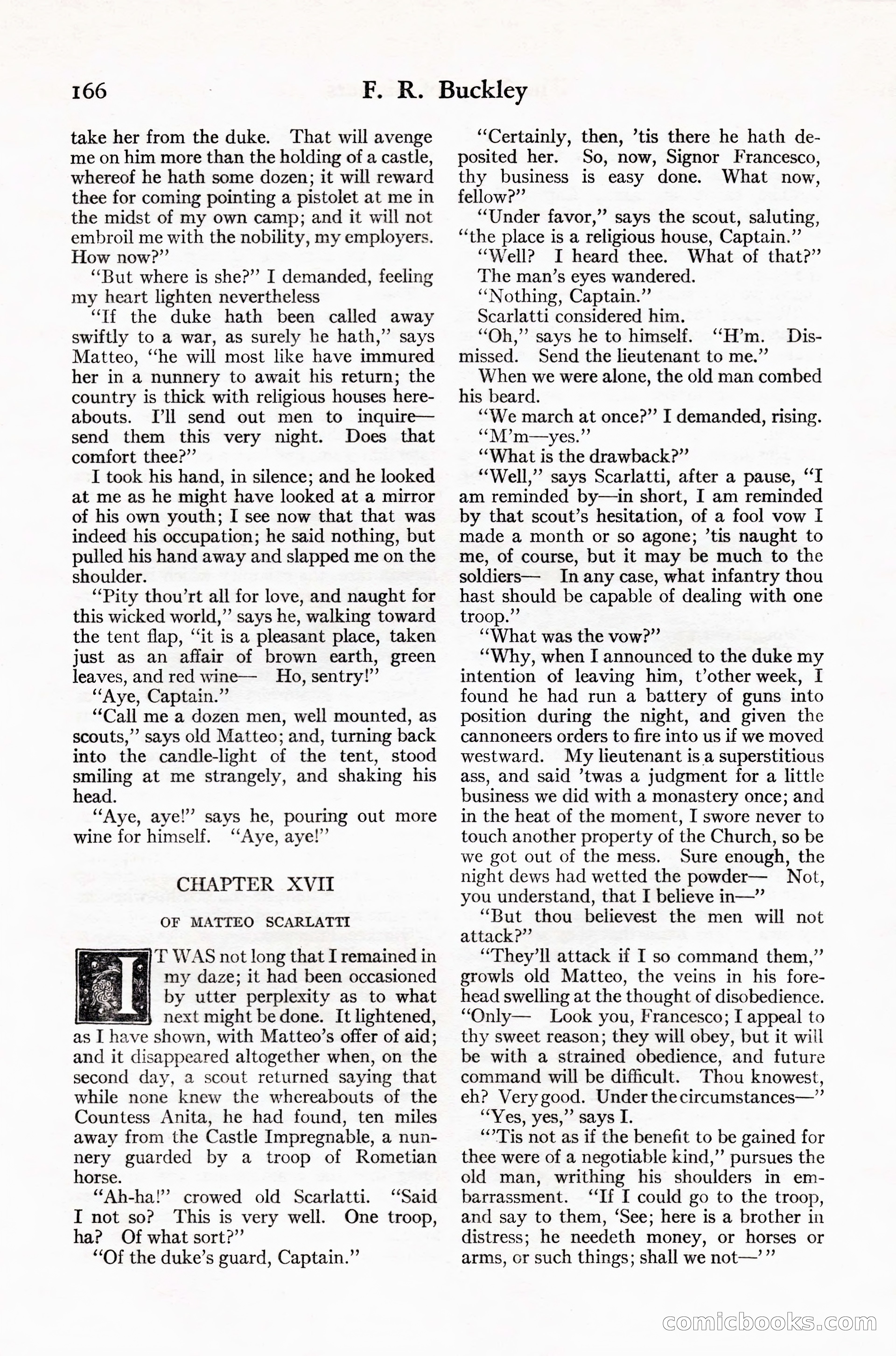
A restored page from Pulp Fiction, 1926. Page through the whole issue in the reader above.
📄 Transcribed text from this page (OCR, searchable)
Machine-transcribed from the original scan — historical spelling and the odd misread are preserved.
166 take her from the duke. That will avenge me on him more than the holding of a castle, whereof he hath some dozen; it will reward thee for coming pointing a pistolet at me in the midst of my own camp; and it will not embroil me with the nobility, my employers. How now?” “But where is she?’”’ I demanded, feeling my heart lighten nevertheless “Tf the duke hath been called away swiftly to a war, as surely he hath,” says Matteo, ‘“‘he will most like have immured her in a nunnery to await his return; the country is thick with religious houses here- abouts. Ill send out men to inquire— send them this very night. Does that comfort thee?” I took his hand, in silence; and he looked at me as he might have looked at a mirror of his own youth; I see now that that was indeed his occupation; he said nothing, but pulled his hand away and slapped me on the shoulder. “Pity thou’rt all for love, and naught for this wicked world,” says he, walking toward the tent flap, “it is a pleasant place, taken just as an affair of brown earth, green leaves, and red wine— _ Ho, sentry!” “Aye, Captain.” “‘Call me a dozen men, well mounted, as scouts,” says old Matteo; and, turning back into the candle-light of the tent, stood smiling at me strangely, and shaking his head. “Aye, aye!” says he, pouring out more wine for himself. ‘“‘Aye, aye!”’ CHAPTER XVII OF MATTEO SCARLATTI T WAS not long that I remained in = M4 my daze; it had been occasioned by utter perplexity as to what =} next might bedone. It lightened, as I have shown, with Matteo’s offer of aid; and it disappeared altogether when, on the second day, a scout returned saying that while none knew the whereabouts of the Countess Anita, he had found, ten miles away from the Castle Impregnable, a nun- nery guarded by a troop of Rometian horse. “fAh-ha!”’? crowed old Scarlatti. I not so? This is very well. ha? Of what sort?” “Of the duke’s guard, Captain.” ‘Said One troop, F. R. Buckley “Certainly, then, ’tis there he hath de- posited her. So, now, Signor Francesco, thy business is easy done. What now, fellow?” “Under favor,” says the scout, saluting, “the place is a religious house, Captain.” “Well? I heard thee. What of that?” The man’s eyes wandered. “Nothing, Captain.” Scarlatti considered him. “Oh,”’ says he to himself. “H’m. Dis- missed. Send the lieutenant to me.” When we were alone, the old man combed his beard. ‘““We march at once?” I demanded, rising. “Mi im—yes.”’ “What is the drawback?” ‘““Well,”’ says Scarlatti, after a pause, “I am reminded by—in short, I am reminded by that scout’s hesitation, of a fool vow I made a month or so agone; ’tis naught to me, of course, but it may be much to the soldiers— In any case, what infantry thou hast should be capable of dealing with one troop.” ‘What was the vow?” ‘“‘Why, when I announced to the duke my intention of leaving him, t’other week, I found he had run a battery of guns into position during the night, and given the cannoneers orders to fire into us if we moved westward. My lieutenant is a superstitious ass, and said ’twas a judgment for a little business we did with a monastery once; and in the heat of the moment, I swore never to touch another property of the Church, so be we got out of the mess. Sure enough, the night dews had wetted the powder— Not, you understand, that I believe in—” “But thou believest the men will not attack?” “They’ll attack if I so command them,” growls old Matteo, the veins in his fore- head swelling at the thought of disobedience. “Only— Look you, Francesco; I appeal to thy sweet reason; they will obey, but it will be with a strained obedience, and future command will be difficult. Thou knowest, eh? Very good. Under thecircumstances—”’ “Yes, yes,” says I. ‘Tis not as if the benefit to be gained for thee were of a negotiable kind,” pursues the old man, writhing his shoulders in em- barrassment. “If [ could go to the troop, and say to them, ‘See; here is a brother in distress; he needeth money, or horses or arms, or such things; shall we not—’”’ COnmiclboooks.c©