
Pulp Fiction, 1926 · page 15 of 232
Adventure Magazine Cover — page 15: what you’re looking at
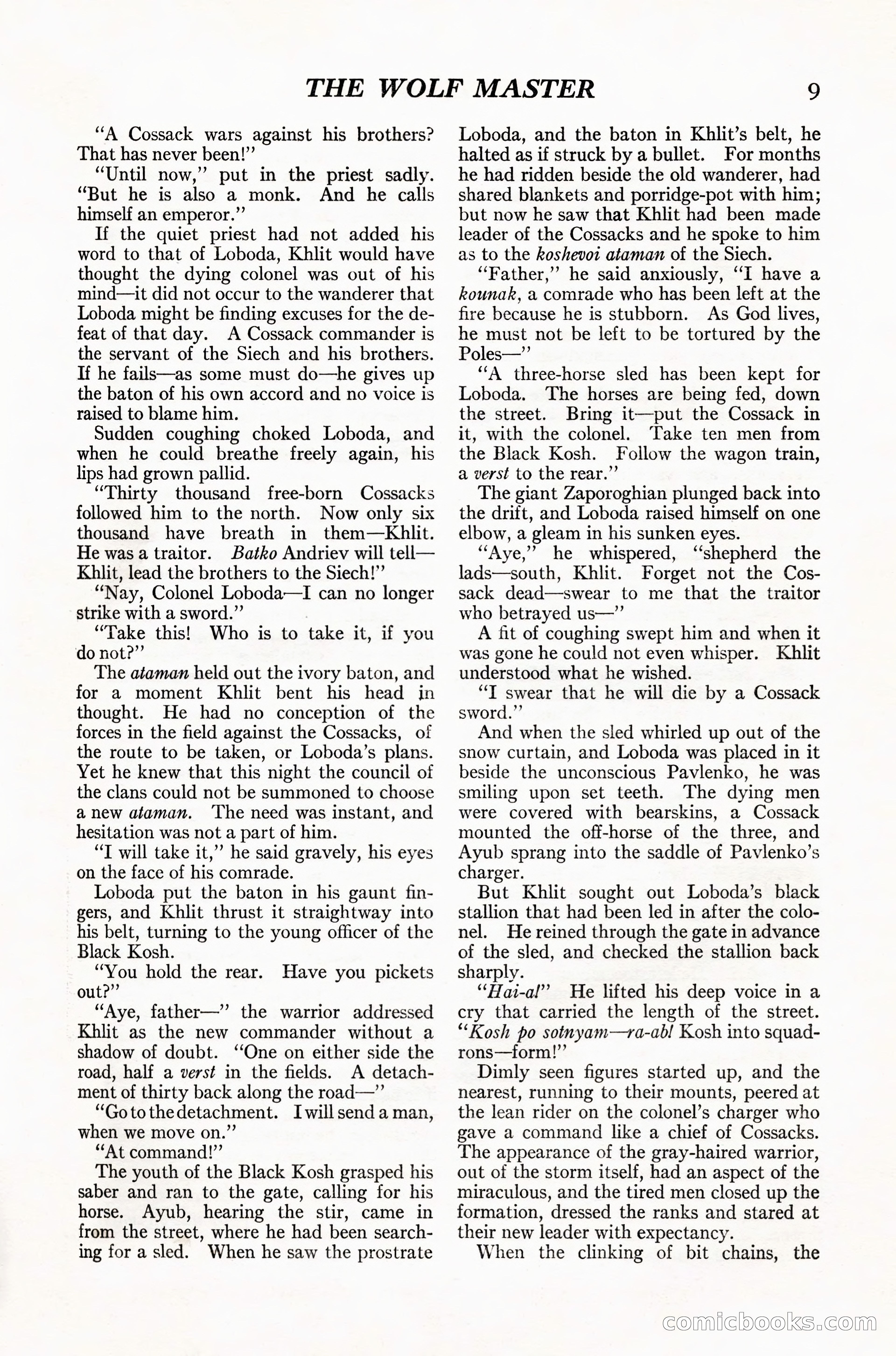
A restored page from Pulp Fiction, 1926. Page through the whole issue in the reader above.
📄 Transcribed text from this page (OCR, searchable)
Machine-transcribed from the original scan — historical spelling and the odd misread are preserved.
THE WOLF MASTER “A Cossack wars against his brothers? That has never been!”’ “Until now,” put in the priest sadly. “But he is also a monk. And he calls himself an emperor.” If the quiet priest had not added his word to that of Loboda, Khlit would have thought the dying colonel was out of his mind—it did not occur to the wanderer that Loboda might be finding excuses for the de- feat of that day. A Cossack commander is the servant of the Siech and his brothers. If he fails—as some must do—he gives up the baton of his own accord and no voice is raised to blame him. Sudden coughing choked Loboda, and when he could breathe freely again, his lips had grown pallid. “Thirty thousand free-born Cossacks followed him to the north. Now only six thousand have breath in them—Knhlit. He was a traitor. Batko Andriev will tell— Khlit, lead the brothers to the Siech!”’ “Nay, Colonel Loboda—I can no longer strike with a sword.” ‘Take this! Who is to take it, if you do not?” The ataman held out the ivory baton, and for a moment Khlit bent his head in thought. He had no conception of the forces in the field against the Cossacks, of the route to be taken, or Loboda’s plans. Yet he knew that this night the council of the clans could not be summoned to choose anew ataman. ‘The need was instant, and hesitation was not a part of him. “T will take it,” he said gravely, his eyes on the face of his comrade. Loboda put the baton in his gaunt fin- gers, and Khlit thrust it straightway into his belt, turning to the young officer of the Black Kosh. ‘You hold the rear. Have you pickets out?” “Aye, father—”’ the warrior addressed Khlit as the new commander without a shadow of doubt. ‘One on either side the road, half a verst in the fields. A detach- ment of thirty back along the road—’”’ “Gotothedetachment. I willsend aman, when we move on.” “At command!”’ The youth of the Black Kosh grasped his saber and ran to the gate, calling for his horse. Ayub, hearing the stir, came in from the street, where he had been search- ing for a sled. When he saw the prostrate 9 Loboda, and the baton in Khlit’s belt, he halted as if struck by a bullet. For months he had ridden beside the old wanderer, had shared blankets and porridge-pot with him; but now he saw that Khlit had been made leader of the Cossacks and he spoke to him as to the koshevot ataman of the Siech. “Father,” he said anxiously, “I have a kounak, a comrade who has been left at the fire because he is stubborn. As God lives, he must not be left to be tortured by the Poles—”’ ‘“‘A three-horse sled has been kept for Loboda. The horses are being fed, down the street. Bring it—put the Cossack in it, with the colonel. Take ten men from the Black Kosh. Follow the wagon train, a verst to the rear.” The giant Zaporoghian plunged back into the drift, and Loboda raised himself on one elbow, a gleam in his sunken eyes. “Aye,” he whispered, ‘“‘shepherd the lads—south, Khlit. Forget not the Cos- sack dead—swear to me that the traitor who betrayed us—”’ A fit of coughing swept him and when it was gone he could not even whisper. Kuhlit understood what he wished. “T swear that he will die by a Cossack sword.” And when the sled whirled up out of the snow curtain, and Loboda was placed in it beside the unconscious Pavlenko, he was smiling upon set teeth. The dying men were covered with bearskins, a Cossack mounted the off-horse of the three, and Ayub sprang into the saddle of Pavlenko’s charger. But Khlit sought out Loboda’s black stallion that had been led in after the colo- nel. He reined through the gate in advance of the sled, and checked the stallion back sharply. “Hat-al” He lifted his deep voice in a cry that carried the length of the street. “Kosh po sotnyam—vra-ab! Kosh into squad- rons—form!”’ Dimly seen figures started up, and the nearest, running to their mounts, peered at the lean rider on the colonel’s charger who gave a command like a chief of Cossacks. The appearance of the gray-haired warrior, out of the storm itself, had an aspect of the miraculous, and the tired men closed up the formation, dressed the ranks and stared at their new leader with expectancy. When the clinking of bit chains, the COMmMiCcoooks C@