
Pulp Fiction, 1926 · page 14 of 232
Adventure Magazine Cover — page 14: what you’re looking at
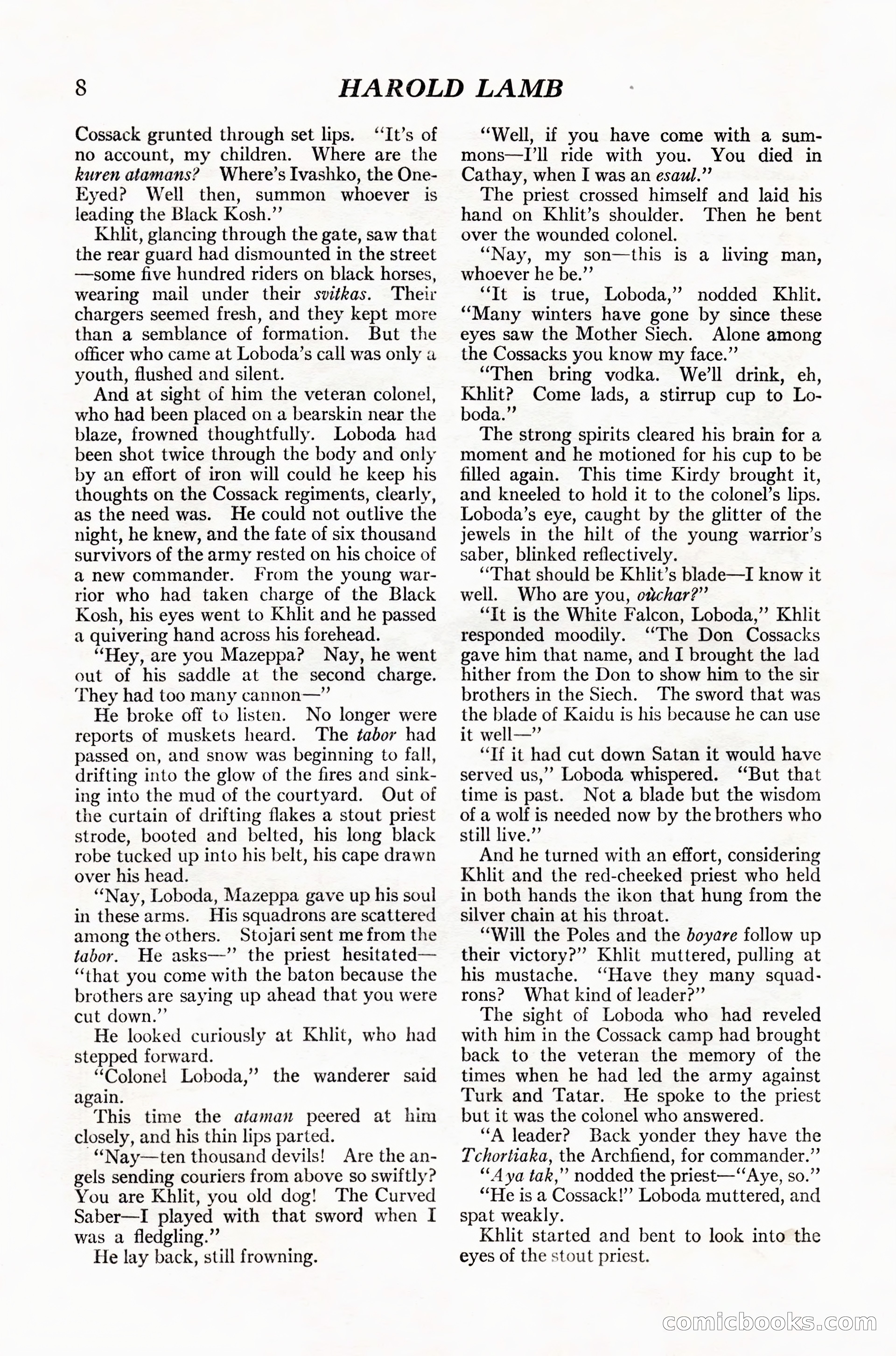
A restored page from Pulp Fiction, 1926. Page through the whole issue in the reader above.
📄 Transcribed text from this page (OCR, searchable)
Machine-transcribed from the original scan — historical spelling and the odd misread are preserved.
8 Cossack grunted through set lips. “It’s of no account, my children. Where are the kuren atamans? Where’s Ivashko, the One- Eyed? Well then, summon whoever is leading the Black Kosh.”’ Khlit, glancing through the gate, saw that the rear guard had dismounted in the street —some five hundred riders on black horses, wearing mail under their svitkas. Their chargers seemed fresh, and they kept more than a semblance of formation. But the officer who came at Loboda’s call was only a youth, flushed and silent. And at sight of him the veteran colonel, who had been placed on a bearskin near the blaze, frowned thoughtfully. Loboda had been shot twice through the body and only by an effort of iron will could he keep his thoughts on the Cossack regiments, clearly, as the need was. He could not outlive the night, he knew, and the fate of six thousand survivors of the army rested on his choice of a new commander. From the young war- rior who had taken charge of the Black Kosh, his eyes went to Khlit and he passed a quivering hand across his forehead. “Hey, are you Mazeppa? Nay, he went out of his saddle at the second charge. They had too many cannon—’”’ He broke off to listen. No longer were reports of muskets heard. The éabor had passed on, and snow was beginning to fall, drifting into the glow of the fires and sink- ing into the mud of the courtyard. Out of the curtain of drifting flakes a stout priest strode, booted and belted, his long black robe tucked up into his belt, his cape drawn over his head. “Nay, Loboda, Mazeppa gave up his soul in these arms. His squadrons are scattered among the others. Stojarisent me from the tabor. He asks—”’ the priest hesitated— “that you come with the baton because the brothers are saying up ahead that you were cut down.”’ He looked curiously at Khlit, who had stepped forward. “Colonel Loboda,”’ the wanderer said again. This time the afaman peered at him closely, and his thin lips parted. ~“Nay—ten thousand devils! Are the an- gels sending couriers from above so swiftly? You are Khlit, you old dog! The Curved Saber—I played with that sword when I was a fledgling.”’ He lay back, still frowning. HAROLD LAMB “Well, if you have come with a sum- mons—I’ll ride with you. You died in Cathay, when I was an esaul.”’ The priest crossed himself and laid his hand on Khlit’s shoulder. Then he bent over the wounded colonel. “Nay, my son—this is a living man, whoever he be.”’ “It is true, Loboda,”’ nodded Knhlit. “Many winters have gone by since these eyes saw the Mother Siech. Alone among the Cossacks you know my face.”’ “Then bring vodka. We’ll drink, eh, Khlit? Come lads, a stirrup cup to Lo- boda.” The strong spirits cleared his brain for a moment and he motioned for his cup to be filled again. This time Kirdy brought it, and kneeled to hold it to the colonel’s lips. Loboda’s eye, caught by the glitter of the jewels in the hilt of the young warrior’s saber, blinked reflectively. “That should be Khlit’s blade—I know it well. Who are you, otchar?” “It is the White Falcon, Loboda,”’ Khlit responded moodily. ‘The Don Cossacks gave him that name, and I brought the lad hither from the Don to show him to the sir brothers in the Siech. The sword that was the blade of Kaidu is his because he can use it well—” “Tf it had cut down Satan it would have served us,’ Loboda whispered. ‘‘But that time is past. Not a blade but the wisdom of a wolf is needed now by the brothers who still live.” And he turned with an effort, considering Khlit and the red-cheeked priest who held in both hands the ikon that hung from the silver chain at his throat. “Will the Poles and the boyare follow up their victory?” Khlit muttered, pulling at his mustache. “Have they many squad- rons? What kind of leader?” The sight of Loboda who had reveled with him in the Cossack camp had brought back to the veteran the memory of the times when he had led the army against Turk and Tatar. He spoke to the priest but it was the colonel who answered. ‘“‘A leader? Back yonder they have the Tchortiaka, the Archfiend, for commander.” ‘Aya tak,” nodded the priest—‘“‘Aye, so.” “He is a Cossack!’ Loboda muttered, and spat weakly. Khlit started and bent to look into the eyes of the stout priest. DOOK C©