
Pulp Fiction, 1926 · page 11 of 232
Adventure Magazine Cover — page 11: what you’re looking at
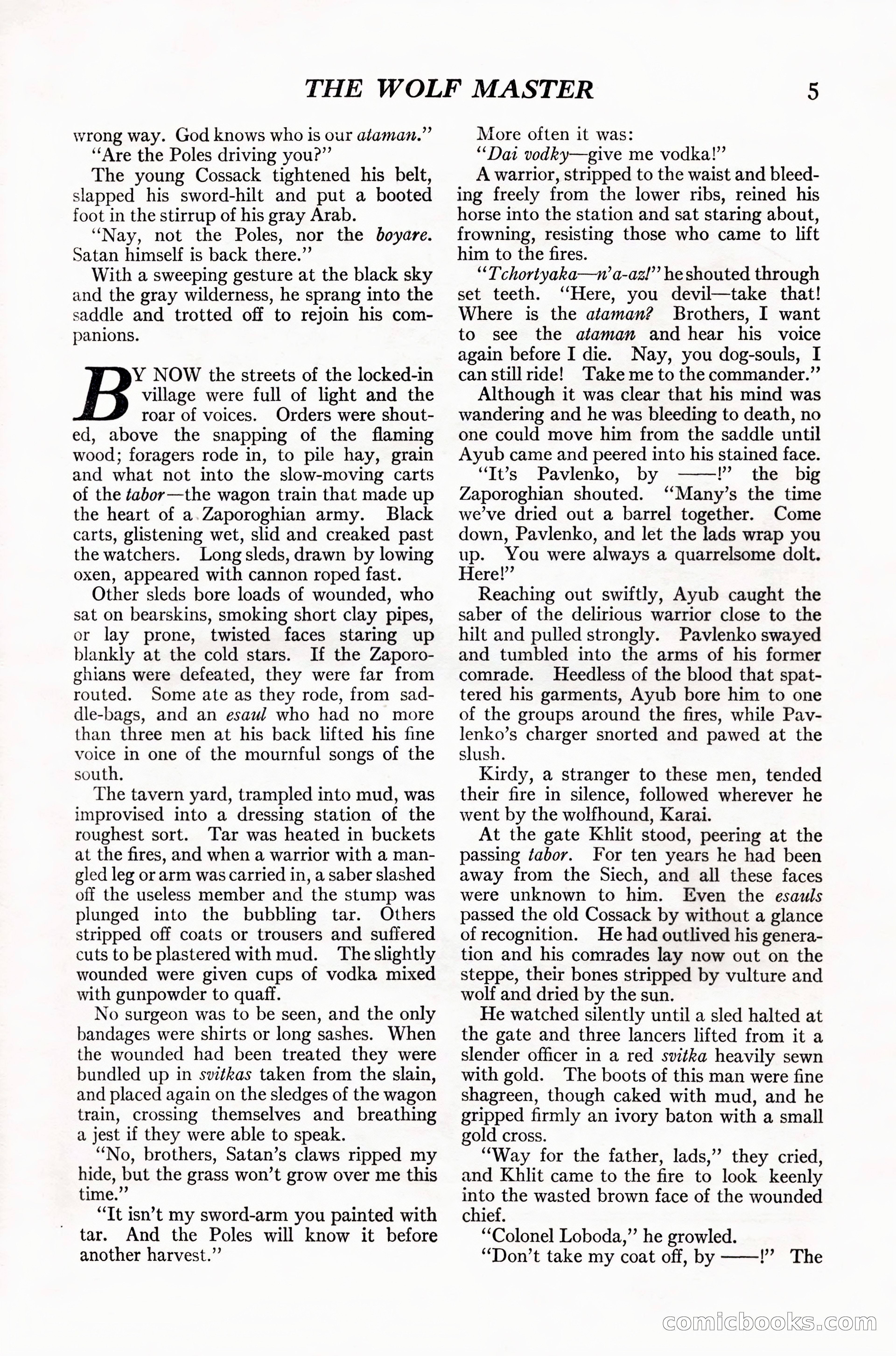
A restored page from Pulp Fiction, 1926. Page through the whole issue in the reader above.
📄 Transcribed text from this page (OCR, searchable)
Machine-transcribed from the original scan — historical spelling and the odd misread are preserved.
THE WOLF MASTER 5 wrong way. God knows who is our aiaman.”’ ‘‘Are the Poles driving you?”’ The young Cossack tightened his belt, slapped his sword-hilt and put a booted foot in the stirrup of his gray Arab. “Nay, not the Poles, nor the boyare. Satan himself is back there.” With a sweeping gesture at the black sky and the gray wilderness, he sprang into the saddle and trotted off to rejoin his com- panions. Y NOW the streets of the locked-in B village were full of light and the roar of voices. Orders were shout- ed, above the snapping of the flaming wood; foragers rode in, to pile hay, grain and what not into the slow-moving carts of the ¢abor—the wagon train that made up the heart of a.Zaporoghian army. Black carts, glistening wet, slid and creaked past the watchers. Long sleds, drawn by lowing oxen, appeared with cannon roped fast. Other sleds bore loads of wounded, who sat on bearskins, smoking short clay pipes, or lay prone, twisted faces staring up blankly at the cold stars. If the Zaporo- ghians were defeated, they were far from routed. Some ate as they rode, from sad- dle-bags, and an esaul who had no more than three men at his back lifted his fine voice in one of the mournful songs of the south. The tavern yard, trampled into mud, was improvised into a dressing station of the roughest sort. Tar was heated in buckets at the fires, and when a warrior with a man- gled leg or arm was carried in, a saber slashed off the useless member and the stump was plunged into the bubbling tar. Others stripped off coats or trousers and suffered cuts to be plastered with mud. Theslightly wounded were given cups of vodka mixed with gunpowder to quaff. No surgeon was to be seen, and the only bandages were shirts or long sashes. When the wounded had been treated they were bundled up in svitkas taken from the slain, and placed again on the sledges of the wagon train, crossing themselves and breathing a jest if they were able to speak. “No, brothers, Satan’s claws ripped my hide, but the grass won’t grow over me this time.” “Tt isn’t my sword-arm you painted with tar. And the Poles will know it before another harvest.” More often it was: “Dat vodky—give me vodka!” A warrior, stripped to the waist and bleed- ing freely from the lower ribs, reined his horse into the station and sat staring about, frowning, resisting those who came to lift him to the fires. “T chortyaka—n a-az!”’ he shouted through set teeth. ‘Here, you devil—take that! Where is the ataman? Brothers, I want to see the ataman and hear his voice again before I die. Nay, you dog-souls, I can stillride! Take me to the commander.” Although it was clear that his mind was wandering and he was bleeding to death, no one could move him from the saddle until Ayub came and peered into his stained face. “It’s Pavlenko, by ’ the big Zaporoghian shouted. ‘“‘Many’s the time we’ve dried out a barrel together. Come down, Pavlenko, and let the lads wrap you up. You were always a quarrelsome dolt. Here!”’ Reaching out swiftly, Ayub caught the saber of the delirious warrior close to the hilt and pulled strongly. Pavlenko swayed and tumbled into the arms of his former comrade. Heedless of the blood that spat- tered his garments, Ayub bore him to one of the groups around the fires, while Pav- lenko’s charger snorted and pawed at the slush. Kirdy, a stranger to these men, tended their fire in silence, followed wherever he went by the wolfhound, Karai. At the gate Khlit stood, peering at the passing tabor. For ten years he had been away from the Siech, and all these faces were unknown to him. Even the esauls passed the old Cossack by without a glance of recognition. He had outlived his genera- tion and his comrades lay now out on the steppe, their bones stripped by vulture and wolf and dried by the sun. He watched silently until a sled halted at the gate and three lancers lifted from it a slender officer in a red svitka heavily sewn with gold. The boots of this man were fine shagreen, though caked with mud, and he gripped firmly an ivory baton with a small gold cross. ‘‘Way for the father, lads,” they cried, and Khlit came to the fire to look keenly into the wasted brown face of the wounded chief. ‘Colonel Loboda,”’ he growled. “Don’t take my coat off, by ——!”’ The COmiclbookks.c©