
Pulp Fiction, 1926 · page 10 of 232
Adventure Magazine Cover — page 10: what you’re looking at
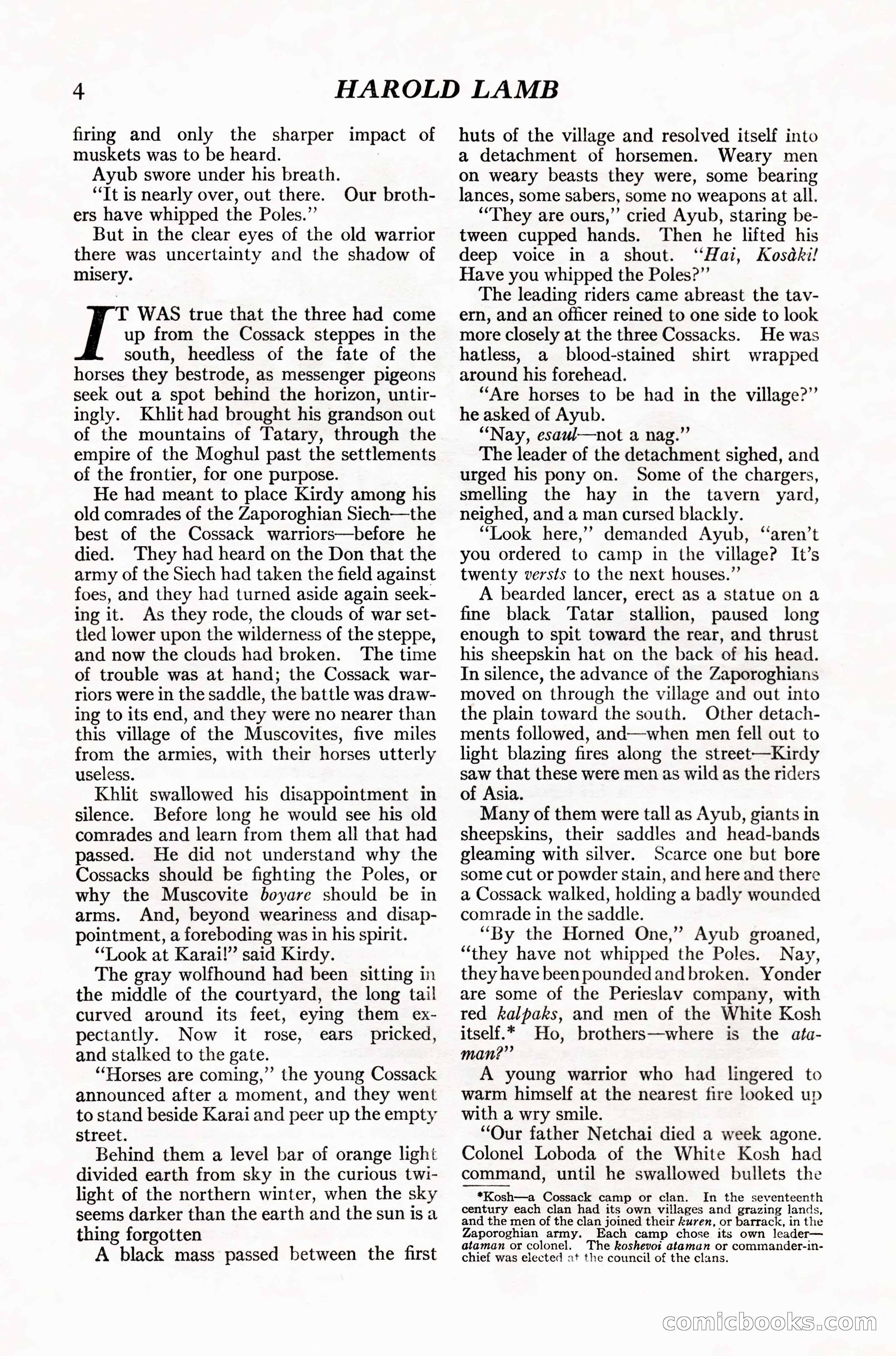
A restored page from Pulp Fiction, 1926. Page through the whole issue in the reader above.
📄 Transcribed text from this page (OCR, searchable)
Machine-transcribed from the original scan — historical spelling and the odd misread are preserved.
4 firing and only the sharper impact of muskets was to be heard. Ayub swore under his breath. “It is nearly over, out there. ers have whipped the Poles.” But in the clear eyes of the old warrior there was uncertainty and the shadow of misery. Our broth- | T WAS true that the three had come up from the Cossack steppes in the south, heedless of the fate of the horses they bestrode, as messenger pigeons seek out a spot behind the horizon, untir- ingly. Khlit had brought his grandson out of the mountains of Tatary, through the empire of the Moghul past the settlements of the frontier, for one purpose. He had meant to place Kirdy among his old comrades of the Zaporoghian Siech—the best of the Cossack warriors—before he died. They had heard on the Don that the army of the Siech had taken the field against foes, and they had turned aside again seek- ing it. As they rode, the clouds of war set- tled lower upon the wilderness of the steppe, and now the clouds had broken. ‘The time of trouble was at hand; the Cossack war- riors were in the saddle, the battle was draw- ing to its end, and they were no nearer than this village of the Muscovites, five miles from the armies, with their horses utterly useless. Khlit swallowed his disappointment in silence. Before long he would see his old comrades and learn from them all that had passed. He did not understand why the Cossacks should be fighting the Poles, or why the Muscovite boyare should be in arms. And, beyond weariness and disap- pointment, a foreboding was in his spirit. “Look at Karai!” said Kirdy. The gray wolfhound had been sitting in the middle of the courtyard, the long tail curved around its feet, eying them ex- pectantly. Now it rose, ears pricked, and stalked to the gate. “Horses are coming,” the young Cossack announced after a moment, and they went to stand beside Karai and peer up the empty street. Behind them a level bar of orange light divided earth from sky in the curious twi- light of the northern winter, when the sky seems darker than the earth and the sun is a thing forgotten A black mass passed between the first HAROLD LAMB huts of the village and resolved itself into a detachment of horsemen. Weary men on weary beasts they were, some bearing lances, some sabers, some no weapons at all. “They are ours,” cried Ayub, staring be- tween cupped hands. Then he lifted his deep voice in a shout. “Hai, Kosdki! Have you whipped the Poles?”’ The leading riders came abreast the tav- ern, and an officer reined to one side to look more closely at the three Cossacks. He was hatless, a blood-stained shirt wrapped around his forehead. “Are horses to be had in the village?” he asked of Ayub. “Nay, esaul—not a nag.” The leader of the detachment sighed, and urged his pony on. Some of the chargers, smelling the hay in the tavern yard, neighed, and a man cursed blackly. “Look here,’’ demanded Ayub, “aren’t you ordered to camp in the village? It’s twenty versts to the next houses.” A bearded lancer, erect as a statue on a fine black Tatar stallion, paused long enough to spit toward the rear, and thrust his sheepskin hat on the back of his head. In silence, the advance of the Zaporoghians moved on through the village and out into the plain toward the south. Other detach- ments followed, and—when men fell out to light blazing fires along the street—Kirdy saw that these were men as wild as the riders of Asia. Many of them were tall as Ayub, giants in sheepskins, their saddles and head-bands gleaming with silver. Scarce one but bore some cut or powder stain, and here and there a Cossack walked, holding a badly wounded comrade in the saddle. “By the Horned One,” Ayub groaned, “they have not whipped the Poles. Nay, they have been pounded and broken. Yonder are some of the Perieslav company, with red kalpaks, and men of the White Kosh itself.* Ho, brothers—where is the ata- man?” A young warrior who had lingered to warm himself at the nearest fire looked up with a wry smile. “Our father Netchai died a week agone. Colonel Loboda of the White Kosh had command, until he swallowed bullets the *Kosh—a Cossack camp or clan. In the seventeenth century each clan had its own villages and grazing lands, and the men of the clan joined their kuren, or barrack, in the Zaporoghian army. Each camp chose its own leader— ataman or colonel. The koshevoi ataman or commander-in- chief was elected at the council of the clans. COMmiclboook (C©