
Pulp Fiction, 1926 · page 203 of 212
Adventure Magazine Cover — page 203: what you’re looking at
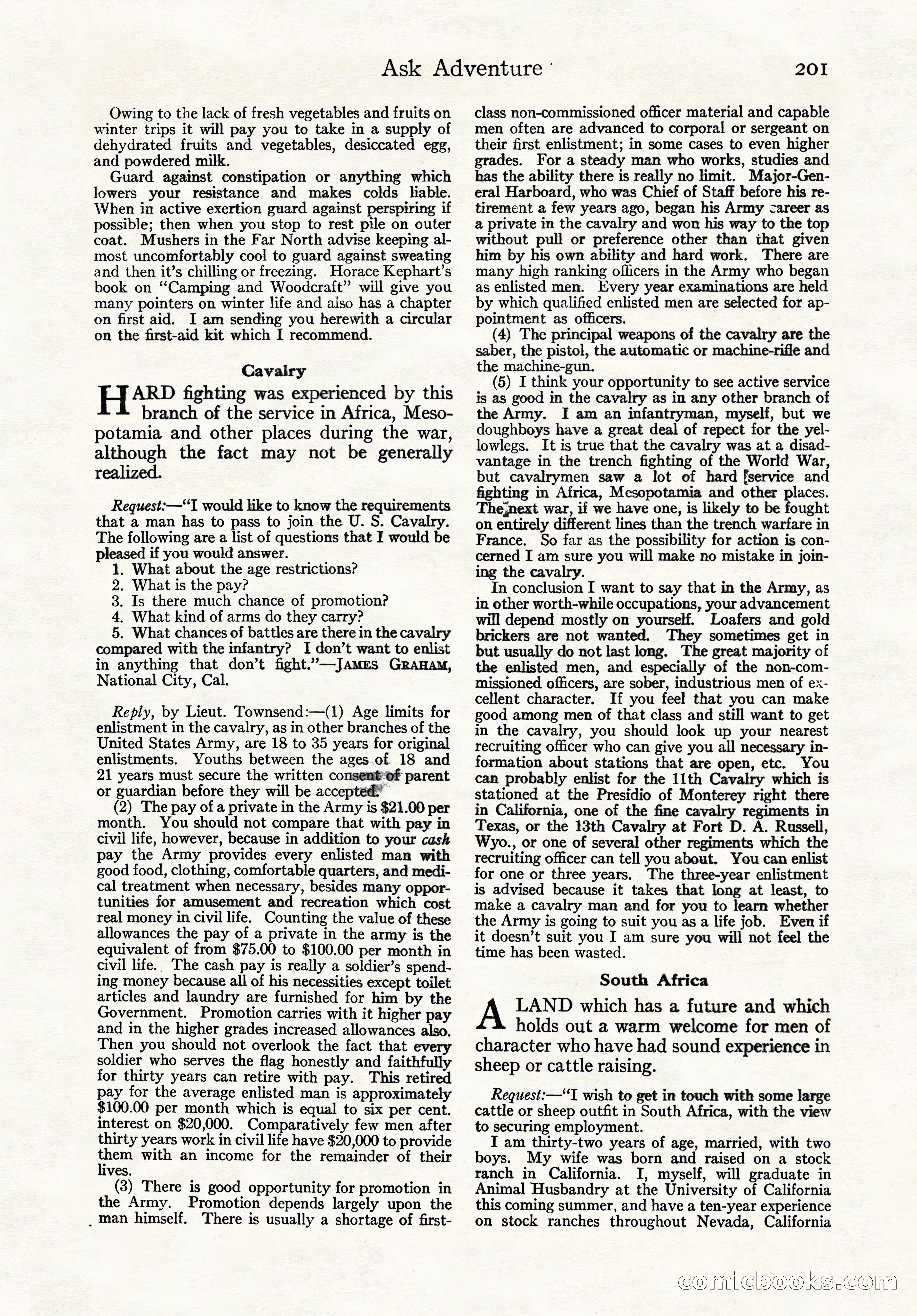
A restored page from Pulp Fiction, 1926. Page through the whole issue in the reader above.
📄 Transcribed text from this page (OCR, searchable)
Machine-transcribed from the original scan — historical spelling and the odd misread are preserved.
Ask Adventure ° Owing to the lack of fresh vegetables and fruits on winter trips it will pay you to take in a supply of dehydrated fruits and vegetables, desiccated egg, and powdered milk. Guard against constipation or anything which lowers your resistance and makes colds hable. When in active exertion guard against perspiring if possible; then when you stop to rest pile on outer coat. Mushers in the Far North advise keeping al- most uncomfortably cool to guard against sweating and then it’s chilling or freezing. Horace Kephart’s book on “Camping and Woodcraft” will give you many pointers on winter life and also has a chapter on first aid. I am sending you herewith a circular on the first-aid kit which I recommend. Cavalry lis Goa fighting was experienced by this branch of the service in Africa, Meso- potamia and other places during the war, although the fact may not be generally realized. Request:—“T would like to know the requirements that a man has to pass to join the U. S. Cavalry. The following are a list of questions that I would be pleased if you would answer. 1. What about the age restrictions? 2. What is the pay? 3. Is there much chance of promotion? 4. What kind of arms do they carry? 5. What chances of battles are there in the cavalry compared with the infantry? I don’t want to enlist in anything that don’t fight.”"—-James GRAHaM, National City, Cal. Reply, by Lieut. Townsend:—(1) Age limits for enlistment in the cavalry, as in other branches of the United States Army, are 18 to 35 years for original enlistments. Youths between the ages.of 18 and 21 years must secure the written consemt-of parent or guardian before they will be accepted}’” (2) The pay of a private in the Army is $21.00 per month. You should not compare that with pay in civil life, however, because in addition to your cash pay the Army provides every enlisted man with good food, clothing, comfortable quarters, and medi- cal treatment when necessary, besides many oppor- tunities for amusement and recreation which cost real money in civil life. Counting the value of these allowances the pay of a private in the army is the equivalent of from $75.00 to $100.00 per month in civil life.. The cash pay is really a soldier’s spend- ing money because all of his necessities except toilet articles and laundry are furnished for him by the Government. Promotion carries with it higher pay and in the higher grades increased allowances also. Then you should not overlook the fact that every soldier who serves the flag honestly and faithfully for thirty years can retire with pay. This retired pay for the average enlisted man is approximately $100.00 per month which is equal to six per cent. interest on $20,000. Comparatively few men after thirty years work in civil life have $20,000 to provide hem with an income for the remainder of their ives. (3) There is good opportunity for promotion in the Army. Promotion depends largely upon the _ man himself. There is usually a shortage of first- 201 class non-commissioned officer material and capable men often are advanced to corporal or sergeant on their first enlistment; in some cases to even higher grades. For a steady man who works, studies and has the ability there is really no imit. Major-Gen- eral Harboard, who was Chief of Staff before his re- tirement a few years ago, began his Army <areer as a private in the cavalry and won his way to the top without pull or preference other than that given him by his own ability and hard work. There are many high ranking officers in the Army who began as enlisted men. Every year examinations are held by which qualified enlisted men are selected for ap- pointment as officers. (4) The principal weapons of the cavalry are the saber, the pistol, the automatic or machine-rifle and the machine-gun. (5) I think your opportunity to see active service is as good im the cavalry as in any other branch of the Army. I am an infantryman, myself, but we doughboys have a great deal of repect for the yel- lowlegs. It is true that the cavalry was at a disad- vantage in the trench fighting of the World War, but cavalrymen saw a lot of hard {service and fighting in Africa, Mesopotamia and other places. The;next war, if we have one, is likely to be fought on entirely different lines than the trench warfare in France. So far as the possibility for action is con- cerned I am sure you will make no mistake in join- ing the cavalry. In conclusion I want to say that in the Army, as in other worth-while occupations, your advancement will depend mostly on yourself. Loafers and gold brickers are not wanted. They sometimes get in but usually do not last long. The great majority of the enlisted men, and especially of the non-com- missioned officers, are sober, industrious men of ex- cellent character. If you feel that you can make good among men of that class and still want to get in the cavalry, you should look up your nearest recruiting officer who can give you all necessary in- formation about stations that are open, etc. You can probably enlist for the 11th Cavalry which is stationed at the Presidio of Monterey right there in California, one of the fine cavalry regiments in Texas, or the 13th Cavalry at Fort D. A. Russell, Wyo., or one of several other regiments which the recruiting officer can tell you about. You can enlist for one or three years. The three-year enlistment is advised because it takes that long at least, to make a cavalry man and for you to learn whether the Army is going to suit you as a life job. Even if it doesn’t suit you I am sure you will not feel the time has been wasted. South Africa LAND which has a future and which holds out a warm welcome for men of character who have had sound experience in sheep or cattle raising. Request:—“T wish to get in touch with some large cattle or sheep outfit in South Africa, with the view to securing employment. I am thirty-two years of age, married, with two boys. My wife was born and raised on a stock ranch in California. I, myself, will graduate in Animal Husbandry at the University of California this coming summer, and have a ten-year experience on stock ranches throughout Nevada, California MICLOOOKS (C@