
Pulp Fiction, 1926 · page 202 of 212
Adventure Magazine Cover — page 202: what you’re looking at
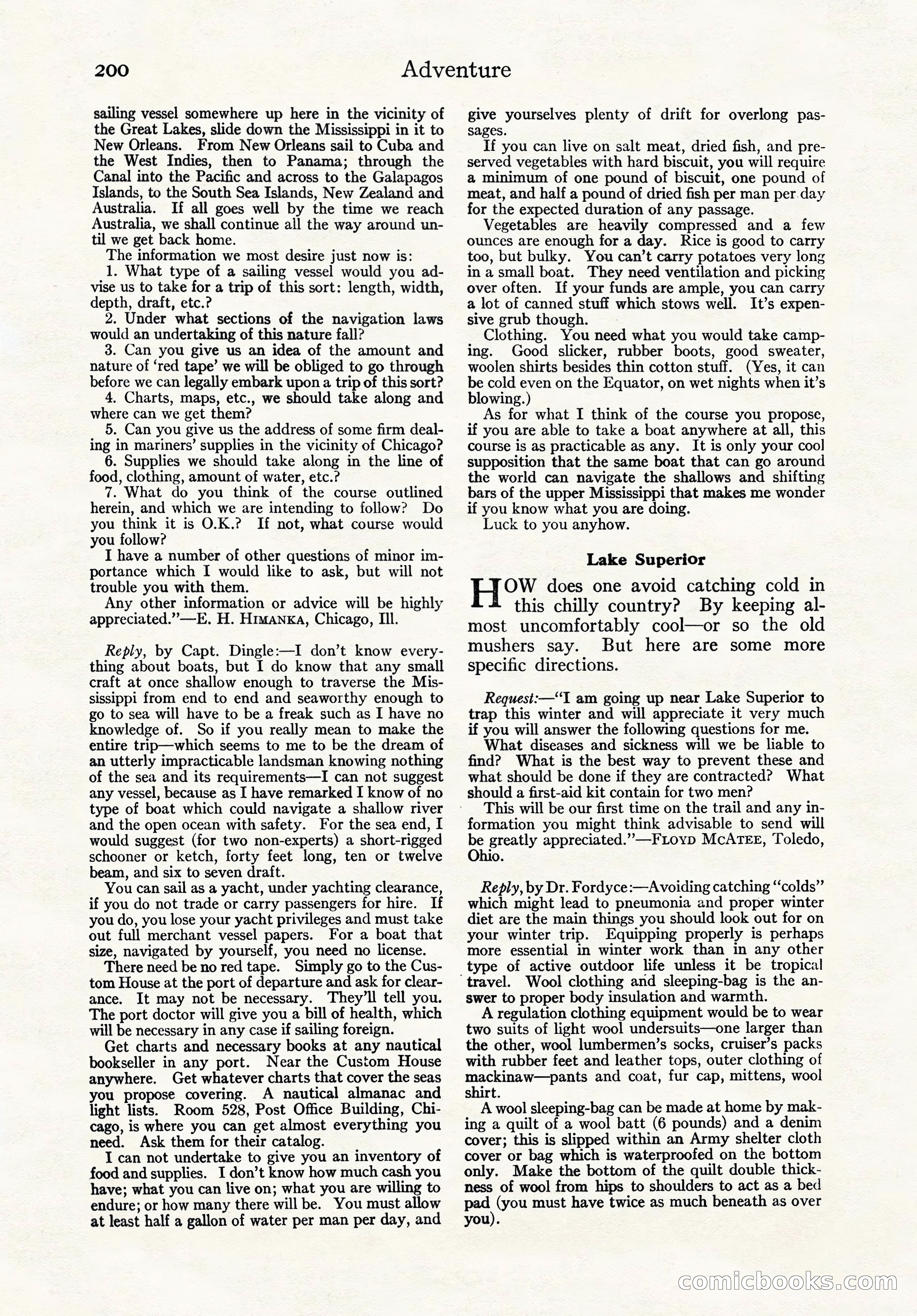
A restored page from Pulp Fiction, 1926. Page through the whole issue in the reader above.
📄 Transcribed text from this page (OCR, searchable)
Machine-transcribed from the original scan — historical spelling and the odd misread are preserved.
200 sailing vessel somewhere up here in the vicinity of the Great Lakes, slide down the Mississippi in it to New Orleans. From New Orleans sail to Cuba and the West Indies, then to Panama; through the Canal into the Pacific and across to the Galapagos Islands, to the South Sea Islands, New Zealand and Australia. If all goes well by the time we reach Australia, we shall continue all the way around un- til we get back home. The information we most desire just now is: 1. What type of a sailing vessel would you ad- vise us to take for a trip of this sort: length, width, depth, draft, etc.? 2. Under what sections of the navigation laws would an undertaking of this nature fall? 3. Can you give us an idea of the amount and nature of ‘red tape’ we will be obliged to go through before we can legally embark upon a trip of this sort? 4, Charts, maps, etc., we should take along and where can we get them? 5. Can you give us the address of some firm deal- ing in mariners’ supplies in the vicinity of Chicago? 6. Supplies we should take along in the line of food, clothing, amount of water, etc.? 7. What do you think of the course outlined herein, and which we are intending to follow? Do you think it is O.K.? If not, what course would you follow? I have a number of other questions of minor im- portance which I would like to ask, but will not trouble you with them. Any other information or advice will be highly appreciated.” —E. H. Hmanxa, Chicago, IIl. Reply, by Capt. Dingle:—I don’t know every- thing about boats, but I do know that any small craft at once shallow enough to traverse the Mis- sissippi from end to end and seaworthy enough to go to sea will have to be a freak such as I have no knowledge of. So if you really mean to make the entire trip—which seems to me to be the dream of an utterly impracticable landsman knowing nothing of the sea and its requirements—I can not suggest any vessel, because as I have remarked I know of no type of boat which could navigate a shallow river and the open ocean with safety. For the sea end, I would suggest (for two non-experts) a short-rigged schooner or ketch, forty feet long, ten or twelve beam, and six to seven draft. You can sail as a yacht, under yachting clearance, if you do not trade or carry passengers for hire. If you do, you lose your yacht privileges and must take out full merchant vessel papers. For a boat that size, navigated by yourself, you need no license. There need be no red tape. Simply go to the Cus- tom House at the port of departure and ask for clear- ance. It may not be necessary. They’ll tell you. The port doctor will give you a bill of health, which will be necessary in any case if sailing foreign. Get charts and necessary books at any nautical bookseller in any port. Near the Custom House anywhere. Get whatever charts that cover the seas you propose covering. A nautical almanac and light lists. Room 528, Post Office Building, Chi- cago, is where you can get almost everything you need. Ask them for their catalog. I can not undertake to give you an inventory of food and supplies. I don’t know how much cash you have; what you can live on; what you are willing to endure; or how many there will be. You must allow at least half a gallon of water per man per day, and Adventure give yourselves plenty of drift for overlong pas- sages. If you can live on salt meat, dried fish, and pre- served vegetables with hard biscuit, you will require a minimum of one pound of biscuit, one pound of meat, and half a pound of dried fish per man per.day for the expected duration of any passage. Vegetables are heavily compressed and a few ounces are enough for a day. Rice is good to carry too, but bulky. You can’t carry potatoes very long in a small boat. They need ventilation and picking over often. If your funds are ample, you can carry a lot of canned stuff which stows well. It’s expen- sive grub though. Clothing. You need what you would take camp- ing. Good slicker, rubber boots, good sweater, woolen shirts besides thin cotton stuff. (Yes, it can be cold even on the Equator, on wet nights when it’s blowing.) As for what I think of the course you propose, if you are able to take a boat anywhere at all, this course is as practicable as any. It is only your cool supposition that the same boat that can go around the world can navigate the shallows and shifting bars of the upper Mississippi that makes me wonder if you know what you are doing. Luck to you anyhow. Lake Superior Ho“ does one avoid catching cold in this chilly country? By keeping al- most uncomfortably cool—or so the old mushers say. But here are some more specific directions. Requesi:—“I am going up near Lake Superior to trap this winter and will appreciate it very much if you will answer the following questions for me. What diseases and sickness will we be liable to find? What is the best way to prevent these and what should be done if they are contracted? What should a first-aid kit contain for two men? This will be our first time on the trail and any in- formation you might think advisable to send will be greatly appreciated.” —FLoyp McATEE, Toledo, Ohio. Reply, by Dr. Fordyce:—Avoiding catching ‘‘colds” which might lead to pneumonia and proper winter diet are the main things you should look out for on your winter trip. Equipping properly is perhaps more essential in winter work than in any other type of active outdoor life unless it be tropical ‘travel. Wool clothing and sleeping-bag is the an- swer to proper body insulation and warmth. A regulation clothing equipment would be to wear two suits of light wool undersuits—one larger than the other, wool lumbermen’s socks, cruiser’s packs with rubber feet and leather tops, outer clothing of mackinaw—pants and coat, fur cap, mittens, wool shirt. A wool sleeping-bag can be made at home by mak- ing a quilt of a wool batt (6 pounds) and a denim cover; this is slipped within an Army shelter cloth cover or bag which is waterproofed on the bottom only. Make the bottom of the quilt double thick- ness of wool from hips to shoulders to act as a bed pad (you must have twice as much beneath as over you). NOOK (©