
Pulp Fiction, 1926 · page 192 of 212
Adventure Magazine Cover — page 192: what you’re looking at
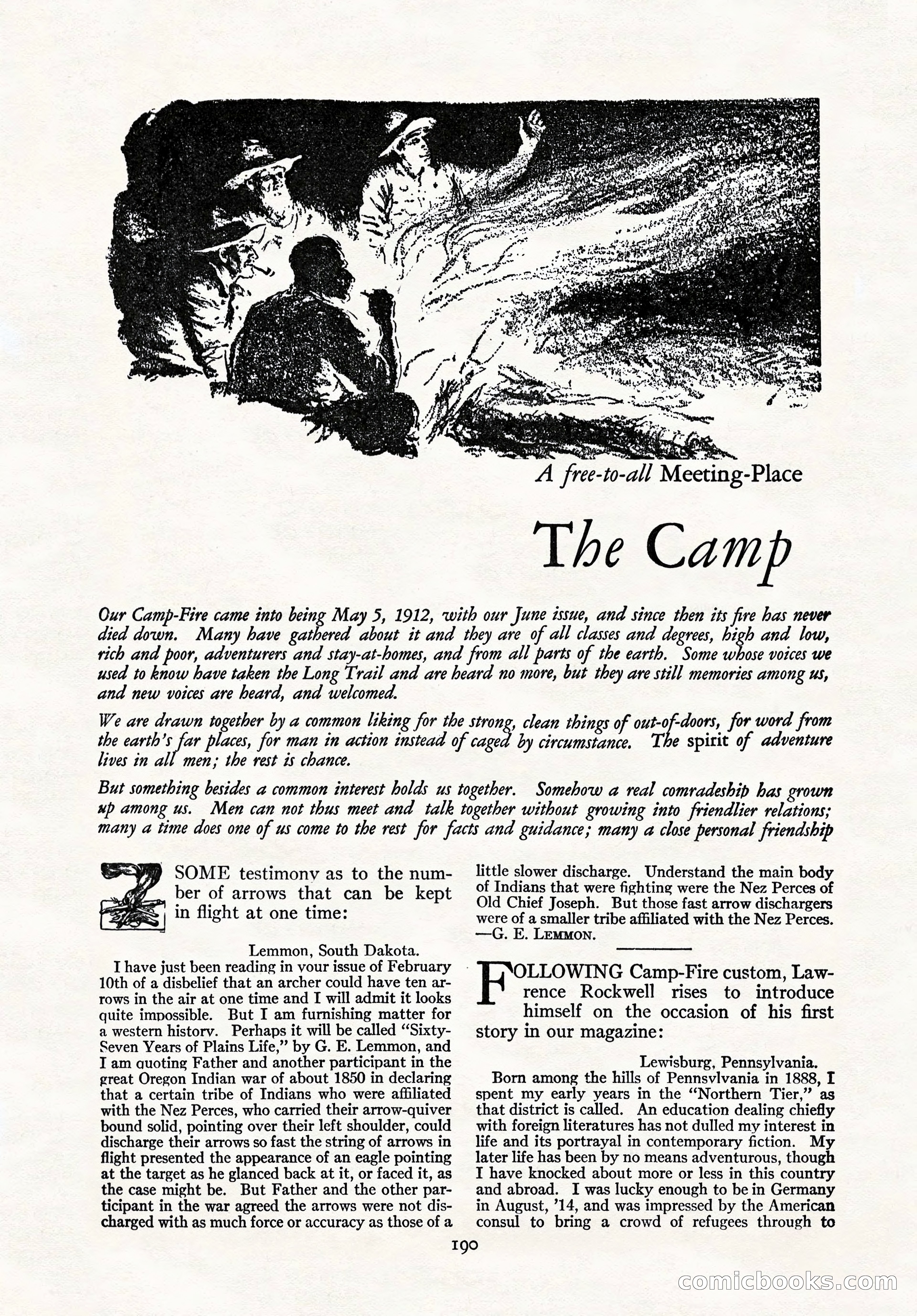
A restored page from Pulp Fiction, 1926. Page through the whole issue in the reader above.
📄 Transcribed text from this page (OCR, searchable)
Machine-transcribed from the original scan — historical spelling and the odd misread are preserved.
The Camp Our Camp-Fire came into being May 5, 1912, with our June issue, and since then its fire has never died down. Many have gathered about it and they are of all classes and degrees, high and low, rich and poor, adventurers and stay-at-homes, and from all parts of the earth. Some ae voices we used to know have taken the Long Trail and are heard no more, but they are still memories among us, and new voices are heard, and welcomed. We are drawn together by a common liking for the strong, clean things of out-o -doors, for word from the earth’s far places, for man in action instead of caged by circumstance, The spirit of adventure lives in all men; the rest is chance. But something besides a common interest holds us together. Somehow a real comradeship has grown xp among us. Men can not thus meet and talk together without growing into friendlier relations; many a time does one of us come to the rest for facts and guidance; many a close personal friendship SOME testimony as to the num- ber of arrows that can be kept in flight at one time: Lemmon, South Dakota. I have just been reading in vour issue of February 10th of a disbelief that an archer could have ten ar- rows in the air at one time and I will admit it looks quite impossible. But I am furnishing matter for a western historv. Perhaps it will be called ‘‘Sixty- Seven Years of Plains Life,”’ by G. E. Lemmon, and I am quoting Father and another participant in the great Oregon Indian war of about 1850 in declaring that a certain tribe of Indians who were affliated with the Nez Perces, who carried their arrow-quiver bound solid, pointing over their left shoulder, could discharge their arrows so fast the string of arrows in flight presented the appearance of an eagle pointing at the target as he glanced back at it, or faced it, as the case might be. But Father and the other par- ticipant in the war agreed the arrows were not dis- charged with as much force or accuracy as those of a little slower discharge. Understand the main body of Indians that were fighting were the Nez Perces of Old Chief Joseph. But those fast arrow dischargers were of a smaller tribe affiliated with the Nez Perces. —G. E. Lemmon. OLLOWING Camp-Fire custom, Law- rence Rockwell rises to introduce himself on the occasion of his first story in our magazine: Lewisburg, Pennsylvania. Born among the hills of Pennsvlvania in 1888, I spent my early years in the ‘‘Northern Tier,” as that district is called. An education dealing chiefly with foreign literatures has not dulled my interest in life and its portrayal in contemporary fiction. My later life has been by no means adventurous, though IT have knocked about more or less in this country and abroad. I was lucky enough to be in Germany in August, 714, and was impressed by the American consul to bring a crowd of refugees through to 190 MICLOO© S (C@