
Pulp Fiction, 1926 · page 190 of 212
Adventure Magazine Cover — page 190: what you’re looking at
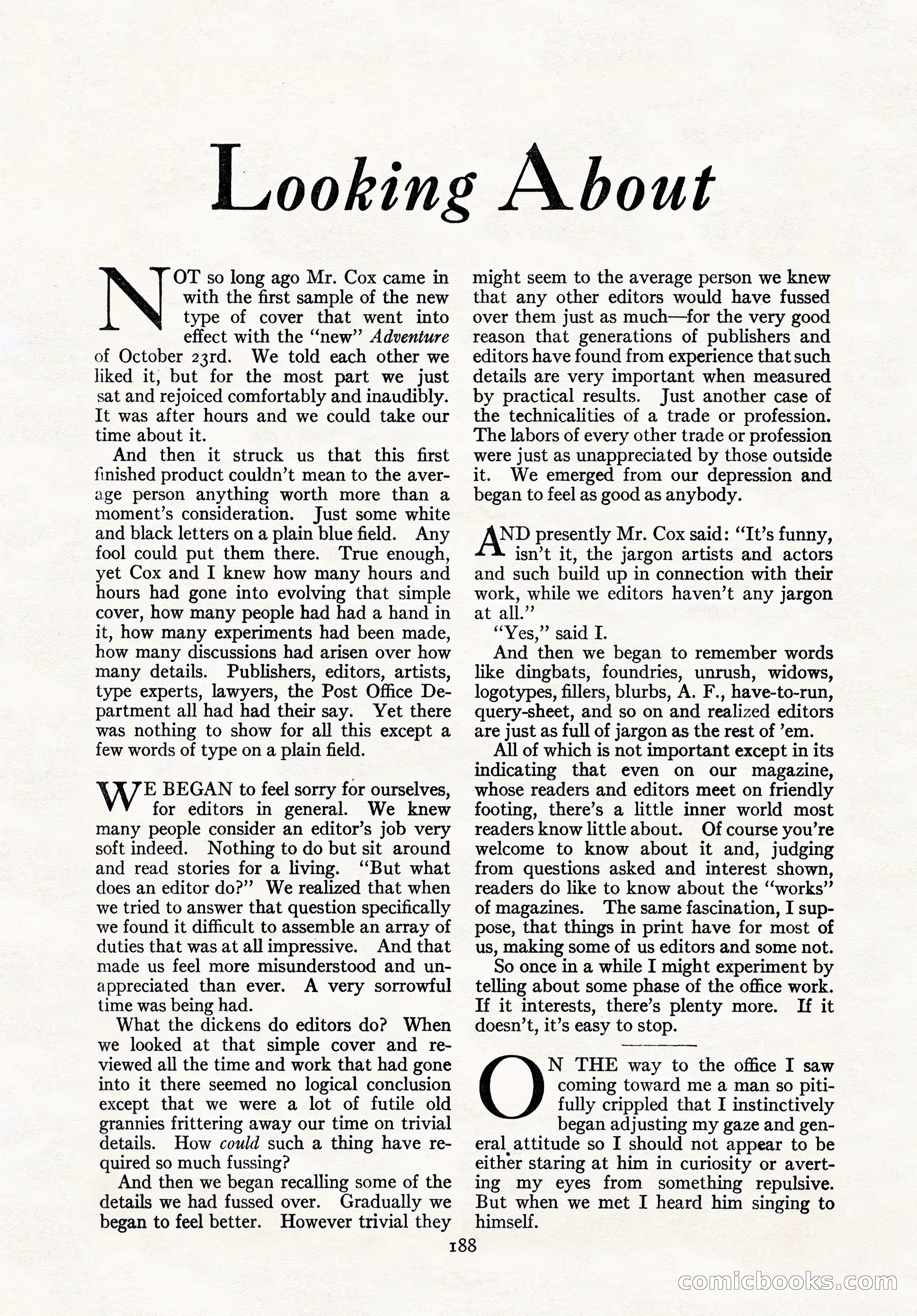
A restored page from Pulp Fiction, 1926. Page through the whole issue in the reader above.
📄 Transcribed text from this page (OCR, searchable)
Machine-transcribed from the original scan — historical spelling and the odd misread are preserved.
Looking About OT so long ago Mr. Cox came in with the first sample of the new type of cover that went into effect with the “new” Adventure of October 23rd. We told each other we liked it, but for the most part we just sat and rejoiced comfortably and inaudibly. It was after hours and we could take our time about it. And then it struck us that this first finished product couldn’t mean to the aver- age person anything worth more than a moment’s consideration. Just some white and black letters on a plain blue field. Any fool could put them there. True enough, yet Cox and I knew how many hours and hours had gone into evolving that simple cover, how many people had had a hand in it, how many experiments had been made, how many discussions had arisen over how many details. Publishers, editors, artists, type experts, lawyers, the Post Office De- partment all had had their say. Yet there was nothing to show for all this except a few words of type on a plain field. WE BEGAN to feel sorry for ourselves, for editors in general. We knew many people consider an editor’s job very soft indeed. Nothing to do but sit around and read stories for a living. “But what does an editor do?” We realized that when we tried to answer that question specifically we found it difficult to assemble an array of duties that was at all impressive. And that made us feel more misunderstood and un- appreciated than ever. A very sorrowful time was being had. What the dickens do editors do? When we looked at that simple cover and re- viewed all the time and work that had gone into it there seemed no logical conclusion except that we were a lot of futile old grannies frittering away our time on trivial details. How could such a thing have re- quired so much fussing? And then we began recalling some of the details we had fussed over. Gradually we began to feel better. However trivial they might seem to the average person we knew that any other editors would have fussed over them just as much—for the very good reason that generations of publishers and editors have found from experience that such details are very important when measured by practical results. Just another case of the technicalities of a trade or profession. The labors of every other trade or profession were just as unappreciated by those outside it. We emerged from our depression and began to feel as good as anybody. ASS presently Mr. Cox said: “It’s funny, isn’t it, the jargon artists and actors and such build up in connection with their work, while we editors haven’t any jargon at all.” “Ves,” said I. And then we began to remember words like dingbats, foundries, unrush, widows, logotypes, fillers, blurbs, A. F., have-to-run, query-sheet, and so on and realized editors are just as full of jargon as the rest of ’em. All of which is not important except in its indicating that even on our magazine, whose readers and editors meet on friendly footing, there’s a little inner world most readers know little about. Of course you’re welcome to know about it and, judging from questions asked and interest shown, readers do like to know about the ‘‘works”’ of magazines. The same fascination, I sup- pose, that things in print have for most of us, making some of us editors and some not. So once in a while I might experiment by telling about some phase of the office work. If it interests, there’s plenty more. If it doesn’t, it’s easy to stop. N THE way to the office I saw coming toward me a man ¢0 piti- fully crippled that I instinctively began adjusting my gaze and gen- eral attitude so I should not appear to be either staring at him in curiosity or avert- ing my eyes from something repulsive. But when we met I heard him singing to himself. 188 MICLOOOK (©