
Pulp Fiction, 1926 · page 189 of 212
Adventure Magazine Cover — page 189: what you’re looking at
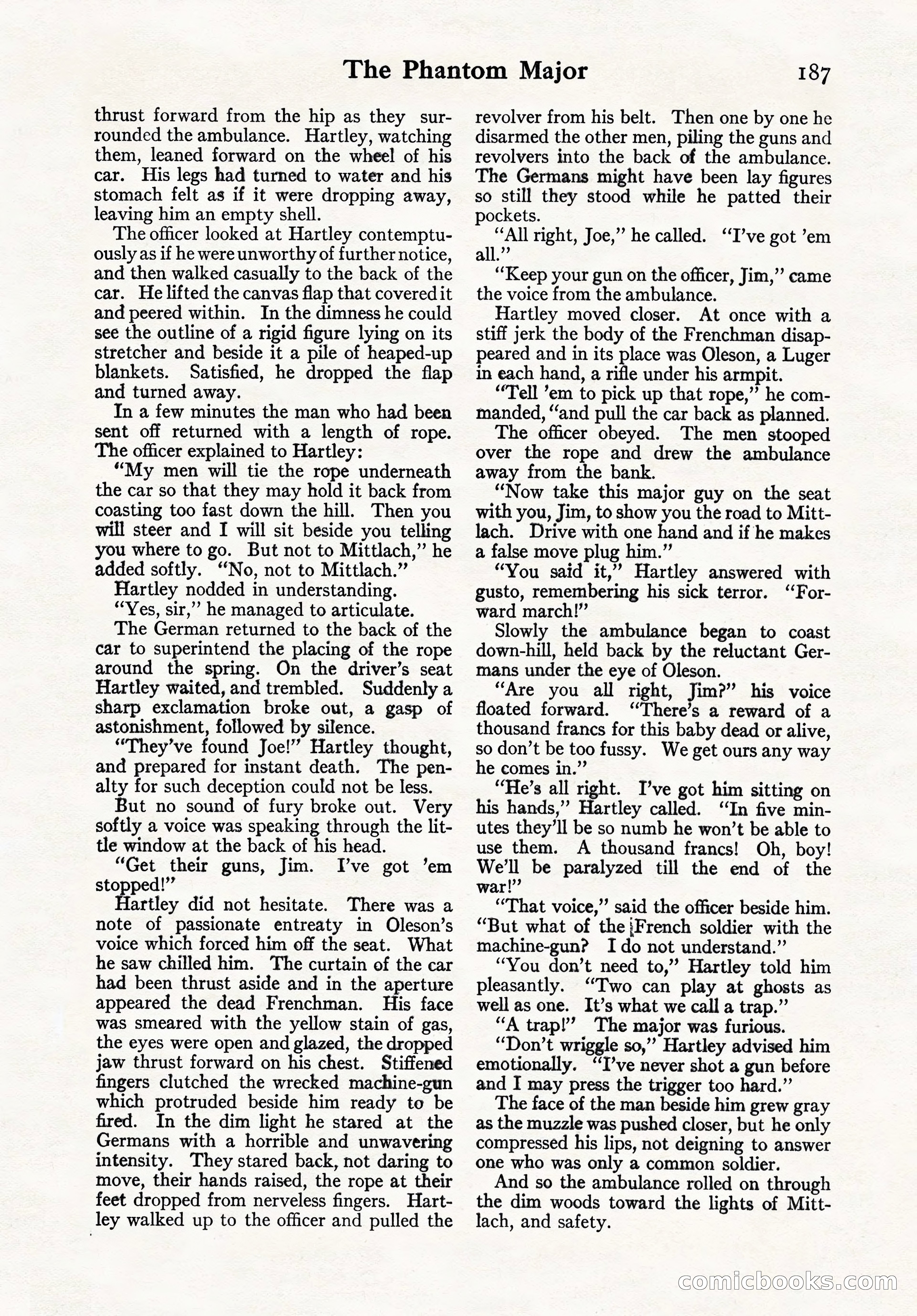
A restored page from Pulp Fiction, 1926. Page through the whole issue in the reader above.
📄 Transcribed text from this page (OCR, searchable)
Machine-transcribed from the original scan — historical spelling and the odd misread are preserved.
The Phantom Major thrust forward from the hip as they sur- rounded the ambulance. Hartley, watching them, leaned forward on the wheel of his car. His legs had turned to water and his stomach felt as if it were dropping away, leaving him an empty shell. The officer looked at Hartley contemptu- ously as if he were unworthy of further notice, and then walked casually to the back of the car. He lifted the canvas flap that covered it and peered within. In the dimness he could see the outline of a rigid figure lying on its stretcher and beside it a pile of heaped-up blankets. Satisfied, he dropped the flap and turned away. In a few minutes the man who had been sent off returned with a length of rope. The officer explained to Hartley: “My men will tie the rope underneath the car so that they may hold it back from coasting too fast down the hill. Then you will steer and I will sit beside you telling you where to go. But not to Mittlach,” he added softly. “No, not to Mittlach.” Hartley nodded in understanding. “Yes, sir,” he managed to articulate. The German returned to the back of the car to superintend the placing of the rope around the spring. On the driver’s seat Hartley waited, and trembled. Suddenly a sharp exclamation broke out, a gasp of astonishment, followed by silence. “They’ve found Joe!”’ Hartley thought, and prepared for instant death. The pen- alty for such deception could not be less. But no sound of fury broke out. Very softly a voice was speaking through the lit- tle window at the back of his head. “Get their guns, Jim. I’ve got ’em stopped!” Hartley did not hesitate. There was a note of passionate entreaty in Oleson’s voice which forced him off the seat. What he saw chilled him. The curtain of the car had been thrust aside and in the aperture appeared the dead Frenchman. His face was smeared with the yellow stain of gas, the eyes were open and glazed, the dropped jaw thrust forward on his chest. Stiffened fingers clutched the wrecked machine-gun which protruded beside him ready to be fired. In the dim light he stared at the Germans with a horrible and unwavering intensity. They stared back, not daring to move, their hands raised, the rope at their feet dropped from nerveless fingers. Hart- ley walked up to the officer and pulled the 187 revolver from his belt. Then one by one he disarmed the other men, piling the guns and revolvers into the back of the ambulance. The Germans might have been lay figures so still they stood while he patted their pockets. “All right, Joe,” he called. ‘T’ve got ’em all.” ‘Keep your gun on the officer, Jim,” came the voice from the ambulance. Hartley moved closer. At once with a stiff jerk the body of the Frenchman disap- peared and in its place was Oleson, a Luger in each hand, a rifle under his armpit. “Tell ’em to pick up that rope,” he com- manded, “and pull the car back as planned. The officer obeyed. The men stooped over the rope and drew the ambulance away from the bank. “Now take this major guy on the seat with you, Jim, to show you the road to Mitt- lach. Drive with one hand and if he makes a false move plug him.” “You said it,’ Hartley answered with gusto, remembering his sick terror. ‘For- ward march!” Slowly the ambulance began to coast down-hill, held back by the reluctant Ger- mans under the eye of Oleson. “Are you all right, Jim?” his voice floated forward. ‘There’s a reward of a thousand francs for this baby dead or alive, so don’t be too fussy. We get ours any way he comes in.” “He’s all right. I’ve got him sitting on his hands,” Hartley called. ‘In five min- utes they’ll be so numb he won’t be able to use them. A thousand francs! Oh, boy! We'll be paralyzed till the end of the war!”’ ‘That voice,” said the officer beside him. “But what of theiFrench soldier with the machine-gun? Ido not understand.” “You don’t need to,” Hartley told him pleasantly. ‘Two can play at ghosts as well as one. It’s what we call a trap.” “A trap!’ The major was furious. “Don’t wriggle so,” Hartley advised him emotionally. “I’ve never shot a gun before and I may press the trigger too hard.” The face of the man beside him grew gray as the muzzle was pushed closer, but he only compressed his lips, not deigning to answer one who was only a common soldier. And so the ambulance rolled on through the dim woods toward the lights of Mitt- lach, and safety. DOOLK (C@