
Pulp Fiction, 1926 · page 186 of 212
Adventure Magazine Cover — page 186: what you’re looking at
A restored page from Pulp Fiction, 1926. Page through the whole issue in the reader above.
📄 Transcribed text from this page (OCR, searchable)
Machine-transcribed from the original scan — historical spelling and the odd misread are preserved.
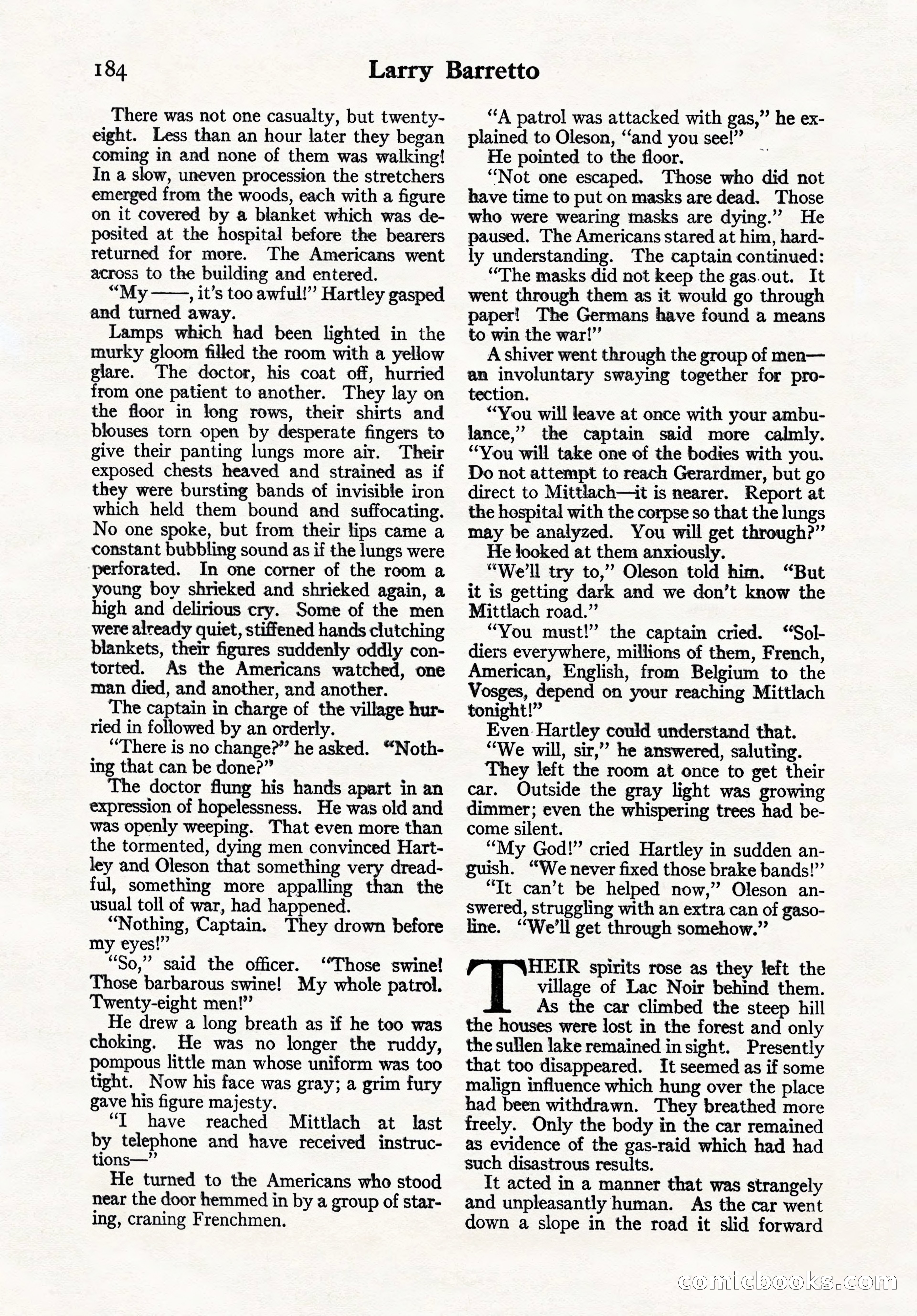
184 There was not one casualty, but twenty- eight. Less than an hour later they began coming in and none of them was walking! In a slow, uneven procession the stretchers emerged from the woods, each with a figure on it covered by a blanket which was de- posited at the hospital before the bearers returned for more. The Americans went across to the building and entered. “My ——, it’s too awful!” Hartley gasped and turned away. Lamps which had been lighted in the murky gloom filled the room with a yellow glare. The doctor, his coat off, hurried from one patient to another. They lay on the floor in long rows, their shirts and blouses torn open by desperate fingers to give their panting lungs more air. Their exposed chests heaved and strained as if they were bursting bands of invisible iron which held them bound and suffocating. No one spoke, but from their lips came a constant bubbling sound as if the lungs were perforated. In one corner of the room a young bov shrieked and shrieked again, a high and delirious cry. Some of the men were already quiet, stiffened hands clutching blankets, their figures suddenly oddly con- torted. As the Americans watched, one man died, and another, and another. The captain in charge of the village hur- ried in followed by an orderly. “There is no change?”’ he asked. “Noth- ing that can be done?” The doctor flung his hands apart in an expression of hopelessness. He was old and was openly weeping. That even more than the tormented, dying men convinced Hart- ley and Oleson that something very dread- ful, something more appalling than the usual toll of war, had happened. “Nothing, Captain. They drown before my eyes!” “So,” said the officer. ‘Those swine! Those barbarous swine! My whole patrol. Twenty-eight men!” He drew a long breath as if he too was choking. He was no longer the ruddy, pompous little man whose uniform was too tight. Now his face was gray; a grim fury gave his figure majesty. “I have reached Mittlach at last by telephone and have received instruc- tions—”’ He turned to the Americans who stood near the door hemmed in by a group of star- ing, craning Frenchmen. Larry Barretto “A patrol was attacked with gas,” he ex- plained to Oleson, “and you see!” _ He pointed to the floor. “Not one escaped. Those who did not have time to put on masks are dead. Those who were wearing masks are dying.” He paused. The Americans stared at him, hard- ly understanding. The captain continued: ‘The masks did not keep the gas.out. It went through them as it would go through paper! The Germans have found a means to win the war!”’ A shiver went through the group of men— an involuntary swaying together for pro- tection. “You will leave at once with your ambu- lance,” the captain said more calmly. “You will take one of the bodies with you. Do not attempt to reach Gerardmer, but go direct to Mittlach—it is nearer. Report at the hospital with the corpse so that the lungs may be analyzed. You will get through?” He looked at them anxiously. “We'll try to,” Oleson told him. “But it is getting dark and we don’t know the Mittlach road.” “You must!’ the captain cried. ‘Sol- diers everywhere, millions of them, French, American, English, from Belgium to the Vosges, depend on your reaching Mittlach tonight!” Even. Hartley could understand that. “We will, sir,” he answered, saluting. They left the room at once to get their car. Outside the gray light was growing dimmer; even the whispering trees had be- come silent. “My God!” cried Hartley in sudden an- guish. “We never fixed those brake bands!” “It can’t be helped now,’ Oleson an- swered, struggling with an extra can of gaso- line. “We'll get through somehow.” . HEIR spirits rose as they left the village of Lac Noir behind them. ) As the car climbed the steep hill the houses were lost in the forest and only the sullen lake remained insight. Presently that too disappeared. It seemed as if some malign influence which hung over the place had been withdrawn. They breathed more freely. Only the body in the car remained as evidence of the gas-raid which had had such disastrous results. It acted in a manner that was strangely and unpleasantly human. As the car went down a slope in the road it slid forward COnmiclboo SS (C©