
Pulp Fiction, 1926 · page 185 of 212
Adventure Magazine Cover — page 185: what you’re looking at
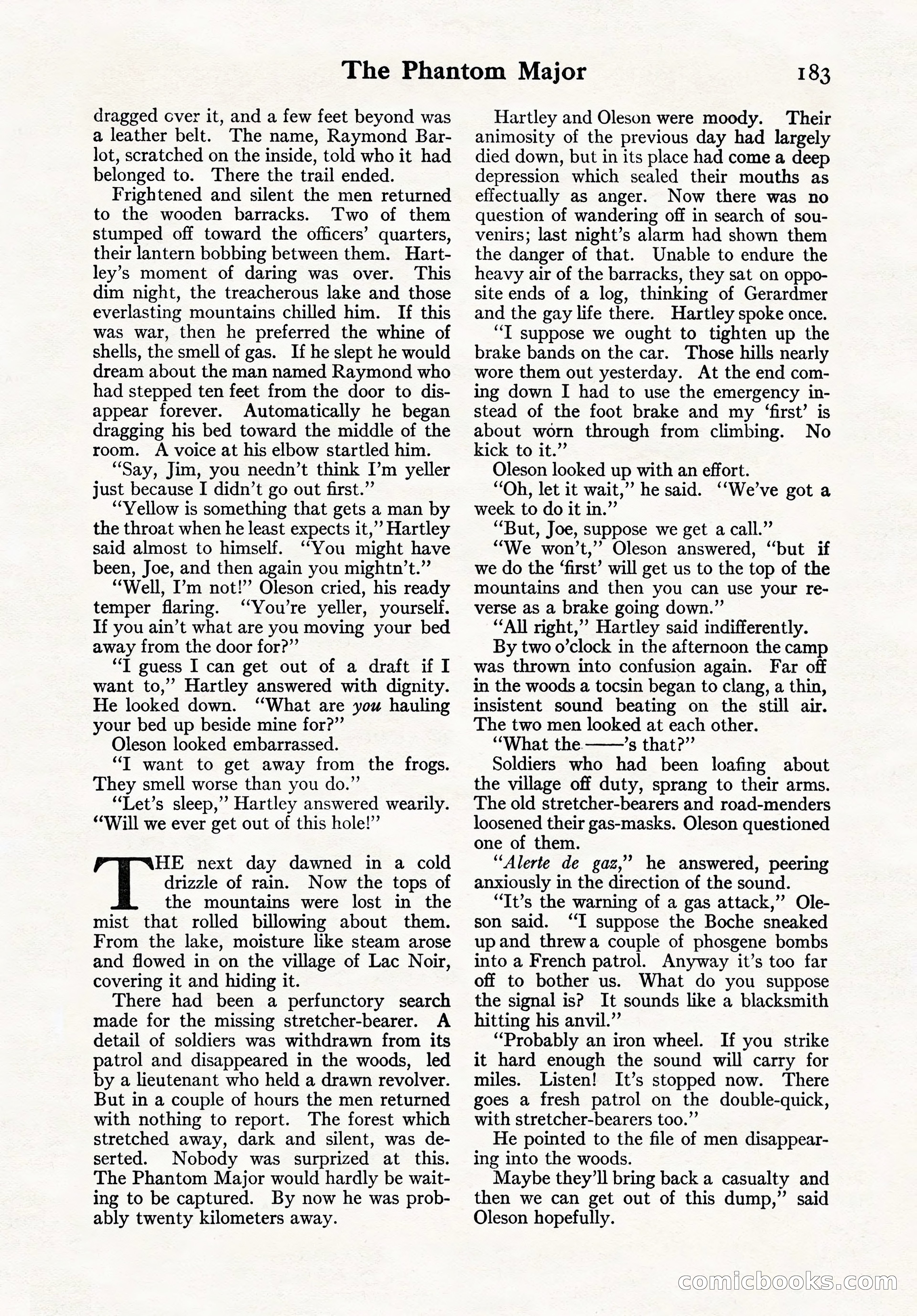
A restored page from Pulp Fiction, 1926. Page through the whole issue in the reader above.
📄 Transcribed text from this page (OCR, searchable)
Machine-transcribed from the original scan — historical spelling and the odd misread are preserved.
The Phantom Major dragged cver it, and a few feet beyond was a leather belt. The name, Raymond Bar- lot, scratched on the inside, told who it had belonged to. There the trail ended. Frightened and silent the men returned to the wooden barracks. Two of them stumped off toward the officers’ quarters, their lantern bobbing between them. Hart- ley’s moment of daring was over. This dim night, the treacherous lake and those everlasting mountains chilled him. If this was war, then he preferred the whine of shells, the smell of gas. If he slept he would dream about the man named Raymond who had stepped ten feet from the door to dis- appear forever. Automatically he began dragging his bed toward the middle of the room. A voice at his elbow startled him. “Say, Jim, you needn’t think I’m yeller just because I didn’t go out first.” ‘Yellow is something that gets a man by the throat when he least expects it,” Hartley said almost to himself. “You might have been, Joe, and then again you mightn’t.”’ “Well, I’m not!” Oleson cried, his ready temper flaring. ‘‘You’re yeller, yourself. If you ain’t what are you moving your bed away from the door for?”’ “T guess I can get out of a draft if I want to,’ Hartley answered with dignity. He looked down. ‘What are you hauling your bed up beside mine for?” Oleson looked embarrassed. “T want to get away from the frogs. They smell worse than you do.” “Let’s sleep,” Hartley answered wearily. ‘Will we ever get out of this hole!” HE next day dawned in a cold : drizzle of rain. Now the tops of the mountains were lost in the mist that rolled billowing about them. From the lake, moisture like steam arose and flowed in on the village of Lac Noir, covering it and hiding it. There had been a perfunctory search made for the missing stretcher-bearer. A detail of soldiers was withdrawn from its patrol and disappeared in the woods, led by a lieutenant who held a drawn revolver. But in a couple of hours the men returned with nothing to report. The forest which stretched away, dark and silent, was de- serted. Nobody was surprized at this. The Phantom Major would hardly be wait- ing to be captured. By now he was prob- ably twenty kilometers away. 183 Hartley and Oleson were moody. Their animosity of the previous day had largely died down, but in its place had come a deep depression which sealed their mouths as effectually as anger. Now there was no question of wandering off in search of sou- venirs; last night’s alarm had shown them the danger of that. Unable to endure the heavy air of the barracks, they sat on oppo- site ends of a log, thinking of Gerardmer and the gay life there. Hartley spoke once. “IT suppose we ought to tighten up the brake bands on the car. Those hills nearly wore them out yesterday. At the end com- ing down I had to use the emergency in- stead of the foot brake and my ‘first’ is about worn through from climbing. No kick to it.” Oleson looked up with an effort. “Oh, let it wait,” he said. ‘‘We’ve got a week to do it in.” “But, Joe, suppose we get a call.” “‘We won't,” Oleson answered, “but if we do the ‘first’ will get us to the top of the mountains and then you can use your re- verse as a brake going down.” “All right,” Hartley said indifferently. By two o’clock in the afternoon the camp was thrown into confusion again. Far off in the woods a tocsin began to clang, a thin, insistent sound beating on the still air. The two men looked at each other. ‘“‘What the. ’s that?” Soldiers who had been loafing about the village off duty, sprang to their arms. The old stretcher-bearers and road-menders loosened their gas-masks. Oleson questioned one of them. “Alerte de gaz,’ he answered, peering anxiously in the direction of the sound. “It’s the warning of a gas attack,’’ Ole- son said. “I suppose the Boche sneaked up and threwa couple of phosgene bombs into a French patrol. Anyway it’s too far off to bother us. What do you suppose the signal isP It sounds like a blacksmith hitting his anvil.”’ “Probably an iron wheel. If you strike it hard enough the sound will carry for miles. Listen! It’s stopped now. There goes a fresh patrol on the double-quick, with stretcher-bearers too.” He pointed to the file of men disappear- Ing into the woods. Maybe they'll bring back a casualty and then we can get out of this dump,” said Oleson hopefully. NOOK C@