
Pulp Fiction, 1926 · page 115 of 212
Adventure Magazine Cover — page 115: what you’re looking at
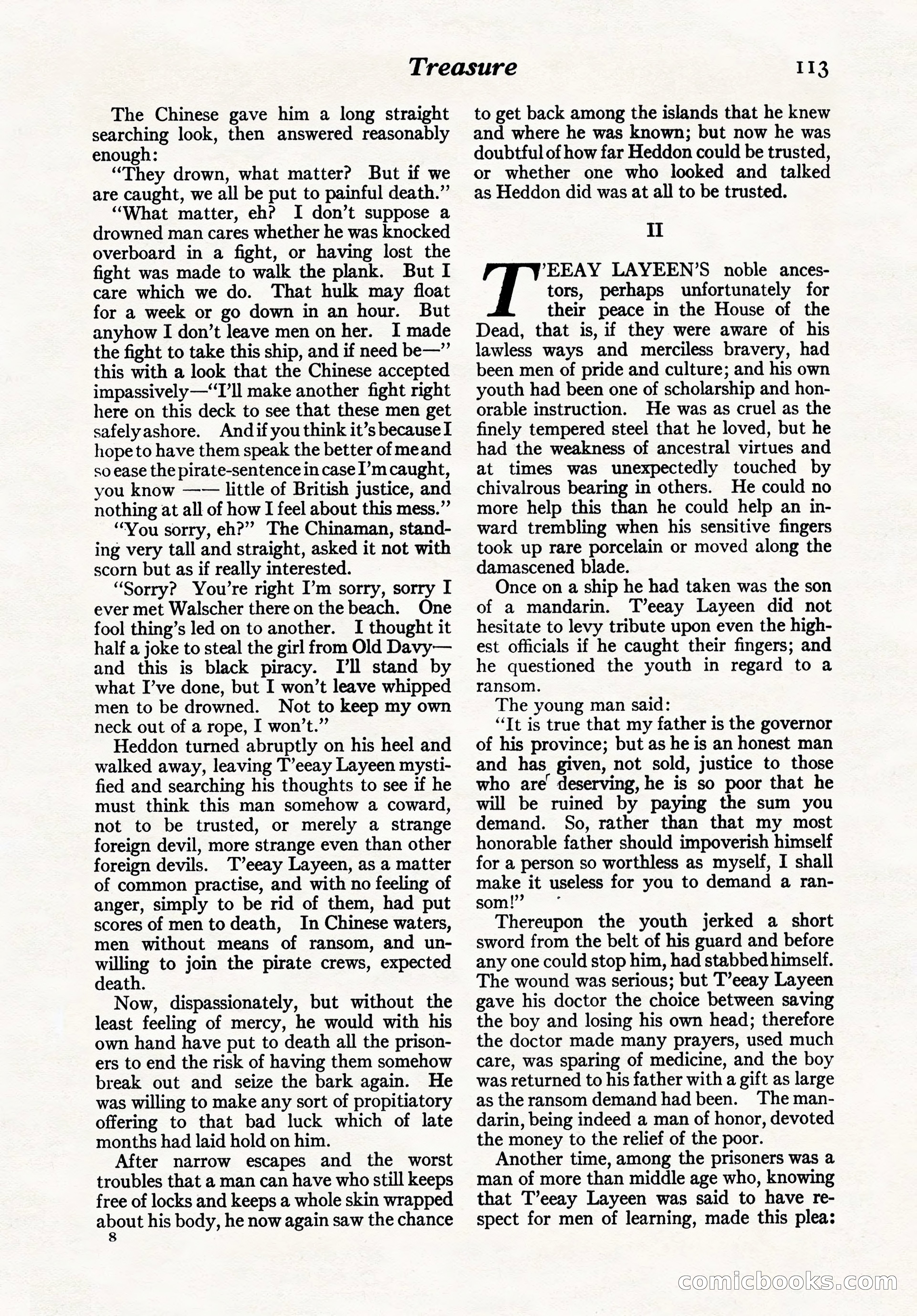
A restored page from Pulp Fiction, 1926. Page through the whole issue in the reader above.
📄 Transcribed text from this page (OCR, searchable)
Machine-transcribed from the original scan — historical spelling and the odd misread are preserved.
Treasure The Chinese gave him a long straight searching look, then answered reasonably enough: “They drown, what matter? But if we are caught, we all be put to painful death.” “What matter, eh? I don’t suppose a drowned man cares whether he was knocked overboard in a fight, or having lost the fight was made to walk the plank. But I care which we do. That hulk may float for a week or go down in an hour. But anyhow I don’t leave men on her. I made the fight to take this ship, and if need be—’”’ this with a look that the Chinese accepted impassively—“T’ll make another fight right here on this deck to see that these men get safelyashore. Andif you think it’s because 1 hope to have them speak the better of meand so ease the pirate-sentence in case 1’m caught, you know —— little of British justice, and nothing at all of how I feel about this mess.” ‘You sorry, eh?” The Chinaman, stand- ing very tall and straight, asked it not with scorn but as if really interested. “Sorry? You’re right I’m sorry, sorry I ever met Walscher there on the beach. One fool thing’s led on to another. I thought it half a joke to steal the girl from Old Davy— and this is black piracy. I'll stand by what I’ve done, but I won’t leave whipped men to be drowned. Not to keep my own neck out of a rope, I won’t.” Heddon turned abruptly on his heel and walked away, leaving T’eeay Layeen mysti- fied and searching his thoughts to see if he must think this man somehow a coward, not to be trusted, or merely a strange foreign devil, more strange even than other foreign devils. ‘T’eeay Layeen, as a matter of common practise, and with no feeling of anger, simply to be rid of them, had put scores of men to death, In Chinese waters, men without means of ransom, and un- willing to join the pirate crews, expected death. Now, dispassionately, but without the least feeling of mercy, he would with his own hand have put to death all the prison- ers to end the risk of having them somehow break out and seize the bark again. He was willing to make any sort of propitiatory offering to that bad luck which of late months had laid hold on him. After narrow escapes and the worst troubles that a man can have who still keeps free of locks and keeps a whole skin wrapped about his body, he now again saw the chance 113 to get back among the islands that he knew and where he was known; but now he was doubtful of how far Heddon could be trusted, or whether one who looked and talked as Heddon did was at all to be trusted. Il "EEAY LAYEEN’S noble ances- tors, perhaps unfortunately for their peace in the House of the Dead, that is, if they were aware of his lawless ways and merciless bravery, had been men of pride and culture; and his own youth had been one of scholarship and hon- orable instruction. He was as cruel as the finely tempered steel that he loved, but he had the weakness of ancestral virtues and at times was unexpectedly touched by chivalrous bearing in others. He could no more help this than he could help an in- ward trembling when his sensitive fingers took up rare porcelain or moved along the damascened blade. Once on a ship he had taken was the son of a mandarin. T’eeay Layeen did not hesitate to levy tribute upon even the high- est officials if he caught their fingers; and he questioned the youth in regard to a ransom. The young man said: “Tt is true that my father is the governor of his province; but as he is an honest man and has given, not sold, justice to those who are’ deserving, he is so poor that he will be ruined by paying the sum you demand. So, rather than that my most honorable father should impoverish himself for a person so worthless as myself, I shall make it useless for you to demand a ran- som!”’ Thereupon the youth jerked a short sword from the belt of his guard and before any one could stop him, had stabbed himself. The wound was serious; but T’eeay Layeen gave his doctor the choice between saving the boy and losing his own head; therefore the doctor made many prayers, used much care, was sparing of medicine, and the boy was returned to his father with a gift as large as the ransom demand had been. The man- darin, being indeed a man of honor, devoted the money to the relief of the poor. Another time, among the prisoners was a man of more than middle age who, knowing that T’eeay Layeen was said to have re- spect for men of learning, made this plea: COMIC OOO® Cc S (C@