
Pulp Fiction, 1926 · page 114 of 212
Adventure Magazine Cover — page 114: what you’re looking at
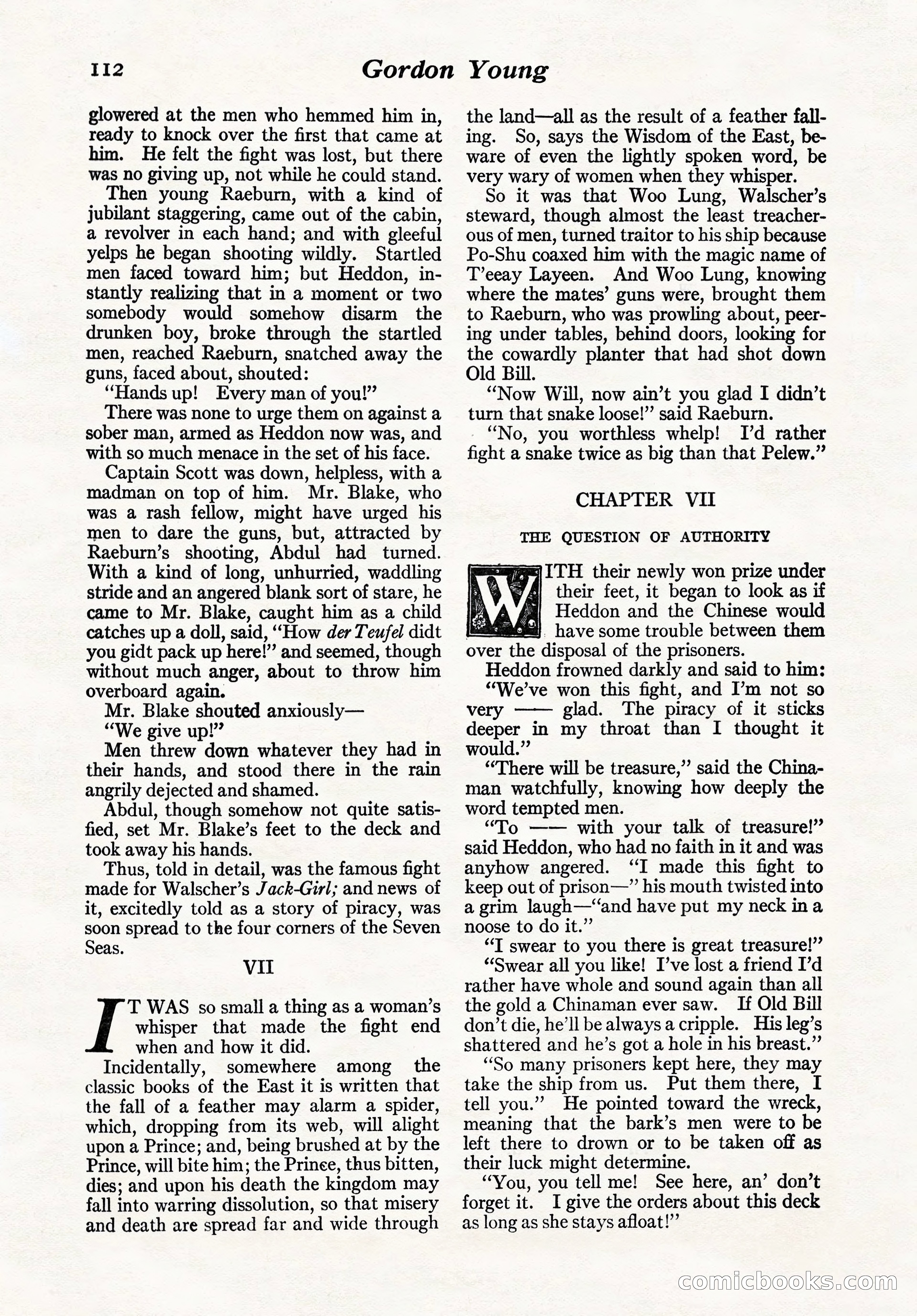
A restored page from Pulp Fiction, 1926. Page through the whole issue in the reader above.
📄 Transcribed text from this page (OCR, searchable)
Machine-transcribed from the original scan — historical spelling and the odd misread are preserved.
I12 glowered at the men who hemmed him in, ready to knock over the first that came at him. He felt the fight was lost, but there was no giving up, not while he could stand. Then young Raeburn, with a kind of jubilant staggering, came out of the cabin, a revolver in each hand; and with gleeful yelps he began shooting wildly. Startled men faced toward him; but Heddon, in- stantly realizing that in a moment or two somebody would somehow disarm the drunken boy, broke through the startled men, reached Raeburn, snatched away the guns, faced about, shouted: “Hands up! Every man of you!”’ There was none to urge them on against a sober man, armed as Heddon now was, and with so much menace in the set of his face. Captain Scott was down, helpless, with a madman on top of him. Mr. Blake, who was a rash fellow, might have urged his men to dare the guns, but, attracted by Raeburn’s shooting, Abdul had turned. With a kind of long, unhurried, waddling stride and an angered blank sort of stare, he came to Mr. Blake, caught him as a child catches up a doll, said, ‘‘How der Teufel didt you gidt pack up here!” and seemed, though without much anger, about to throw him overboard again. Mr. Blake shouted anxiously— “We give up!” Men threw down whatever they had in their hands, and stood there in the rain angrily dejected and shamed. Abdul, though somehow not quite satis- fied, set Mr. Blake’s feet to the deck and took away his hands. Thus, told in detail, was the famous fight made for Walscher’s Jack-Girl; and news of it, excitedly told as a story of piracy, was soon spread to the four corners of the Seven Seas. vil T WAS so small a thing as a woman’s whisper that made the fight end when and how it did. Incidentally, somewhere among the classic books of the East it is written that the fall of a feather may alarm a spider, which, dropping from its web, will alight upon a Prince; and, being brushed at by the Prince, will bite him; the Prinee, thus bitten, dies; and upon his death the kingdom may fall into warring dissolution, so that misery and death are spread far and wide through Gordon Young the land—all as the result of a feather fall- ing. So, says the Wisdom of the East, be- ware of even the lightly spoken word, be very wary of women when they whisper. So it was that Woo Lung, Walscher’s steward, though almost the least treacher- ous of men, turned traitor to his ship because Po-Shu coaxed him with the magic name of T’eeay Layeen. And Woo Lung, knowing where the mates’ guns were, brought them to Raeburn, who was prowling about, peer- ing under tables, behind doors, looking for the cowardly planter that had shot down Old Bill. “Now Will, now ain’t you glad I didn’t turn that snake loose!” said Raeburn. “No, you worthless whelp! I’d rather fight a snake twice as big than that Pelew.” CHAPTER VII THE QUESTION OF AUTHORITY 7 ITH their newly won prize under their feet, it began to look as if Heddon and the Chinese would jee}. have some trouble between them over the disposal of the prisoners. Heddon frowned darkly and said to him: “‘We’ve won this fight, and I’m not so very —— glad. The piracy of it sticks deeper in my throat than I thought it would.” “There will be treasure,’ said the China- man watchfully, knowing how deeply the word tempted men. “To —— with your talk of treasure!’ said Heddon, who had no faith in it and was anyhow angered. “I made this fight to keep out of prison—”’ his mouth twisted into a grim laugh—“and have put my neck ina noose to do it.”’ “T swear to you there is great treasure!” ‘Swear all you like! I’ve lost a friend I’d rather have whole and sound again than all the gold a Chinaman ever saw. If Old Bill don’t die, he’ll be always a cripple. His leg’s shattered and he’s got a hole in his breast.”’ “So many prisoners kept here, they may take the ship from us. Put them there, I tell you.”” He pointed toward the wreck, meaning that the bark’s men were to be left there to drown or to be taken off as their luck might determine. “You, you tell me! See here, an’ don’t forget it. I give the orders about this deck as long as she stays afloat!” cConmmiclboool (©