
Pulp Fiction, 1925 · page 205 of 212
Adventure Magazine Cover, June 20, 1925 — page 205: what you’re looking at
A restored page from Pulp Fiction, 1925. Page through the whole issue in the reader above.
📄 Transcribed text from this page (OCR, searchable)
Machine-transcribed from the original scan — historical spelling and the odd misread are preserved.
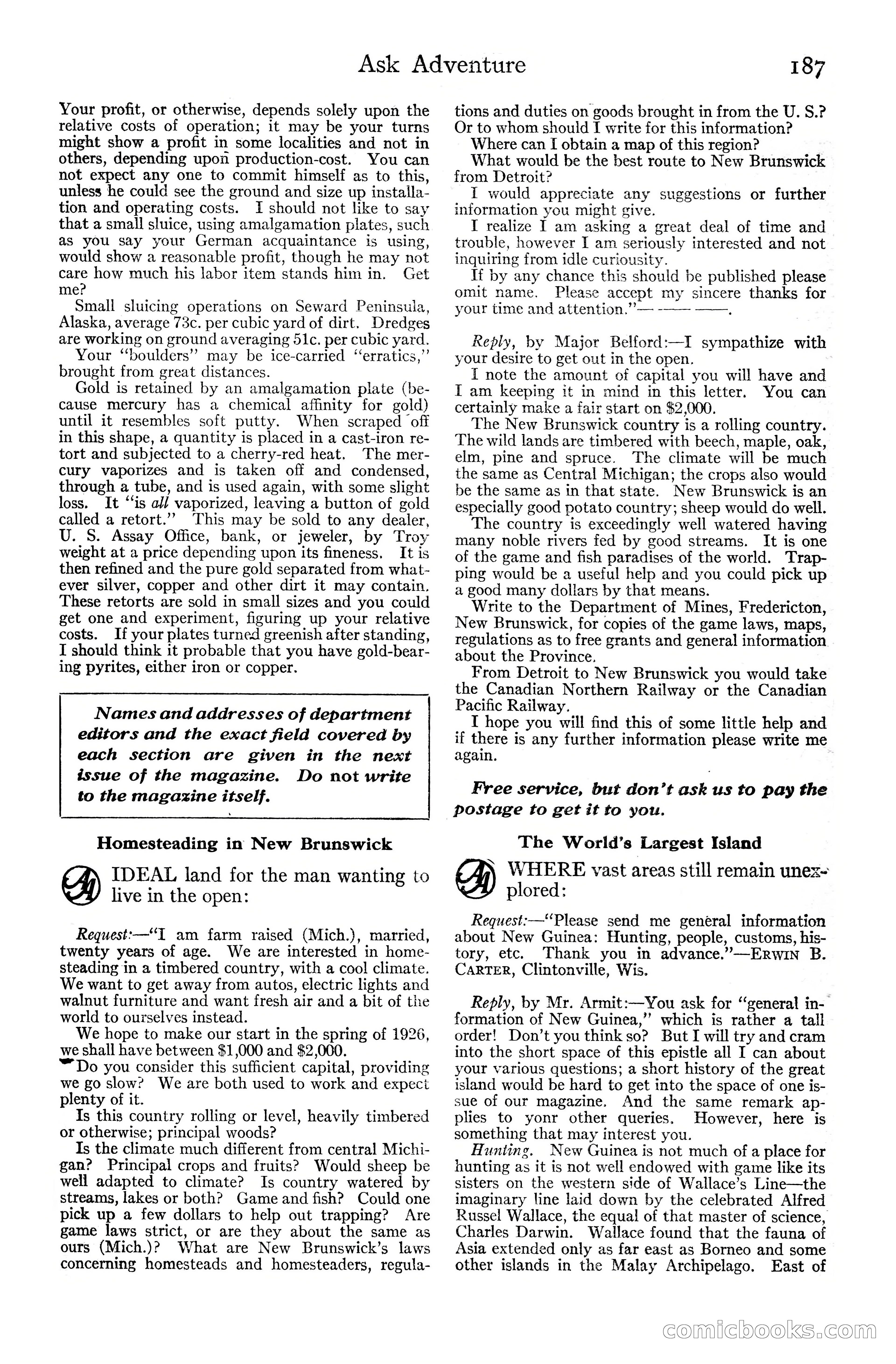
Ask Adventure Your profit, or otherwise, depends solely upon the relative costs of operation; it may be your turns might show a profit in some localities and not in others, depending upon production-cost. You can not expect any one to commit himself as to this, unless he could see the ground and size up installa- tion and operating costs. I should not like to say that a small sluice, using amalgamation plates, such as you say your German acquaintance is using, would show a reasonable profit, though he may not care how much his labor item stands him in. Get me? Small sluicing operations on Seward Peninsula, Alaska, average 73c. per cubic yard of dirt. Dredges are working on ground averaging dlc. per cubic yard. Your “boulders” may be ice-carried ‘‘erratics,’’ brought from great distances. Gold is retained by an amalgamation plate (be- cause mercury has a chemical affinity for gold) until it resembles soft putty. When scraped off in this shape, a quantity is placed in a cast-iron re- tort and subjected to a cherry-red heat. The mer- cury vaporizes and is taken off and condensed, through a tube, and is used again, with some slight loss. It “‘is all vaporized, leaving a button of gold called a retort.”” This may be sold to any dealer, U. S. Assay Office, bank, or jeweler, by Troy weight at a price depending upon its fineness. It is then refined and the pure gold separated from what- ever silver, copper and other dirt it may contain. These retorts are sold in small sizes and you could get one and experiment, figuring up your relative costs. If your plates turned greenish after standing, I should think it probable that you have gold-bear- ing pyrites, either iron or copper. Names and addresses of department editors and the exact field covered by each section are given in the next issue of the magazine. Do not write to the magazine itself. Homesteading in New Brunswick IDEAL land for the man wanting to live in the open: Request:—“I am farm raised (Mich.), married, twenty years of age. We are interested in home- steading in a timbered country, with a coo! climate. We want to get away from autos, electric lights and walnut furniture and want fresh air and a bit of the world to ourselves instead. We hope to make our start in the spring of 1926, we shall have between $1,000 and $2,000. “Do you consider this sufficient capital, providing we go slow? We are both used to work and expect plenty of it. Is this country rolling or level, heavily timbered or otherwise; principal woods? Is the climate much different from central Michi- gan? Principal crops and fruits? Would sheep be well adapted to climate? Is country watered by streams, lakes or both? Game and fish? Could one pick up a few dollars to help out trapping? Are game laws strict, or are they about the same as ours (Mich.)? What are New Brunswick’s laws concerning homesteads and homesteaders, regula- 187 tions and duties on goods brought in from the U. S.? Or to whom should I write for this information? Where can [ obtain a map of this region? What would be the best route to New Brunswick from Detroit? 1 would appreciate any suggestions or further information you might give. I realize I am asking a great deal of time and trouble, however I am seriously interested and not inquiring from idle curiousity. If by any chance this should be published please omit name. Please accept my sincere thanks for your time and attention.’’— -—— Reply, by Major Belford:—I sympathize with your desire to get out in the open. { note the amount of capital you will have and I am keeping it in mind in this letter. You can certainly make a fair start on $2,000. The New Brunswick country is a rolling country. The wild lands are timbered with beech, maple, oak, elm, pine and spruce. The climate will be much the same as Central Michigan; the crops also would be the same as in that state. New Brunswick is an especially good potato country; sheep would do well. The country is exceedingly well watered having many noble rivers fed by good streams. It is one of the game and fish paradises of the world. Trap- ping would be a useful help and you could pick up a good many dollars by that means. Write to the Department of Mines, Fredericton, New Brunswick, for copies of the game laws, maps, regulations as to free grants and general information about the Province. From Detroit to New Brunswick you would take the Canadian Northern Railway or the Canadian Pacific Railway. I hope you will find this of some little help and if there is any further information please write me again. Free service, but don’t ask us to pay the postage to get it to you. The World’s Largest Island \ WHERE vast areas still remain unex- plored: Request:—“Please send me general information about New Guinea: Hunting, people, customs, his- tory, etc. Thank you in advance.”—ERwIn B. CARTER, Clintonville, Wis. Reply, by Mr. Armit:—You ask for “general in- formation of New Guinea,” which is rather a tall order! Don’t you think so? But I will try and cram into the short space of this epistle all I can about your various questions; a short history of the great island would be hard to get into the space of one is- sue of our magazine. And the same remark ap- plies to yonr other queries. However, here is something that may interest you. Hunting. New Guinea is not much of a place for hunting as it is not well endowed with game like its sisters on the western side of Wallace’s Line—the imaginary line laid down by the celebrated Alfred Russel Wallace, the equal of that master of science, Charles Darwin. Wallace found that the fauna of Asia extended only as far east as Borneo and some other islands in the Malay Archipelago. East of COMIGDIOOKSEEO