
Pulp Fiction, 1925 · page 204 of 212
Adventure Magazine Cover, June 20, 1925 — page 204: what you’re looking at
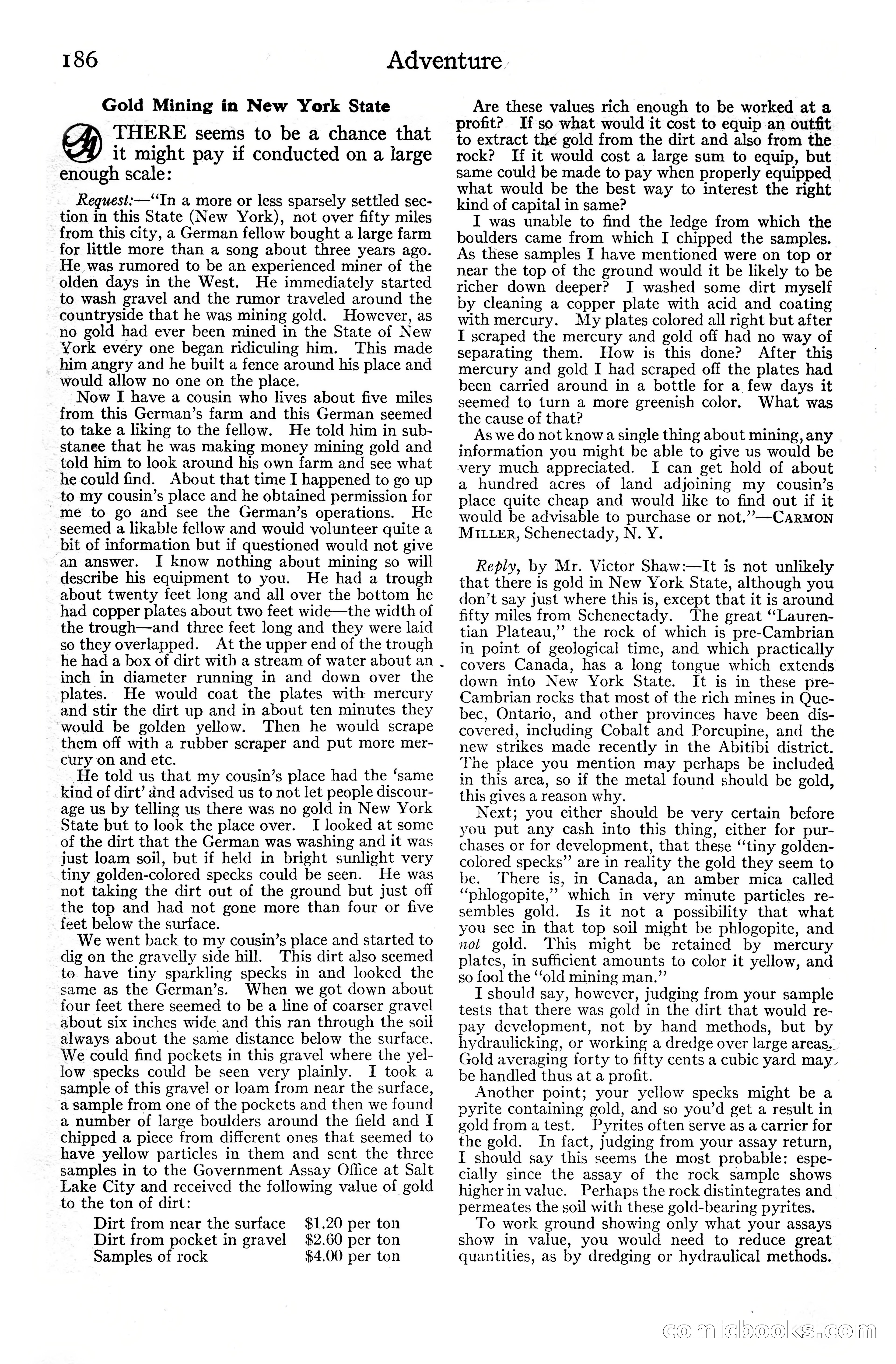
A restored page from Pulp Fiction, 1925. Page through the whole issue in the reader above.
📄 Transcribed text from this page (OCR, searchable)
Machine-transcribed from the original scan — historical spelling and the odd misread are preserved.
186 Gold Mining in New York State THERE seems to be a chance that it might pay if conducted on a large enough scale: Request:—“In a more or less sparsely settled sec- tion in this State (New York), not over fifty miles from this city, a German fellow bought a large farm for little more than a song about three years ago. He was rumored to be an experienced miner of the olden days in the West. He immediately started to wash gravel and the rumor traveled around the countryside that he was mining gold. However, as no gold had ever been mined in the State of New York every one began ridiculing him. This made him angry and he built a fence around his place and would allow no one on the place. “Now I have a cousin who lives about five miles from this German’s farm and this German seemed to take a liking to the fellow. He told him in sub- stanee that he was making money mining gold and told him to look around his own farm and see what he could find. About that time I happened to go up to my cousin’s place and he obtained permission for -me to go and see the German’s operations. He - seemed a likable fellow and would volunteer quite a bit of information but if questioned would not give an answer. I know nothing about mining so will describe his equipment to you. He had a trough about twenty feet long and all over the bottom he had copper plates about two feet wide—the width of the trough—and three feet long and they were laid so they overlapped. At the upper end of the trough he had a box of dirt with a stream of water about an . inch in diameter running in and down over the plates. He would coat the plates with mercury and stir the dirt up and in about ten minutes they would be golden yellow. Then he would scrape them off with a rubber scraper and put more mer- cury on and etc. He told us that my cousin’s place had the ‘same kind of dirt’ and advised us to not let people discour- age us by telling us there was no gold in New York State but to look the place over. I looked at some of the dirt that the German was washing and it was just loam soil, but if held in bright sunlight very tiny golden-colored specks could be seen. He was not taking the dirt out of the ground but just off the top and had not gone more than four or five feet below the surface. We went back to my cousin’s place and started to dig on the gravelly side hill. This dirt also seemed to have tiny sparkling specks in and looked the same as the German’s. When we got down about four feet there seemed to be a line of coarser gravel about six inches wide and this ran through the soil always about the same distance below the surface. We could find pockets in this gravel where the yel- low specks could be seen very plainly. I took a sample of this gravel or loam from near the surface, a sample from one of the pockets and then we found a number of large boulders around the field and I chipped a piece from different ones that seemed to have yellow particles in them and sent the three samples in to the Government Assay Office at Salt Lake City and received the following value of gold to the ton of dirt: Dirt from near the surface Dirt from pocket in gravel Samples of rock $1.20 per ton $2.60 per ton $4.00 per ton Adventure. Are these values rich enough to be worked at a profit? If so what would it cost to equip an outfit to extract thé gold from the dirt and also from the rock? If it would cost a large sum to equip, but same could be made to pay when properly equipped what would be the best way to interest the right kind of capital in same? I was unable to find the ledge from which the boulders came from which I chipped the samples. As these samples I have mentioned were on top or near the top of the ground would it be likely to be richer down deeper? JI washed some dirt myself by cleaning a copper plate with acid and coating with mercury. My plates colored all right but after I scraped the mercury and gold off had no way of separating them. How is this done? After this mercury and gold I had scraped off the plates had been carried around in a bottle for a few days it seemed to turn a more greenish color. What was the cause of that? As we do not know a single thing about mining, any information you might be able to give us would be very much appreciated. I can get hold of about a hundred acres of land adjoining my cousin’s place quite cheap and would like to find out if it would be advisable to purchase or not.’ —CARMON MILLER, Schenectady, N. Y. Reply, by Mr. Victor Shaw:—It is not unlikely that there is gold in New York State, although you don’t say just where this is, except that it is around fifty miles from Schenectady. ‘The great ‘‘Lauren- tian Plateau,” the rock of which is pre-Cambrian in point of geological time, and which practically covers Canada, has a long tongue which extends down into New York State. It is in these pre- Cambrian rocks that most of the rich mines in Que- bec, Ontario, and other provinces have been dis- covered, including Cobalt and Porcupine, and the new strikes made recently in the Abitibi district. The place you mention may perhaps be included in this area, so if the metal found should be gold, this gives a reason why. Next; you either should be very certain before you put any cash into this thing, either for pur- chases or for development, that these “‘tiny golden- colored specks” are in reality the gold they seem to be. There is, in Canada, an amber mica called ‘phlogopite,’ which in very minute particles re- sembles gold. Is it not a possibility that what you see in that top soil might be phlogopite, and not gold. This might be retained by mercury plates, in sufficient amounts to color it yellow, and so fool the ‘‘old mining man.’ I should say, however, judging from your sample tests that there was gold in the dirt that would re- pay development, not by hand methods, but by hydraulicking, or working a dredge over large areas. Gold averaging forty to fifty cents a cubic yard may be handled thus at a profit. Another point; your yellow specks might be a pyrite containing gold, and so you’d get a result in gold from atest. Pyrites often serve as a carrier for the gold. In fact, judging from your assay return, I should say this seems the most probable: espe- cially since the assay of the rock sample shows higher in value. Perhaps the rock distintegrates and permeates the soil with these gold-bearing pyrites. To work ground showing only what your assays show in value, you would need to reduce great quantities, as by dredging or hydraulical methods. COMICLOOOkKS. CO