
Pulp Fiction, 1925 · page 198 of 212
Adventure Magazine Cover, June 20, 1925 — page 198: what you’re looking at
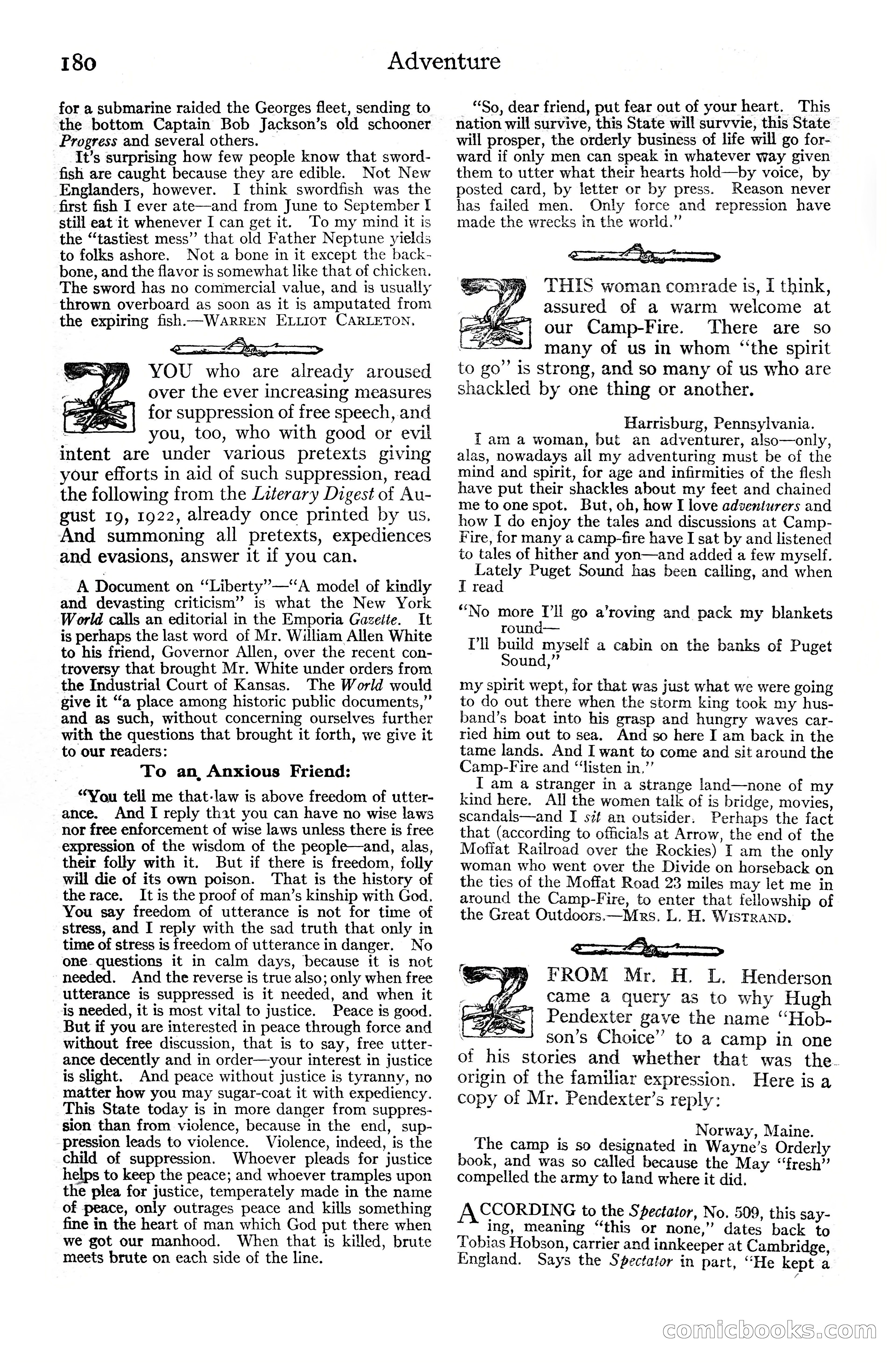
A restored page from Pulp Fiction, 1925. Page through the whole issue in the reader above.
📄 Transcribed text from this page (OCR, searchable)
Machine-transcribed from the original scan — historical spelling and the odd misread are preserved.
180 for a submarine raided the Georges fleet, sending to the bottom Captain Bob Jackson’s old schooner Progress and several others. It’s surprising how few people know that sword- fish are caught because they are edible. Not New Englanders, however. I think swordfish was the first fish I ever ate—and from June to September I still eat it whenever I can get it. To my mind it is the “tastiest mess” that old Father Neptune yields to folks ashore. Not a bone in it except the back- bone, and the flavor is somewhat like that of chicken. The sword has no commercial value, and is usually thrown overboard as soon as it is amputated from the expiring fish —WARREN ELLIOT CARLETON. are already aroused over the ever increasing measures for suppression of free speech, and : you, too, who with good or evil intent are under various pretexts giving your efforts in aid of such suppression, read the following from the Literary Digest of Au- gust 19, 1922, already once printed by us, And summoning all pretexts, expediences and evasions, answer it if you can. A Document on ‘“‘Liberty’—“A model of kindly and devasting criticism” is what the New York World calls an editorial in the Emporia Gazette. It is perhaps the last word of Mr. William Allen White to his friend, Governor Allen, over the recent con- troversy that brought Mr. White under orders from the Industrial Court of Kansas. The World would give it “a place among historic public documents,” and as such, without concerning ourselves further with the questions that brought it forth, we give it to our readers: To an, Anxious Friend: “You tell me that-law is above freedom of utter- ance. And I reply that you can have no wise laws nor free enforcement of wise laws unless there is free expression of the wisdom of the people—and, alas, their folly with it. But if there is freedom, folly will die of its own poison. That is the history of the race. It is the proof of man’s kinship with God. You say freedom of utterance is not for time of stress, and I reply with the sad truth that only in time of stress is freedom of utterance in danger. No one. questions it in calm days, because it is not needed. And the reverse is true also; only when free utterance is suppressed is it needed, and when it is needed, it is most vital to justice. Peace is good. But if you are interested in peace through force and without free discussion, that is to say, free utter- ance decently and in order—your interest in justice is slight. And peace without justice is tyranny, no matter how you may sugar-coat it with expediency. This State today is in more danger from suppres- sion than from violence, because in the end, sup- pression leads to violence. Violence, indeed, is the child of suppression. Whoever pleads for justice helps to keep the peace; and whoever tramples upon the plea for justice, temperately made in the name of peace, only outrages peace and kills something fine in the heart of man which God put there when we got our manhood. When that is killed, brute meets brute on each side of the line. Adventure “So, dear friend, put fear out of your heart. This nation will survive, this State will survvie, this State will prosper, the orderly business of life will go for- ward if only men can speak in whatever way given them to utter what their hearts hold—by voice, by posted card, by letter or by press. Reason never has failed men. Only force and repression have made the wrecks in the world.”’ % THIS woman comrade is, I think, f assured of a warm welcome at | our Camp-Fire. ‘There are so =~ many of us in whom “the spirit to go” is strong, and so many of us who are shackled by one thing or another. Harrisburg, Pennsylvania. 1 am a woman, but an adventurer, also—only, alas, nowadays all my adventuring must be of the mind and spirit, for age and infirmities of the flesh have put their shackles about my feet and chained me to one spot. But, oh, how I love adventurers and how I do enjoy the tales and discussions at Camp- Fire, for many a camp-fire have I sat by and listened to tales of hither and yon—and added a few myself. ; Lately Puget Sound has been calling, and when rea “No more ll go a’roving and pack my blankets round— I'll build myself a cabin on the banks of Puget Sound,” my spirit wept, for that was just what we were going to do out there when the storm king took my hus- band’s boat into his grasp and hungry waves car- ried him out to sea. And so here I am back in the tame lands. And I want to come and sit around the Camp-Fire and “listen in,’’ I am a stranger in a strange land—none of my kind here. All the women talk of is bridge, movies, scandais—and I sit an outsider. Perhaps the fact that (according to officials at Arrow, the end of the Moffat Railroad over the Rockies) I am the only woman who went over the Divide on horseback on the ties of the Moffat Road 23 miles may let me in around the Camp-Fire, to enter that fellowship of the Great Outdoors.—Mrs. L. H. Wistranp. oe “ay TF FROM Mr. H. L. Henderson _ came a query as to why Hugh | Pendexter gave the name “Hob- ’ son’s Choice” to a camp in one ot his stories and whether that was the. origin of the familiar expression. Here is a copy of Mr. Pendexter’s reply: Norway, Maine. The camp is so designated in Wayne’s Orderly book, and was so called because the May “fresh” compelled the army to land where it did. ACCORDIN G to the Spectator, No. 509, this say- ing, meaning “this or none,” dates back to Lobias Hobson, carrier and innkeeper at Cambridge, England. Says the Spectator in part, “He kept a COMIGDIOOKSEEO