
Pulp Fiction, 1925 · page 197 of 212
Adventure Magazine Cover, June 20, 1925 — page 197: what you’re looking at
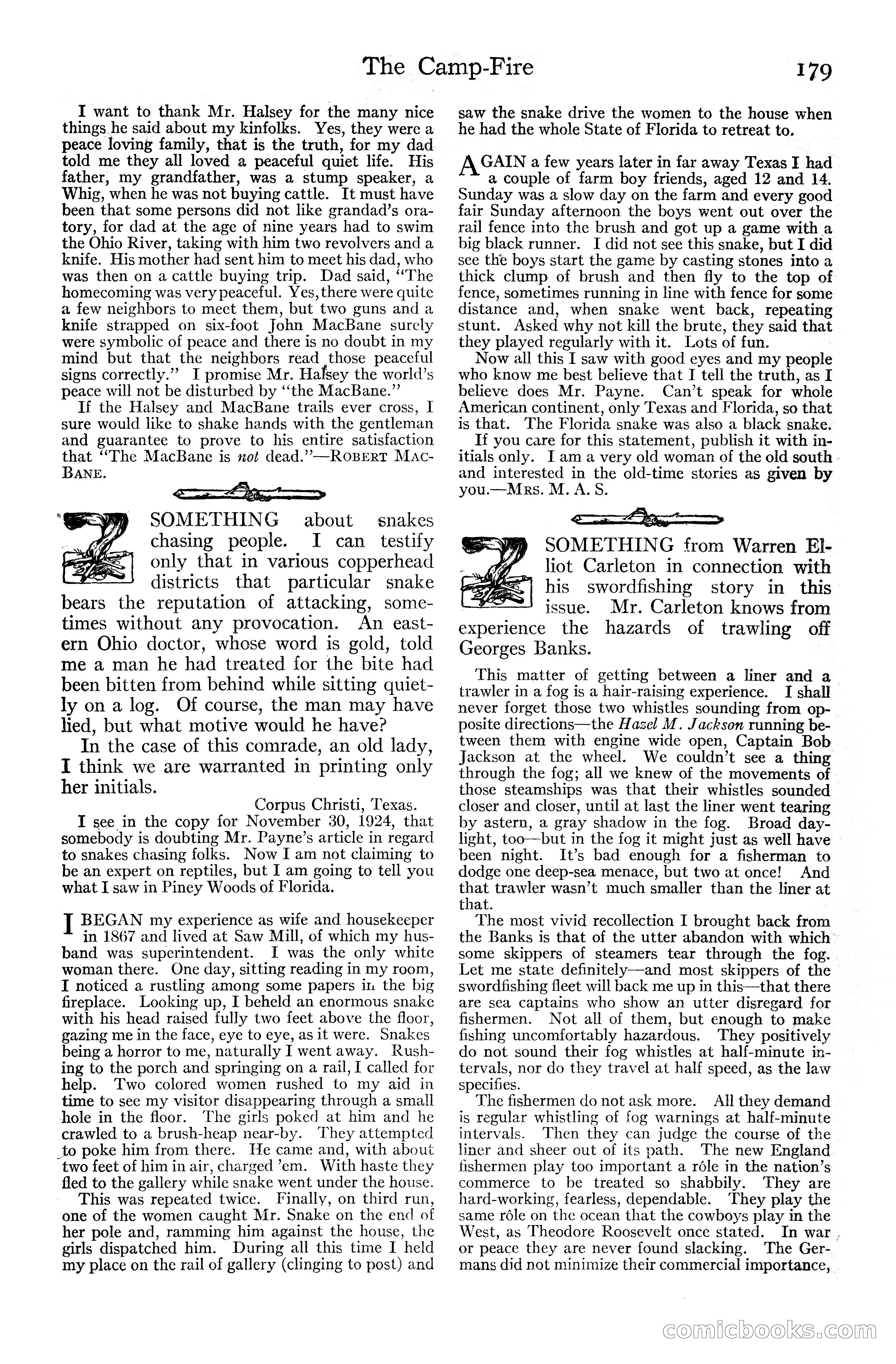
A restored page from Pulp Fiction, 1925. Page through the whole issue in the reader above.
📄 Transcribed text from this page (OCR, searchable)
Machine-transcribed from the original scan — historical spelling and the odd misread are preserved.
The Camp-Fire I want to thank Mr. Halsey for the many nice things he said about my kinfolks. Yes, they were a peace loving family, that is the truth, for my dad told me they all loved a peaceful quiet life. His father, my grandfather, was a stump speaker, a Whig, ‘when he was not buying cattle. It must have been that some persons did not like grandad’s ora- tory, for dad at the age of nine years had to swim the Ohio River, taking with him two revolvers and a knife. His mother had sent him to meet his dad, who was then on a cattle buying trip. Dad said, ‘““The homecoming was very peaceful. Yes, there were quite a few neighbors to meet them, but two guns and a knife strapped on six-foot John MacBane surely were symbolic of peace and there is no doubt in my mind but that the neighbors read those peaceful signs correctly.”” I promise Mr. Halsey the world’s peace will not be disturbed by ‘‘the MacBane.”’ If the Halsey and MacBane trails ever cross, I sure would like to shake hands with the gentleman and guarantee to prove to his entire satisfaction that ‘““The MacBane is not dead.”—ROBERT MaAc- BANE. SOMETHIN G stiout snakes chasing people. I can testify only that in various copperhead districts that particular snake bears the reputation of attacking, some- times without any provocation. An east- ern Ohio doctor, whose word is gold, told me a man he had treated for the bite had been bitten from behind while sitting quiet- ly on a log. Of course, the man may have lied, but what motive would he have? In the case of this comrade, an old lady, I think we are warranted im printing only her initials. Corpus Christi, Texas. I see in the copy for November 30, 1924, that somebody is doubting Mr. Payne’s article in regard to snakes chasing folks. Now I am not claiming to be an expert on reptiles, but J am going to tell you what I saw in Piney Woods of Florida. ] BEGAN my experience as wife and housekeeper in 1867 and lived at Saw Mill, of which my hus- band was superintendent. I was the only white woman there. One day, sitting reading in my room, I noticed a rustling among some papers in the big fireplace. Looking up, I beheld an enormous snake with his head raised fully two feet above the floor, gazing me in the face, eye to eye, as it were. Snakes being a horror to me, naturally I went away. Rush- ing to the porch and springing on a rail, I called for help. Two colored women rushed to my aid in time to see my visitor disappearing through a small hole in the floor. The girls poked at him and he crawled to a brush-heap near-by. They attempted to poke him from there. He came and, with about two feet of him in air, charged ’em. With haste they fled to the gallery while snake went under the house. This was repeated twice. Finally, on third run, one of the women caught Mr. Snake on the end of her pole and, ramming him against the house, the girls dispatched him. During all this time I ‘held my place on the rail of gallery (clinging to post) and 179 saw the snake drive the women to the house when he had the whole State of Florida to retreat to. GAIN a few years later in far away Texas I had a couple of farm boy friends, aged 12 and 14. Sunday was a slow day on the farm and every good fair Sunday afternoon the boys went out over the rail fence into the brush and got up a game with a big black runner. I did not see this snake, but I did see the boys start the game by casting stones into a thick clump of brush and then fly to the top of fence, sometimes running in line with fence for some distance and, when snake went back, repeating stunt. Asked why not kill the brute, they said that they played regularly with it. Lots of fun. Now all this I saw with good eyes and my people who know me best believe that I tell the truth, as I believe does Mr. Payne. Can’t speak for whole American continent, only Texas and Florida, so that is that. The Florida snake was also a black snake. If you care for this statement, publish it with in- itials only. I ama very old woman of the old south and interested in the old-time stories as given by you.—Mrs. M.A.S. OE > SOMETHING from Warren EI- liot Carleton in connection with his swordfishing story in this issue. Mr. Carleton knows from experience the hazards of trawling off Georges Banks. This matter of getting between a liner and a trawler in a fog is a hair-raising experience. I shall never forget those two whistles sounding from op- posite directions—the Hazel M. Jackson running be- tween them with engine wide open, Captain Bob Jackson at the wheel. We couldn’t see a thing through the fog; all we knew of the movements of those steamships was that their whistles sounded closer and closer, until at last the liner went tearing by astern, a gray shadow in the fog. Broad day- light, too—but in the fog it might just as well have been night. It’s bad enough for a fisherman to dodge one deep-sea menace, but two at once! And that trawler wasn’t much smaller than the liner at that. The most vivid recollection I brought back from the Banks is that of the utter abandon with which some skippers of steamers tear through the fog. Let me state definitely—and most skippers of the swordfishing fleet will back me up in this—that there are sea captains who show an utter disregard for fishermen. Not all of them, but enough to make fishing uncomfortably hazardous. They positively do not sound their fog whistles at half-minute in- tervals, nor do they travel at half speed, as the law specifies. The fishermen do not ask more. All they demand is regular whistling of fog warnings at half-minute intervals. Then they can judge the course of the liner and sheer out of its path. The new England fishermen play too important a réle in the nation’s commerce to be treated so shabbily. They are hard-working, fearless, dependable. They play the same réle on the ocean that the cowboys play in the West, as Theodore Roosevelt once stated. In war . or peace they are never found slacking. The Ger- mans did not minimize their commercial importance, COMIGDIOOKSEEO