
Pulp Fiction, 1925 · page 169 of 212
Adventure Magazine Cover, June 20, 1925 — page 169: what you’re looking at
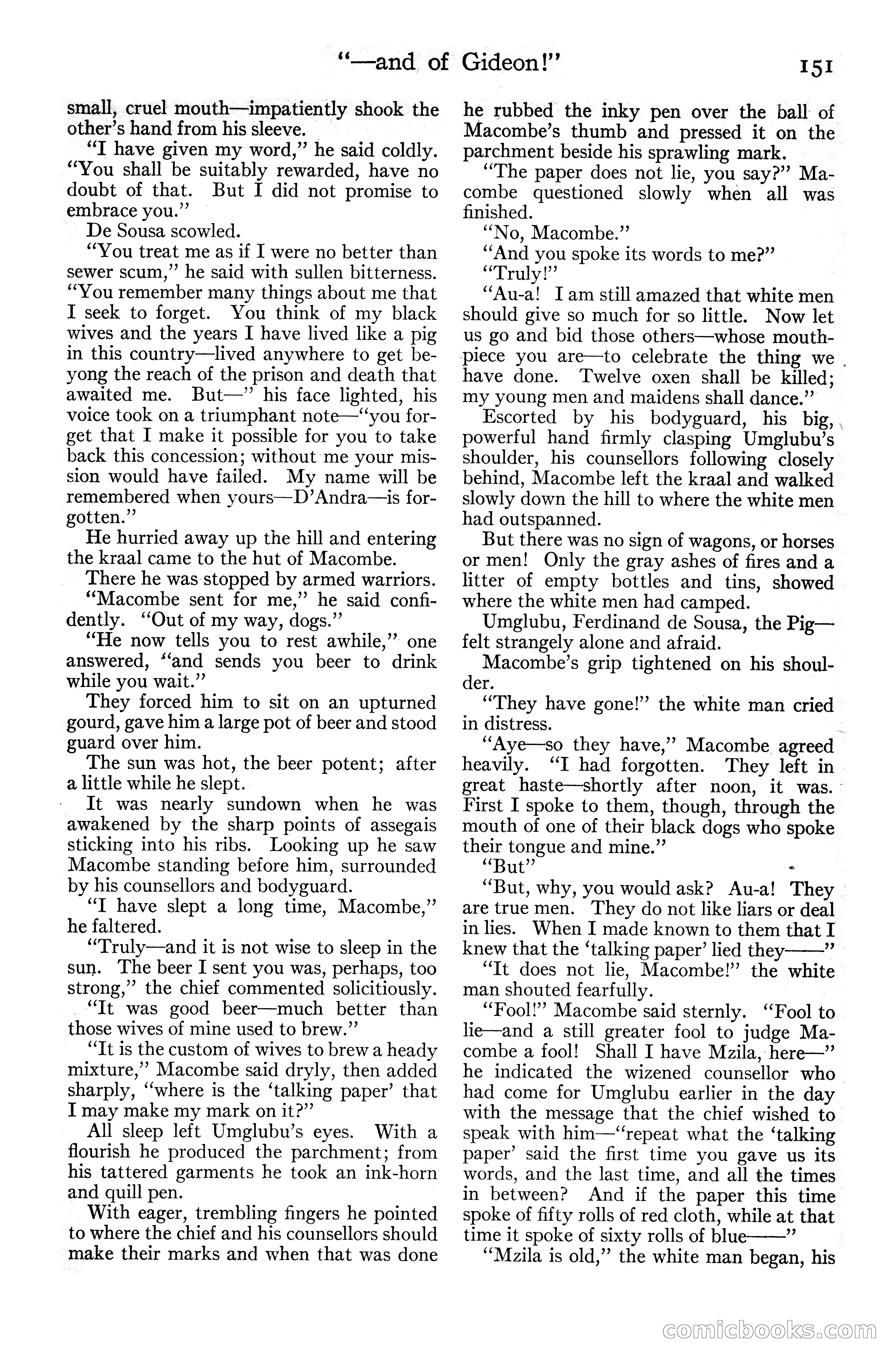
A restored page from Pulp Fiction, 1925. Page through the whole issue in the reader above.
📄 Transcribed text from this page (OCR, searchable)
Machine-transcribed from the original scan — historical spelling and the odd misread are preserved.
“and of Gideon!’’ small, cruel mouth—impatiently shook the other’s hand from his sleeve. © “I have given my word,” he said coldly. “You shall be suitably rewarded, have no doubt of that. But I did not promise to embrace you.”’ De Sousa scowled. “You treat me as if I were no better than sewer scum,” he said with sullen bitterness. “You remember many things about me that I seek to forget. You think of my black wives and the years I have lived like a pig in this country—lived anywhere to get be- yong the reach of the prison and death that awaited me. But—” his face lighted, his voice took on a triumphant note—“‘you for- get that I make it possible for you to take back this concession; without me your mis- sion would have failed. My name will be remembered when yours—D’Andra—is for- gotten.” He hurried away up the hill and entering the kraal came to the hut of Macombe. There he was stopped by armed warriors. ‘“‘Macombe sent for me,” he said confi- dently. “Out of my way, dogs.” “He now tells you to rest awhile,’”’ one answered, “‘and sends you beer to drink while you wait.” They forced him to sit on an upturned gourd, gave him a large pot of beer and stood guard over him. The sun was hot, the beer potent; after a little while he slept. It was nearly sundown when he was awakened by the sharp points of assegais sticking into his ribs. Looking up he saw Macombe standing before him, surrounded by his counsellors and bodyguard. “T have slept a long time, Macombe,”’ he faltered. ‘“Truly—and it is not wise to sleep in the sun. The beer I sent you was, perhaps, too strong,” the chief commented solicitiously. “Tt was good beer—much better than those wives of mine used to brew.” “Tt is the custom of wives to brew a heady mixture,” Macombe said dryly, then added sharply, ‘‘where is the ‘talking paper’ that I may make my mark on it?” All sleep left Umglubu’s eyes. With a flourish he produced the parchment; from his tattered garments he took an ink-horn and quill pen. With eager, trembling fingers he pointed to where the chief and his counsellors should make their marks and when that was done 151 he rubbed the inky pen over the ball of Macombe’s thumb and pressed it on the parchment beside his sprawling mark. ‘The paper does not lie, you say?” Ma- combe questioned slowly when all was finished. “No, Macombe.”’ ‘“‘And you spoke its words to me?” “Truly!” “Au-a! Iam still amazed that white men should give so much for so little. Now let us go and bid those others—whose mouth- piece you are—to celebrate the thing we . have done. Twelve oxen shall be killed; my young men and maidens shall dance.” Escorted by his bodyguard, his big, powerful hand firmly clasping Umglubu’s shoulder, his counsellors following closely behind, Macombe left the kraal and walked slowly down the hill to where the white men had outspanned. But there was no sign of wagons, or horses or men! Only the gray ashes of fires and a litter of empty bottles and tins, showed where the white men had camped. Umglubu, Ferdinand de Sousa, the Pig— felt strangely alone and afraid. Macombe’s grip tightened on his shoul- der. “They have gone!” the white man cried in distress. ‘““Aye—so they have,” Macombe agreed heavily. “I had forgotten. They left in great haste—shortly after noon, it was. First I spoke to them, though, through the mouth of one of their black dogs who spoke their tongue and mine.” “But” im “But, why, you would ask? Au-a! They are truemen. They do not like liars or deal in lies. When I made known to them that I knew that the ‘talking paper’ lied they “Tt does not lie, Macombe!’”’ the white man shouted fearfully. ‘Fool!’ Macombe said sternly. ‘Fool to lie—and a still greater fool to judge Ma- combe a fool! Shall I have Mzila, here—” he indicated the wizened counsellor who had come for Umglubu earlier in the day with the message that the chief wished to speak with him—‘‘repeat what the ‘talking paper’ said the first time you gave us its words, and the last time, and all the times in between? And if the paper this time spoke of fifty rolls of red cloth, while at that time it spoke of sixty rolls of blue “ ‘“Mzila is old,” the white man began, his COMIGDIOOKSEEO