
Pulp Fiction, 1925 · page 168 of 212
Adventure Magazine Cover, June 20, 1925 — page 168: what you’re looking at
A restored page from Pulp Fiction, 1925. Page through the whole issue in the reader above.
📄 Transcribed text from this page (OCR, searchable)
Machine-transcribed from the original scan — historical spelling and the odd misread are preserved.
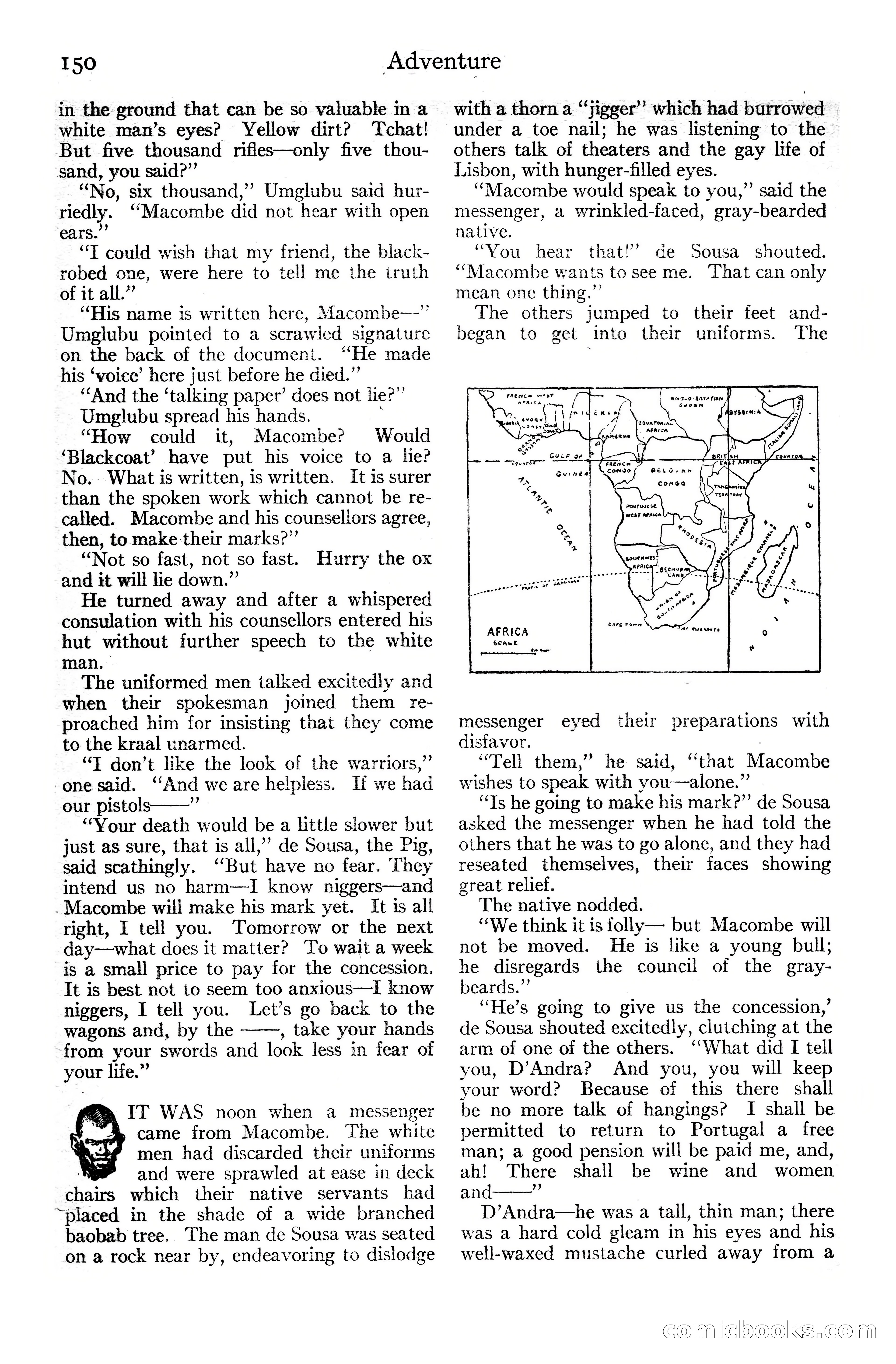
150 in the. ground that can be so valuable ma white man’s eyes? Yellow dirt? ‘Tchat! But five thousand rifles—only five thou- sand, you said?” “No, six thousand,’ Umglubu said hur- riedly. “Macombe did not hear with open ears.” | “fT could wish that my friend, the black- robed one, were here to tell me the truth of it all.” “His name is written here, Macombe—”’ Umglubu pointed to a scrawled signature on the back of the document. “He made his ‘voice’ here just before he died.” ‘‘And the ‘talking paper’ does not hie?” Umglubu spread his hands. “How could it, Macombe? Would ‘Blackcoat’ have put his voice to a he? No. What is written, is written. It is surer than the spoken work which cannot be re- called. Macombe and his counsellors agree, then, to make their marks?” “Not so fast, not so fast. Hurry the ox and it will lie down.” He turned away and after a whispered cconsulation with his counsellors entered his hut without further speech to the white man. The uniformed men talked excitedly and when their spokesman joined them re- proached him for insisting that they come to the kraal unarmed. “TY don’ t like the look of the warriors,” one said. ~And we are helpless. Li we had our pistols “Vour death would be a little slower but just as sure, that is all,” de Sousa, the Pig, said scathingly. “But have no fear. They intend us no harm—I know niggers—and .Macombe will make his mark yet. It 1s all right, I tell you. Tomorrow or the next day—what does it matter? To wait a week is a small price to pay for the concession. It is best not to seem too anxious—I know niggers, I tell you. Let’s go back to the wagons and, by the , take your hands from your swords and look less in fear of your life.” @» IT WAS noon when a messenger “A came from Macombe. The white men had discarded their uniforms and were sprawled at ease in deck hairs which their native servants had “placed in the shade of a wide branched baobab tree. The man de Sousa was seated on a rock near by, endeavoring to dislodge Adventure with a thorn a “jigger” which had burrowed under a toe nail; he was listening to the others talk of theaters and the gay life of Lisbon, with hunger-filled eyes. ‘‘Macombe would speak to you,” said the messenger, a wrinkled-faced, gray-bearded native. “You hear that!’ de Sousa shouted. ““Macombe wants tosee me. That can only mean one thing.”’ The others jumped to their feet and- began to get into their uniforms. The AFROCA AAR Rw \ y a Zavu ‘ Rica wn . [ od Z oss p GULF of FF — ar ‘ Guinla . ines Pe wore ica » o* Gages of CAP AFRICA [|| Cave tse anne! messenger eyed their preparations with disfavor. “Tell them,” he said, “that Macombe wishes to speak with you—alone.” “Ts he going to make his mark?” de Sousa asked the messenger when he had told the others that he was to go alone, and they had reseated themselves, their faces showing great relief. The native nodded. “We think it is folly— but Macombe will not be moved. He is like a young bull; he disregards the council of the gray- beards.”’ “He’s going to give us the concession,’ de Sousa shouted excitedly, clutching at the arm of one of the others. ‘‘What did I tell you, D’Andra? And you, you will keep your word? Because of this there shall be no more talk of hangings? I shall be permitted to return to Portugal a free man; a good pension will be paid me, and, ah! There shall be wine and women and——” D’Andra—he was a tall, thin man; there was a hard cold gleam in his eyes and his well-waxed mustache curled away from a COMIGDIOOKSEEO