
Pulp Fiction, 1925 · page 9 of 196
Adventure Magazine Cover — page 9: what you’re looking at
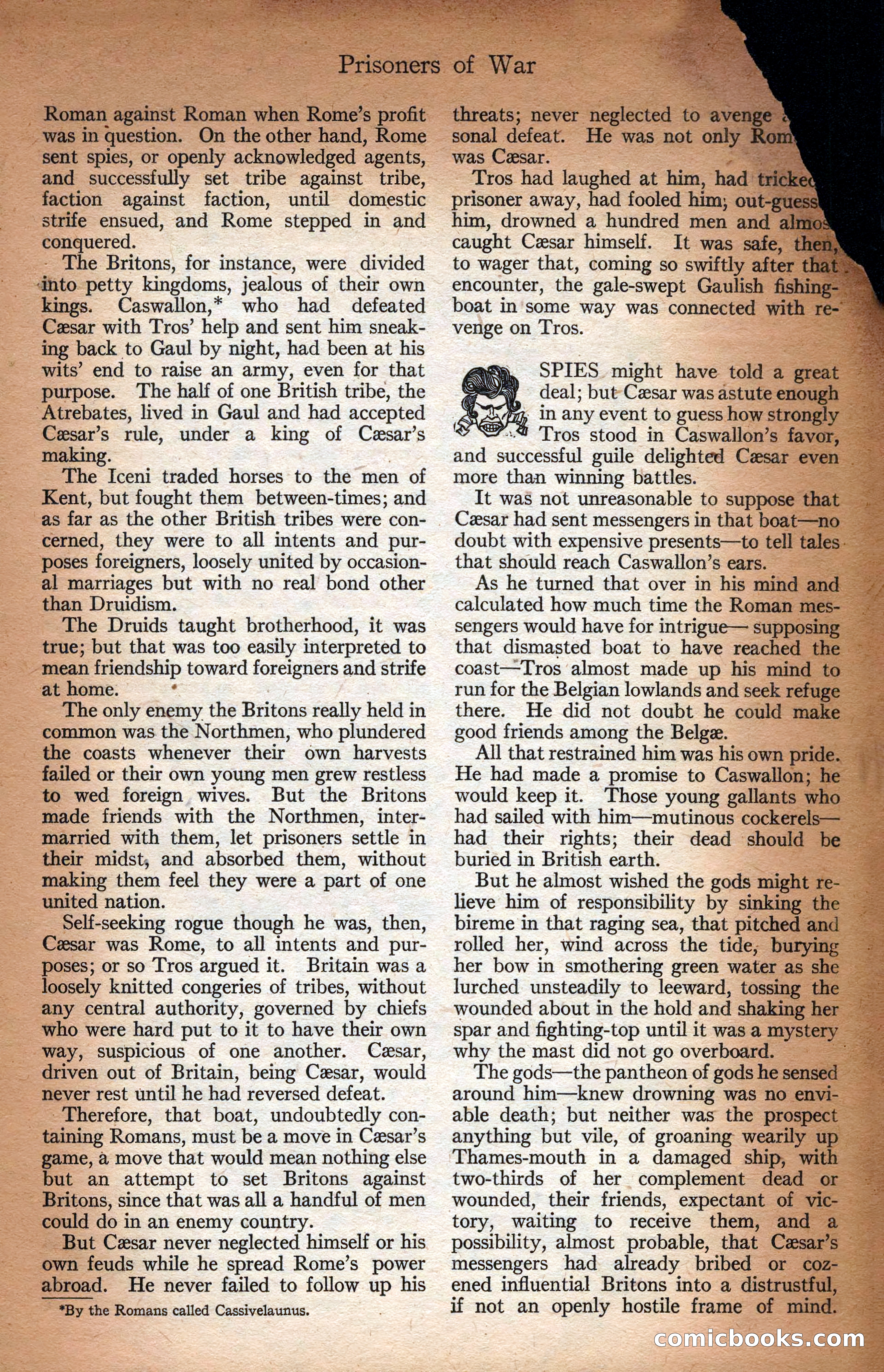
A restored page from Pulp Fiction, 1925. Page through the whole issue in the reader above.
📄 Transcribed text from this page (OCR, searchable)
Machine-transcribed from the original scan — historical spelling and the odd misread are preserved.
Prisoners of War Roman against Roman when Rome’s profit was in question. On the other hand, Rome sent spies, or openly acknowledged agents, and successfully set tribe against tribe, faction against faction, until domestic strife ensued, and Rome stepped in and conquered. The Britons, for instance, were divided anto petty kingdoms, jealous of their own kings. Caswallon,~ who had defeated Cesar with Tros’ help and sent him sneak- ing back to Gaul by night, had been at his wits’ end to raise an army, even for that purpose. The half of one British tribe, the Atrebates, lived in Gaul and had accepted Cesar’s rule, under a king of Cesar’s making. The Iceni traded horses to the men of Kent, but fought them between-times; and as far as the other British tribes were con- cerned, they were to all intents and pur- poses foreigners, loosely united by occasion- al marriages but with no real bond other than Druidism. The Druids taught brotherhood, it was true; but that was too easily interpreted to mean friendship toward foreigners and strife at home. | The only enemy the Britons really held in common was the Northmen, who plundered the coasts whenever their own harvests failed or their own young men grew restless to wed foreign wives. But the Britons made friends with the Northmen, inter- married with them, let prisoners settle in their midst, and absorbed them, without making them feel they were a part of one united nation. Self-seeking rogue though he was, then, Cesar was Rome, to all intents and pur- poses; or so Tros argued it. Britain was a loosely knitted congeries of tribes, without any central authority, governed by chiefs who were hard put to it to have their own Way, suspicious of one another. Cesar, driven out of Britain, being Cesar, would never rest until he had reversed defeat. Therefore, that boat, undoubtedly con- taining Romans, must be a move in Cesar’s game, a move that would mean nothing else but an attempt to set Britons against Britons, since that was all a handful of men could do in an enemy country. But Cesar never neglected himself or his own feuds while he spread Rome’s power abroad. He never failed to follow up his *By the Romans called Cassivelaunus. threats; never neglected to avenge sonal defeat. He was not only Rom! was Cesar. Tros had laughed at him, had tricked prisoner away, had fooled him, out-guess him, drowned a hundred men and almos caught Cesar himself. It was safe, then. to wager that, coming so swiftly after thates encounter, the gale-swept Gaulish fishing=-— ~ boat in'some way was connected with re=- venge on Tros. 6 SPIES. might have told a great deal; but-Ceesar was astute enough Zp iM any event to guess how strongly V¥.4 ‘Tros stood in Caswallon’s favor, and successful guile delighted Cesar even — more than winning battles. It was not unreasonable to suppose that Cesar had sent messengers in that boat—no doubt with expensive presents—to tell tales. that should reach Caswallon’s ears. As he turned that over in his mind and calculated how much time the Roman mes- sengers would have for intrigue— supposing that dismasted boat to have reached the coast—Tros almost made up his mind to run for the Belgian lowlands and seek refuge there. He did not doubt he could make good friends among the Belge. All that restrained him was his own pride. He had made a promise to Caswallon; he would keep it. Those young gallants who had sailed with him—mutinous cockerels— had their rights; their dead should be buried in British earth. But he almost wished the gods might re- lieve him of responsibility by sinking the bireme in that raging sea, that pitched and rolled her, wind across the tide; burying her bow in smothering green water as she lurched unsteadily to leeward, tossing the wounded about in the hold and shaking her spar and fighting-top until it was a mystery why the mast did not go overboard. | The gods—the pantheon of gods he sensed around him—knew drowning was no envi- able death; but neither was the prospect anything but vile, of groaning wearily up Thames-mouth in a damaged ship, with two-thirds of her complement dead or wounded, their friends, expectant of vic- tory, waiting to receive them, and a possibility, almost probable, that Ceesar’s messengers had already bribed or coz- ened influential Britons into a distrustful, if not an openly hostile frame of mind. Eomicbooks.com